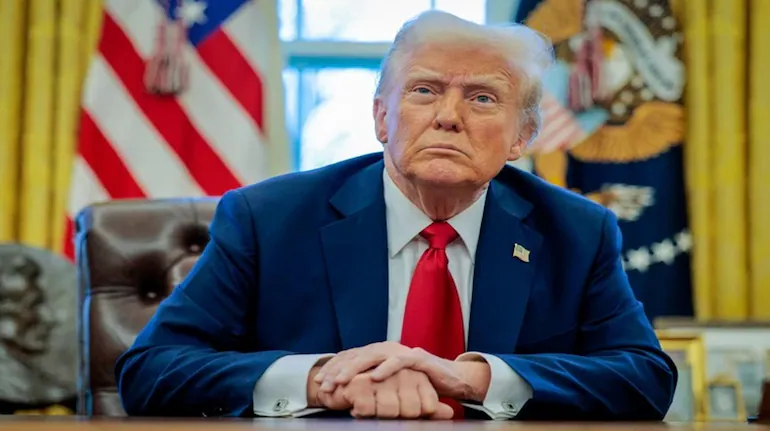
Donald Trump, in a move that has raised eyebrows across the entertainment industry, recently announced a 100% tariff on all films produced outside the United States. This is part of his ongoing trade war and an attempt to bring back film production to America, which he claims is being undermined by foreign countries offering incentives to filmmakers. Trump’s decision to impose this tariff has sparked concerns in Hollywood and could have significant ramifications for the global film industry, including Indian cinema.
Trump’s Announcement and the Tariff on Foreign Films
On May 4, Trump took to his Truth Social platform to announce that he was authorizing the Commerce Department and U.S. Trade Representative to levy a 100% tariff on all movies produced outside the U.S. and imported into the country. Trump described the U.S. film industry as “dying a very fast death” and blamed foreign incentives, claiming that other nations were enticing filmmakers away from Hollywood. According to Trump, this situation has become a national security threat and is also part of foreign “messaging and propaganda.” He called for a push to create more films in America.
However, while the announcement has caused considerable confusion and raised a number of questions, the details of how this tariff will be implemented remain vague. The film industry is an international business, and many films are produced across various countries, with shooting locations spanning multiple nations. For example, films like Mission: Impossible – The Final Reckoning were primarily shot in the UK, but are American productions. Questions arise as to whether such films will fall under this new tariff.
Challenges with Implementing the Tariff
The primary question surrounding this tariff is whether Trump has the legal authority to enforce such a policy. Movies, unlike physical goods, are intellectual properties, and there are no clear precedents for applying tariffs to them. The Trump administration would need to determine how to assess the value of a movie for tariff purposes and what criteria would classify a film as an import. Moreover, it remains unclear whether television shows made overseas but distributed in the U.S. would also face similar tariffs.
The movie-making process is highly internationalized, and determining which films would be impacted by such a policy could prove challenging. Some films, such as The Fantastic Four and Jurassic World Rebirth, were filmed in countries like Spain, the UK, and Thailand but are produced by U.S. companies. The ambiguity surrounding these details is one of the reasons why many in the industry are skeptical about the effectiveness of such a move.
Why Trump Is Pushing for This Tariff
Trump’s push to levy tariffs on foreign films could be a reaction to the increasing trend of U.S. films being shot abroad. Films like A Minecraft Movie, which was filmed primarily in New Zealand, and Jurassic World Rebirth, which was shot in several countries, including Thailand and the UK, represent a growing trend of U.S. studios moving their productions outside the country due to tax incentives offered by other nations.
Foreign cities, including Toronto and Dublin, have been offering substantial tax breaks to film and television productions, leading many filmmakers to relocate their operations. As a result, thousands of middle-class film workers in the U.S. have lost their jobs, which is one of the main reasons behind Trump’s stance.
Will the 100% Tariff Help or Hurt Hollywood?
The impact of the 100% tariff on Hollywood is uncertain. On one hand, Trump believes that imposing the tariff would incentivize production houses to shoot more films in the U.S. However, this could have unintended consequences. Producing films in the U.S. is far more expensive compared to other countries that offer tax incentives. This means that films made in the U.S. would need to be sold to distributors at a higher price, which would result in increased ticket prices for consumers.
This could be a major blow to Hollywood, which is already struggling with ticket sales. The global box office, which peaked at nearly \$12 billion in 2018, plummeted to just over \$2 billion in 2020 due to the COVID-19 pandemic. Although it has bounced back since then, it has yet to surpass the \$9 billion mark. Increasing the cost of movie tickets could further harm the already struggling industry.
Additionally, retaliatory tariffs from foreign governments could have devastating consequences for Hollywood. Countries like Canada, the UK, and Australia, which are major contributors to film production, could impose their own tariffs on American films. This could lead to a tit-for-tat situation that might end up harming the entire film industry.
Impact of the Tariff on Indian Cinema
While the tariff would have serious implications for Hollywood, it could also hurt the Indian film industry. Most Indian films are not shot in the U.S., which means that they would be subject to the 100% tariff if they are imported. For Indian films, this would significantly increase the cost of distribution. For example, if an Indian film is sold for \$1 million in the U.S., the distributor would have to pay an additional $1 million in tariffs, making the total cost of distributing the film \$2 million.
This would make it financially unfeasible for U.S. distributors to purchase Indian films, which could result in fewer Indian films being screened in the U.S. This would be a massive blow to the Indian film industry, which has seen increasing success in the U.S. in recent years. For instance, RRR, directed by S. S. Rajamouli, grossed \$65 million in its opening weekend and continued to perform well at the U.S. box office. Imposing tariffs on Indian films could reduce such successes, impacting the Indian film industry’s reach in the U.S. market.
Filmmaker Vivek Agnihotri has already expressed concerns that Trump’s move could lead to the collapse of India’s struggling film industry, which is already facing significant challenges.
Trump’s 100% tariff on foreign films, while framed as an effort to revive Hollywood and protect American workers, could have serious consequences for both the U.S. film industry and international cinema, particularly Indian films. While the ultimate impact remains to be seen, the proposal has already generated significant concern within the industry, with many questioning its feasibility and potential for retaliation. As the debate continues, it remains to be seen whether this bold move will achieve Trump’s intended goal or end up backfiring on the global film industry.