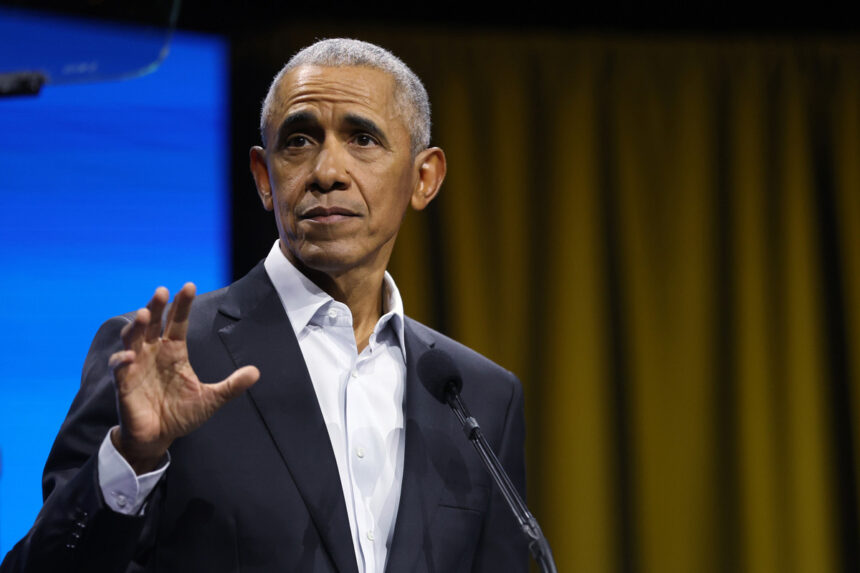
Former U.S. President Barack Obama, during an engaging discussion at the Jefferson Educational Society’s Global Summit, was momentarily interrupted by a pro-Palestine slogan but used the incident to highlight broader lessons about conflict, human dignity, and America’s role in defending universal values. Barack Obama, no longer in office, reminded the audience he was not the current president and stressed that shouting at him over foreign policy would be misplaced. Yet, rather than dismiss the moment, he expanded it into a powerful reflection on the Israel-Palestine crisis and the dangers of dehumanization in global conflicts.
Barack Obama Confronts Interruption and Clarifies His Role
In a conversation moderated by journalist Steve Scully, Barack Obama was speaking on the theme of international challenges when an audience member interrupted with a slogan that appeared to reference Palestine. While the exact words of the protest were not clearly audible, the disruption was significant enough to briefly shift the tone of the session. Barack Obama responded firmly but calmly, telling the protester, “Sir, don’t shout at me. I am not the President of the United States, currently. There is no point in shouting at me about it. I am not in charge of foreign policy, currently.”
His sharp yet measured remark drew attention not only to his status as a former leader but also to the misplaced nature of directing anger toward someone no longer holding executive power. However, Barack Obama chose not to end the matter there. Instead, he seized the opportunity to transition into a broader discussion about the ongoing crisis in the Middle East, particularly the devastation unfolding in Gaza, and to examine the deeper issues of mindset that fuel such conflicts.
Barack Obama acknowledged that the Middle East conflict is not merely about territory or politics but about a pervasive mindset rooted in division. He described this as a “zero-sum game” where one side’s gain is perceived to come only at the expense of the other. This tribal thinking, he argued, has shaped conflicts for centuries and continues to justify atrocities when one group begins to see others as less human.
The former president emphasized America’s founding principles as a counterweight to such destructive worldviews. “Everybody counts and everybody’s equal under the law and has an inherent dignity and respect,” he said. For Barack Obama, the refusal to recognize the humanity of others inevitably leads to catastrophe. When people stop seeing each other as people, he said, “bad things happen.”
Reflecting specifically on the events of October 7, 2023, when Hamas-led militants launched a deadly assault on Israel, Barack Obama acknowledged the brutality inflicted on civilians, including women and children, who were slaughtered in cold blood. He argued that the perpetrators justified such violence by dehumanizing their victims, treating them as less deserving of life and dignity. At the same time, Barack Obama pointed to Israel’s military response, where withholding food, medicine, and shelter from millions in Gaza has similarly dehumanized Palestinians who continue to suffer from displacement, bombardments, and shortages of basic necessities.
He was careful, however, not to equate the two situations directly. “I want to be clear,” he said, “I’m not drawing equivalences, because this is part of how our debates get bogged down. What I’m saying is that when we don’t see people as people, bad things happen.” His emphasis lay in the shared consequence of dehumanization, whether it occurs through terror attacks or state responses, both of which deepen the cycle of suffering.
The Gaza Crisis and International Response
As Barack Obama was speaking at the summit, the situation in Gaza continued to deteriorate dramatically. Israeli forces advanced deeper into Gaza City with ground troops and tanks, forcing more residents to flee the already devastated region. The latest offensives included more than 150 air and artillery strikes in recent days, bringing down high-rise buildings that had been sheltering displaced civilians in tent camps. Israel insisted that Hamas was using these towers as surveillance posts, but the toll on ordinary Palestinians was catastrophic.
The conflict, which began after the October 7 Hamas attacks, has stretched nearly two years and exacted an extraordinary human cost. According to Gaza’s Health Ministry, run by Hamas, the death toll has now surpassed 65,000 people, with more than 165,000 injured. These figures include thousands of women and children, highlighting the disproportionate impact of the fighting on civilians.
Hospitals in Gaza, already overwhelmed and undersupplied, reported at least 16 deaths from overnight airstrikes this week alone. Among those killed were women and children who had sought shelter from the bombardments. Beyond physical destruction, the humanitarian situation has been compounded by communication blackouts. Airstrikes severed phone and internet lines, leaving families unable to call for ambulances, coordinate evacuations, or report attacks. Regulators, citing Associated Press, confirmed that the blackout severely hampered medical response and left many residents stranded amid ongoing strikes.
The international community has been increasingly alarmed by the scale of destruction. For the first time since the conflict began, a United Nations–mandated investigative commission issued an independent assessment accusing Israel of committing “genocide” in Gaza. The report alleged that Israel’s actions since October 2023 were carried out with the intent to “destroy” the Palestinian people. This stark accusation will likely dominate discussions at the upcoming UN General Assembly summit in New York, intensifying diplomatic scrutiny on Israel and its allies, particularly the United States.
Barack Obama’s words at the Jefferson summit resonated deeply against this backdrop. He reminded his audience that America, at its best, has stood for the principle that “everybody counts.” Yet, he also warned that when the U.S. appears to waver on this commitment, autocratic regimes around the world take it as permission to justify their own abuses. “When we lose that idea here,” Barack Obama said, “the whole world gets dimmer.”
The former president linked America’s credibility on human rights abroad to its own actions at home. If the U.S. compromises on treating all people with dignity and respect, he argued, it weakens its ability to challenge injustices elsewhere. In his view, the struggle in Gaza is not isolated but connected to a global contest between inclusive democracy and exclusionary authoritarianism.
The audience at the Global Summit witnessed not just a disruption and a rebuttal, but a moment where Barack Obama used an unexpected interruption to drive home an enduring message. He urged a rethinking of the zero-sum mentality that perpetuates war and repression, emphasizing that only by seeing others as fully human can peace and justice take root.