United States president Donald Trump said that negotiations with ukraine to end the nearly four-year-long war with russia are moving significantly forward, claiming that washington and kyiv are “a lot closer, maybe very close” to a peace agreement, even as major disagreements over territory and long-term security arrangements continue to pose serious challenges.
Speaking after a high-profile meeting with ukrainian president Volodymyr Zelenskiy at his mar-a-lago residence in palm beach, florida, trump acknowledged that progress has been made on some of the most sensitive issues in the talks, while cautioning that a few “thorny issues” still need to be resolved before any final deal can be reached. Chief among these unresolved matters is the future of eastern ukraine’s donbas region, much of which is currently under russian control and remains a central point of contention between kyiv and moscow.
security guarantees, diplomacy, and competing visions for peace
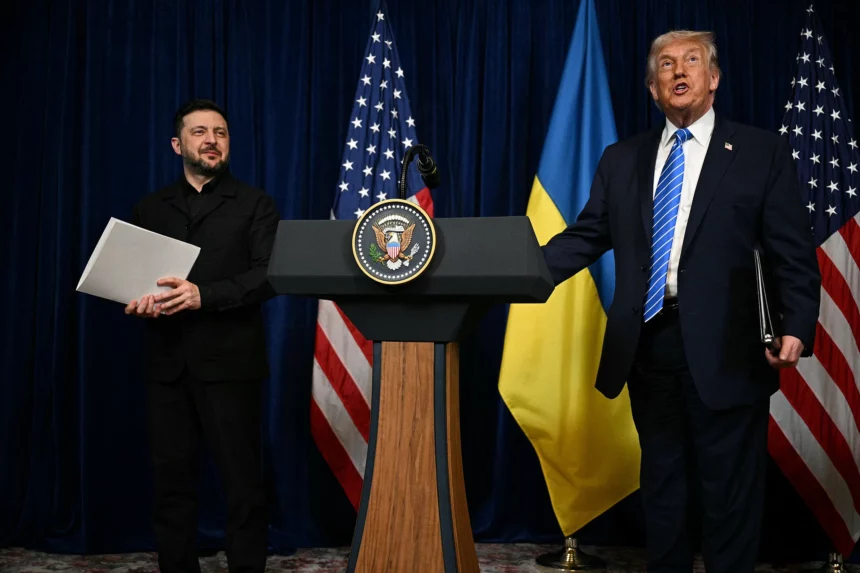
The meeting between trump and zelenskiy marked a significant diplomatic moment, coming amid intensified international efforts to halt the fighting and stabilise the region. Both leaders appeared together at a joint news conference and projected cautious optimism, though they avoided offering concrete timelines or detailed frameworks for a final agreement. Trump said it would become clear “in a few weeks” whether the negotiations would succeed, suggesting that discussions have entered a decisive phase.
Zelenskiy told reporters that ukraine and the united states had reached agreement on security guarantees, which he described as the most critical foundation for any lasting peace. According to him, such guarantees are essential to ensure that ukraine is not left vulnerable to renewed aggression once the war formally ends. Trump, while broadly agreeing, adopted a more guarded tone, stating that the two sides were about ninety-five percent of the way toward a security arrangement. He added that european countries would be expected to shoulder a significant portion of responsibility for guaranteeing ukraine’s security, with backing from the united states.
European leaders were quick to signal their involvement. French president Emmanuel Macron, in a message posted on social media after the mar-a-lago meeting, said progress had indeed been made on security guarantees. Macron announced that countries forming what he called a “coalition of the willing” would meet in paris in early january to finalise their concrete contributions, indicating that europe is preparing to play a more structured role in any post-war security framework.
Despite these assurances, significant ambiguity remains around what form such guarantees would take. Russia has repeatedly stated that it would not accept any foreign troop deployments in ukraine, a red line that complicates proposals involving nato members or european peacekeeping forces. Zelenskiy has maintained that ukraine needs guarantees strong enough to deter future attacks, whether through military commitments, economic mechanisms, or binding international agreements.
Trump also addressed the issue of democratic legitimacy, noting that any peace deal would ultimately need approval from ukraine’s parliament or through a national referendum. Zelenskiy echoed this position, stressing that no agreement could bypass ukraine’s constitutional processes. Trump said he would be willing to address ukraine’s parliament directly if doing so would help secure public and political backing for the deal.
donbas dispute, russia’s role, and wider international stakes
While security guarantees appear closer to resolution, the question of territory remains deeply contentious. The donbas region, parts of which have been contested since 2014 and heavily fought over since russia’s full-scale invasion nearly four years ago, continues to divide the negotiating parties. Moscow has demanded full control over donbas, while kyiv has insisted that any settlement must respect ukraine’s sovereignty and avoid forced territorial concessions.
Zelenskiy has previously expressed hope of softening a us proposal that would see ukrainian forces withdraw completely from donbas, a move widely viewed in kyiv as tantamount to ceding territory under pressure. Ukraine has instead argued for freezing the conflict along current battle lines, at least temporarily, as a compromise that avoids formal recognition of russian territorial gains. Trump confirmed that the fate of donbas remains unresolved but said discussions are “moving in the right direction.”
In an effort to bridge the gap, the united states has floated the idea of establishing a free economic zone in donbas if ukraine were to leave the area. However, details about how such a zone would operate, who would govern it, and how security would be maintained remain unclear. Trump acknowledged the difficulty of the issue, calling it “a very tough problem” but insisting that negotiators are getting closer to a solution.
The diplomatic complexity of the talks was underscored by trump’s engagement with russian president Vladimir Putin. Shortly before zelenskiy arrived in florida, trump held a lengthy phone call with putin, which he described as productive and friendly. According to the kremlin, putin criticised a proposed sixty-day ceasefire backed by the european union and ukraine, arguing that it would merely prolong the conflict rather than resolve it.
Trump said the two leaders spoke for more than two hours and claimed that putin expressed a willingness to help rebuild ukraine after the war, including by supplying cheap energy. “russia wants to see ukraine succeed,” trump remarked, acknowledging that the statement might sound unusual given the history of the conflict. As trump spoke positively about putin, observers noted zelenskiy’s restrained reaction, with the ukrainian leader reportedly tilting his head and smiling.
The kremlin has publicly welcomed trump’s diplomatic efforts. Kirill dmitriev, putin’s special envoy, said on social media that trump and his team’s peace initiatives were being appreciated around the world. Trump indicated that he plans to speak with putin again following his meeting with zelenskiy, suggesting that washington sees moscow as an indispensable participant in any final settlement.
Beyond territorial and security issues, negotiators have also discussed strategic infrastructure, including the zaporizhzhia nuclear power plant, which has been under russian control and has raised international alarm due to repeated fighting nearby. Trump said progress had been made on deciding the fate of the facility, which he claimed could resume operations almost immediately. The international atomic energy agency has reported that power line repairs are underway following a local ceasefire, highlighting the fragile but ongoing cooperation around nuclear safety.
The broader military situation remains volatile. On the eve of zelenskiy’s trip to florida, russian forces launched large-scale missile and drone attacks on kyiv and other parts of ukraine, knocking out power and heating in sections of the capital. Zelenskiy has described such strikes as russia’s response to us-brokered peace efforts, while trump said he believes both putin and zelenskiy are serious about ending the war despite continued fighting.
European leaders have remained closely engaged in the process. European commission president Ursula von der Leyen said europe is ready to continue working with ukraine and the united states, stressing that ironclad security guarantees are of paramount importance. A spokesperson for british prime minister Keir Starmer said european leaders had underlined the urgency of ending what they described as a barbaric war as soon as possible.
Russia currently controls all of crimea, annexed in 2014, and claims to hold roughly twelve percent of ukraine’s territory, including most of donbas and large portions of the zaporizhzhia and kherson regions. Moscow has also made incremental advances in other regions in recent months, reinforcing its bargaining position even as diplomatic talks intensify.
As negotiations continue, the stakes remain high not only for ukraine and russia but also for the wider international order. The outcome of the talks could reshape european security, redefine the role of the united states in conflict resolution, and set precedents for how territorial disputes and security guarantees are handled in future wars.