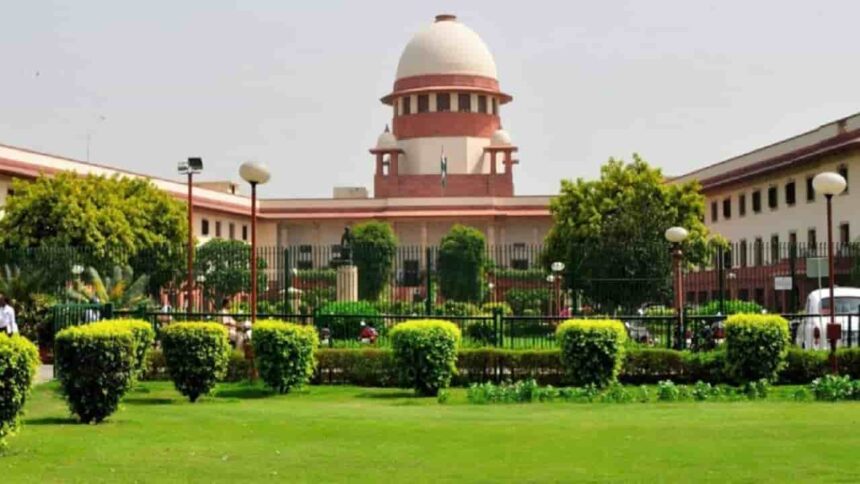
The Supreme Court of India has taken suo motu cognisance of concerns surrounding the definition, protection, and conservation of the aravalli range, signalling heightened judicial attention to one of india’s most ecologically fragile and historically significant mountain systems. The matter will be heard on december 29 by a bench comprising chief justice of india surya kant along with justices j k maheshwari and a g masih, at a time when environmental protection, illegal mining, and developmental pressures are at the centre of intense public and political debate.
The court’s intervention comes against the backdrop of mounting anxiety among environmentalists, civil society groups, and local communities over the future of the aravallis, which stretch across multiple states from delhi to gujarat. Long regarded as a natural barrier against desertification, a groundwater recharge zone, and a repository of biodiversity, the aravalli range has been subjected to decades of mining, urban expansion, and ecological degradation. The suo motu writ petition reflects judicial recognition that unresolved ambiguities in definition and enforcement could have far-reaching consequences for environmental governance across the region.
judicial scrutiny, mining bans, and scientific planning for the aravallis
The decision of the supreme court to take up the matter on its own motion follows growing concern over how the aravalli hills and ranges are defined for the purposes of legal protection. According to a previous court order dated november 20, 2025, only landforms with an elevation of 100 metres or more would be classified as aravalli hills. Environmental experts and activists have argued that such a definition could exclude more than ninety percent of the range from regulatory protection, potentially opening vast tracts to mining and construction.
Amid this legal and environmental uncertainty, the Ministry of Environment, Forest and Climate Change has taken a firm administrative stance. The ministry has directed all concerned state governments to impose a complete ban on granting any new mining leases across the aravalli landscape. This prohibition is intended to apply uniformly across the entire range, covering its full geographical spread from the national capital region through rajasthan and haryana to gujarat.
In its communication, the ministry emphasised that the objective of the ban is to preserve the integrity of the aravalli range as a continuous geological ridge. It underlined that unregulated and piecemeal mining has not only damaged the physical structure of the hills but has also disrupted ecosystems, groundwater systems, and local livelihoods. By halting new mining leases, the government aims to draw a clear line against further degradation while longer-term conservation measures are put in place.
To strengthen the scientific basis of protection, the ministry has also tasked the Indian Council of Forestry Research and Education with identifying additional areas across the aravalli range where mining must be prohibited. This exercise will go beyond areas already restricted by existing notifications and court orders. The identification process will be guided by ecological sensitivity, geological significance, and landscape-level considerations, reflecting a more holistic approach to conservation.
In addition, icfre has been directed to prepare a comprehensive, science-based management plan for sustainable mining for the entire aravalli region. The plan is expected to assess cumulative environmental impacts, evaluate ecological carrying capacity, and identify conservation-critical zones. It will also outline measures for restoration and rehabilitation of degraded areas. Importantly, the ministry has stated that this plan will be placed in the public domain to enable wide stakeholder consultation, including inputs from scientists, local communities, industry representatives, and civil society organisations.
For mining operations that are already underway, the union government has instructed state governments to ensure strict compliance with environmental safeguards and adherence to existing supreme court orders. This includes monitoring of environmental clearances, enforcement of restoration obligations, and action against illegal mining activities. Officials have indicated that failure to enforce these safeguards could invite legal and administrative consequences.
political reactions, public protests, and competing narratives on conservation
The renewed focus on the aravalli range has also triggered political reactions and public mobilisation, particularly in rajasthan, where large sections of the range are located. On december 26, rajasthan chief minister bhajan lal sharma accused the congress of hypocrisy and of spreading misinformation regarding the state government’s approach to aravalli protection. He asserted that the bjp-led government remains fully committed to safeguarding the ecological, cultural, and religious significance of the range.
At the same time, protests have erupted across several districts of rajasthan, including udaipur, jodhpur, sikar, and alwar. Demonstrators have voiced strong opposition to the approval of mining activities in the aravalli mountain range and have demanded the withdrawal of the apex court’s earlier order defining aravalli hills based on elevation. Protesters have warned that agitation could intensify if what they perceive as threats to the aravallis are not addressed decisively.
Environmental groups argue that the aravallis cannot be reduced to a narrow technical definition based solely on height. They point out that the range is among the oldest mountain systems in the world and plays a crucial role in regulating climate, preventing desert expansion, and sustaining wildlife and human populations. According to these groups, excluding large portions of the range from protection could irreversibly damage ecological balance in north-western india.
Responding to these concerns, union environment minister Bhupendra Yadav has sought to reassure the public that the aravalli range is completely safe. He stated that the supreme court’s decision was taken while maintaining a balance between environmental protection, prevention of illegal mining, and developmental needs. The minister emphasised that the government’s intent is not to weaken conservation but to ensure clarity and effective enforcement.
Addressing apprehensions raised by various groups, yadav highlighted that alwar remains an integral part of the aravalli mountain range and continues to be home to important natural and heritage sites such as the Sariska Tiger Reserve and Siliserh Lake. He stated that the conservation and development of these areas are non-negotiable and reiterated the government’s commitment to safeguarding the ecological balance of the region.
The minister also underscored that lawful and sustainable development must go hand in hand with environmental protection. According to him, the challenge lies in curbing illegal mining and environmentally destructive practices while allowing legitimate economic activities that do not compromise long-term ecological health. This balance, he suggested, is at the heart of the government’s approach to the aravalli issue.
As the supreme court prepares to hear the suo motu writ petition, the aravalli range has once again become a focal point of national debate. The outcome of the hearing is expected to influence not only how the aravallis are defined and protected but also how india approaches the broader question of reconciling environmental conservation with developmental aspirations in ecologically sensitive regions.