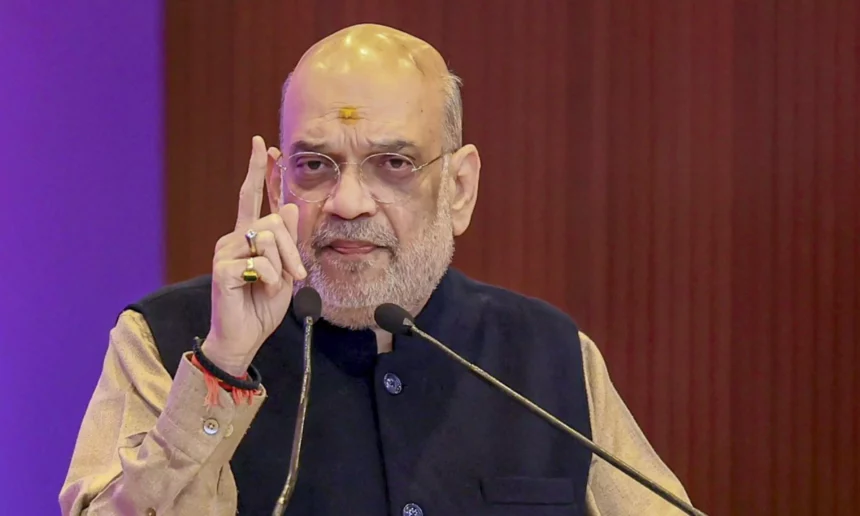
Union home minister Amit Shah on sunday launched a sharp political attack on the congress and its leader Rahul Gandhi, asserting that the party is destined to lose not only the 2029 lok sabha elections but also the forthcoming assembly polls in tamil nadu and west bengal, as he accused the opposition of consistently opposing issues that resonate with the people.
Speaking at a public gathering in a village near ahmedabad, shah said electoral success depends on aligning with public sentiment, a principle he claimed the congress has repeatedly failed to understand. His remarks came during an event that combined political messaging with the inauguration of development projects and the distribution of land ownership certificates to flood-affected families, allowing the bjp leader to contrast governance delivery with opposition politics.
shah’s criticism of congress strategy and rahul gandhi’s leadership
Addressing the audience, shah remarked that a political party cannot expect electoral victories if it opposes everything that people support. He said it was beyond his capacity to explain this “simple logic” to rahul gandhi, adding that even leaders within the congress had been unable to make him understand it. Referring to a recent debate in the Lok Sabha, shah recalled a question posed by gandhi about why his party keeps losing elections.
According to shah, instead of reflecting on public opinion, gandhi chose to raise the question during a parliamentary debate. Using a sarcastic tone, shah said gandhi would find his answer if he understood the initiatives launched at the event venue. He suggested that governance initiatives and development work, rather than constant opposition, were the reasons behind the bjp’s electoral success.
The home minister went on to say that gandhi should not get tired of losing elections, because the congress would “definitely” lose the upcoming assembly elections in tamil nadu and west bengal as well. Looking further ahead, shah predicted that in the 2029 lok sabha elections too, the bjp would return to power under the leadership of prime minister Narendra Modi.
Shah attributed the bjp’s continued success to what he described as a strong connection between the party’s principles and public aspirations. In contrast, he accused the congress of taking positions that were out of sync with popular sentiment. He listed several major policy decisions and initiatives opposed by the congress, including the ram mandir, surgical strikes against terrorists, the abrogation of article 370, the uniform civil code, legislation against triple talaq, and campaigns aimed at identifying and deporting illegal bangladeshi infiltrators.
According to shah, opposing these measures alienated the congress from voters who supported them. He posed a rhetorical question to underline his argument, asking how a party could expect votes if it stood against what people liked. Reiterating his criticism of rahul gandhi, shah said such reasoning seemed impossible for the congress leader to grasp, since even his own party colleagues had failed to convince him.
development initiatives, local governance, and political messaging
Beyond political rhetoric, shah used the occasion to highlight development initiatives undertaken by the government. At the event held at navi vanzar, he distributed land ownership certificates, known as sanad, to 173 residents. These beneficiaries were originally from vanzar village, located along the banks of the sabarmati river, and had been resettled after losing their homes, land, and belongings during the devastating floods of 1973.
Shah described the distribution of sanad as an example of the government’s commitment to addressing long-pending issues faced by ordinary citizens. He said the rehabilitation of flood-affected families and the formal recognition of land ownership were part of a broader effort to ensure dignity and security for people who had suffered decades earlier.
The union minister also inaugurated the western trunk line, a major drainage and sewerage project designed to handle waste generated by nearly fifteen lakh residents in newly developed areas of ahmedabad, including shela, south bopal, shantipura, and thaltej. Speaking about the project, shah said it would significantly reduce problems related to sewage overflow and improve living conditions in western parts of the city.
He noted that despite residents facing inconvenience for years due to the absence of a proper drainage system, there had been no protests or agitation. According to shah, the government nonetheless took responsibility for addressing the issue and completed the project before the deadline. He contrasted this approach with what he described as the opposition’s focus on criticism rather than constructive solutions.
Linking governance to political criticism, shah again referred to rahul gandhi, saying the congress leader needed to understand how development work was carried out quietly and efficiently. He added that instead of focusing on such governance issues, gandhi was trying to “decode” the special intensive revision of electoral rolls, a task shah said was not his “cup of tea.”
Shah, who represents the gandhinagar lok sabha constituency, used the platform to reinforce the bjp’s narrative of development-driven politics. His remarks combined local achievements with national-level political messaging, portraying the bjp as a party aligned with public aspirations and the congress as disconnected from voters’ priorities.
The comments are likely to intensify political sparring between the ruling bjp and the opposition congress, especially as preparations gradually begin for upcoming state elections and the longer-term battle for the 2029 general elections. By invoking both development projects and ideological positions, shah sought to frame the electoral contest as one between delivery-oriented governance and what he characterised as habitual opposition.