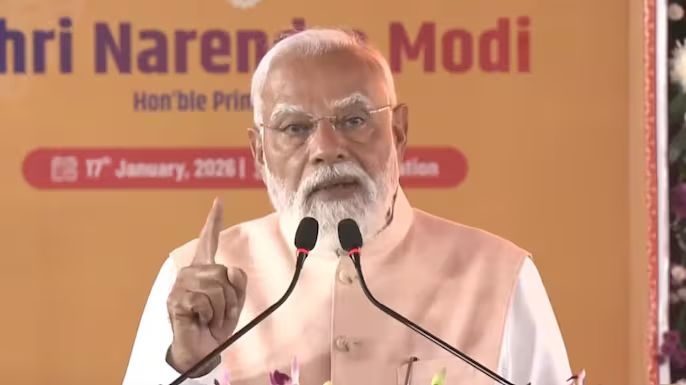
Prime Minister Narendra Modi is set to dedicate and lay the foundation stone for a series of major rail and road infrastructure projects in West Bengal, with a combined investment running into several thousand crore rupees. The projects, spread across Malda and Singur in Hooghly district, are aimed at transforming connectivity, improving logistics efficiency, and accelerating economic development in key regions of the state. With projects worth over ₹3,250 crore planned in and around Malda and additional initiatives exceeding ₹830 crore in Singur, the visit underscores the central government’s focus on infrastructure-led growth as a driver of regional and national development.
The initiatives form part of a broader strategy to modernise India’s transport network, reduce travel time, strengthen freight movement, and ensure balanced development across regions. Railways and road connectivity are being positioned as the backbone of this transformation, particularly in eastern India, which serves as a vital link between the rest of the country and the northeastern states. The Prime Minister’s engagements in Malda and Singur are expected to signal a renewed push for large-scale public investment that combines economic objectives with improved quality of life for citizens.
Malda projects focus on rail modernisation, logistics efficiency, and improved regional connectivity
In Malda, Prime Minister Modi will dedicate and lay the foundation stone for a wide range of rail and road projects valued at more than ₹3,250 crore. These initiatives are designed to address long-standing connectivity challenges in North Bengal while also supporting future growth in passenger and freight movement. Malda occupies a strategically important position on the rail map of eastern India, serving as a junction that connects several districts of West Bengal with Bihar, Jharkhand, and the northeastern region. Strengthening infrastructure in this area is expected to have a cascading impact on trade, mobility, and regional integration.
A major highlight of the Malda programme is the emphasis on railway expansion and modernisation. New rail lines, upgraded maintenance facilities, and enhanced passenger amenities are central to the planned investments. These projects aim to decongest existing routes, improve train reliability, and reduce delays that often affect long-distance and regional services. By expanding capacity and upgrading infrastructure, Indian Railways seeks to meet the growing demand for travel and freight transportation in one of the country’s busiest corridors.
The projects also include initiatives to modernise freight handling and logistics infrastructure. Improved freight facilities are expected to benefit agricultural producers, small businesses, and industries that rely on efficient transport to access markets. North Bengal is a significant producer of agricultural commodities, and better rail and road connectivity can help farmers and traders reduce transportation costs and minimise losses. Enhanced logistics efficiency is also likely to attract new investment to the region, creating employment opportunities and supporting local economies.
Road infrastructure development forms another key component of the Malda projects. New and upgraded roads are expected to improve last-mile connectivity, linking rural areas more effectively with urban centres and transport hubs. Better roads not only facilitate faster movement of goods and people but also improve access to education, healthcare, and other essential services. The integration of rail and road projects reflects a holistic approach to infrastructure planning, where different modes of transport complement each other.
The Prime Minister is expected to highlight how these projects align with the government’s vision of inclusive development. By focusing on regions that have historically faced infrastructure constraints, the initiatives aim to reduce regional disparities and ensure that the benefits of growth reach a wider population. The Malda projects are also anticipated to generate employment during both the construction and operational phases, contributing to local livelihoods.
In addition to their economic impact, the projects are designed with an eye on sustainability and long-term efficiency. Modern construction standards, improved safety features, and better maintenance systems are expected to enhance the durability and performance of the infrastructure. As passenger numbers and freight volumes continue to rise, such investments are seen as essential to prevent bottlenecks and support India’s broader economic ambitions.
Singur initiatives emphasise multimodal connectivity, local development, and economic revitalisation
Following the Malda engagements, Prime Minister Modi will visit Singur in Hooghly district, where he will inaugurate and lay the foundation stone for development projects worth more than ₹830 crore. Singur holds symbolic and strategic importance in West Bengal’s industrial and political landscape, and the new initiatives are aimed at strengthening infrastructure, improving connectivity, and supporting local economic activity.
The projects in Singur include a mix of transport and logistics-related initiatives, with a strong focus on creating multimodal connectivity. Among the key components is the development of an extended port gate system at Balagarh, which is expected to enhance the integration of road, rail, and inland water transport. Such systems are designed to streamline the movement of goods between ports and inland destinations, reducing congestion and improving efficiency in supply chains.
The inclusion of inland water transport facilities reflects a growing emphasis on utilising India’s waterways as a cost-effective and environmentally friendly mode of transport. By connecting riverine transport with road and rail networks, the Singur projects aim to create a more resilient and diversified logistics ecosystem. This approach is particularly relevant for regions like Hooghly, which have access to navigable rivers and can benefit from reduced dependence on road transport alone.
Road infrastructure improvements are also a significant part of the Singur initiatives. New road links and upgraded bridges are expected to improve connectivity for local residents and businesses, making it easier to access markets and services. Better roads can play a crucial role in revitalising local economies by attracting investment and facilitating the movement of goods and labour. For residents, improved infrastructure often translates into shorter travel times and enhanced safety.
The projects in Singur are also expected to generate employment and stimulate economic activity in the surrounding areas. Construction work will create short-term jobs, while improved connectivity and logistics infrastructure can support long-term growth in manufacturing, trade, and services. By focusing on both immediate and lasting benefits, the initiatives aim to deliver tangible outcomes for the local population.
Prime Minister Modi is likely to emphasise the role of such projects in supporting the broader vision of development-led governance. Infrastructure investments in places like Singur are presented as part of a national effort to modernise transport systems, reduce inefficiencies, and build a foundation for sustained economic growth. The projects also align with efforts to strengthen eastern India’s role in the national economy by improving connectivity within the region and with other parts of the country.
Across both Malda and Singur, the combined investments highlight the scale and ambition of the government’s infrastructure push. By dedicating and launching projects worth several thousand crore rupees in a single visit, the Prime Minister’s programme underscores the centrality of rail and road development in India’s growth strategy. The focus on connectivity, logistics, and regional development reflects an understanding that modern infrastructure is essential not only for economic competitiveness but also for social progress.
As these projects move from planning to execution, their impact is expected to be felt across multiple sectors. Improved rail and road networks can boost trade, support tourism, enhance mobility, and improve access to essential services. For West Bengal, the initiatives represent an opportunity to strengthen its infrastructure base and position itself more effectively within India’s evolving economic landscape.