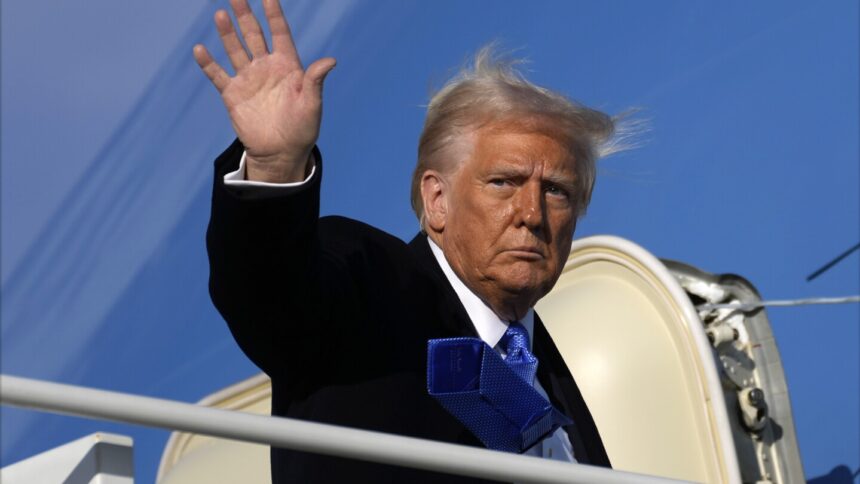
United States president Donald Trump has frozen aid to South Africa, escalating tensions between his administration and Pretoria over a controversial land expropriation law. The law, signed last month by South African president Cyril Ramaphosa, allows the government to seize land without compensation under certain conditions, a move aimed at addressing historical land inequalities dating back to apartheid.
In an executive order signed on Friday, Donald Trump criticized the legislation, describing it as a “shocking disregard” for citizens’ rights. He argued that the law would allow the South African government to seize land from ethnic minority Afrikaners without compensation. Donald Trump also accused the South African government of implementing policies that dismantle equal opportunity and engaging in rhetoric that incites violence against “racially disfavored” landowners.
The dispute over land reform has intensified in recent days, with Donald Trump and Cyril Ramaphosa exchanging strong words. Donald Trump accused Cyril Ramaphosa’s administration of “confiscating land” and mistreating “certain classes of people,” prompting a firm response from the South African leader. Cyril Ramaphosa defended the law, stating that it is a “constitutionally mandated legal process” intended to ensure equitable land distribution and public access. He dismissed Donald Trump’s criticisms, declaring that South Africa would not be “bullied” and that his government would continue pursuing policies in the best interests of its citizens.
Adding to the diplomatic strain, Donald Trump’s executive order also cited South Africa’s foreign policy decisions as reasons for the aid freeze. He pointed to Pretoria’s recent accusation against Israel at the International Court of Justice, where South Africa alleged that Israel was committing genocide in Gaza. Donald Trump also condemned South Africa’s growing ties with Iran, suggesting that these moves were in opposition to United States interests and posed security threats to American allies.
In a further protest against South Africa’s policies, United States secretary of state Marco Rubio announced on Wednesday that he would skip the upcoming Group of 20 talks in Johannesburg, citing concerns over the expropriation law and other “very bad things” happening in the country.
Donald Trump’s order also outlined plans to promote the resettlement of Afrikaners “escaping government-sponsored race-based discrimination.” Meanwhile, the Democratic Alliance, South Africa’s largest opposition party, has strongly criticized the law, warning that it could threaten property rights and deter foreign investment.
South Africa’s land reform debate remains deeply contentious. Despite Black South Africans making up more than 80 percent of the population, they own just 4 percent of privately held farmland, according to a 2017 government audit. White South Africans, who represent around 7 percent of the population, hold about three-quarters of the country’s land.
The Donald Trump administration’s decision to freeze aid comes as part of a broader crackdown on United States foreign assistance, including efforts to significantly reduce the role of the United States Agency for International Development. In 2023, Washington allocated approximately $440 million in assistance to South Africa, an amount now under review following Donald Trump’s latest directive. As tensions escalate, the diplomatic fallout from the land reform dispute is likely to shape United States-South Africa relations in the months ahead.