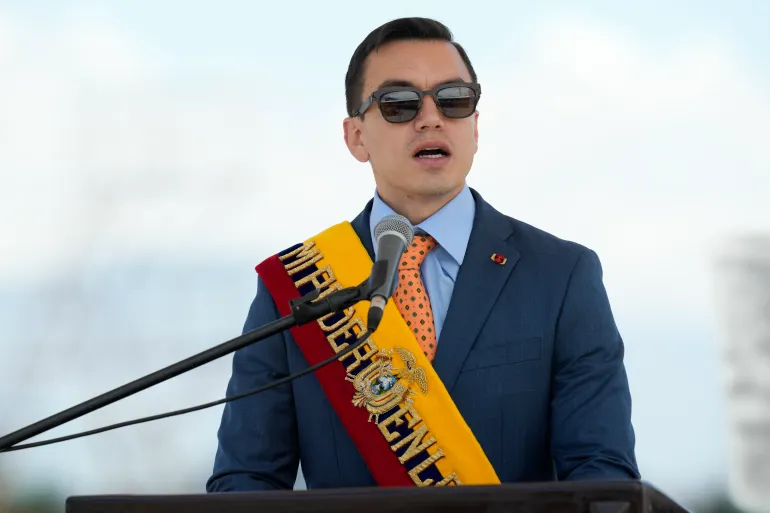
Ecuador heads to the polls as president Daniel Noboa seeks re-election, despite facing mounting criticism over his governance. In his brief tenure, the country has endured 14-hour daily blackouts, violent prison riots, and a diplomatic crisis with Mexico. Yet, Noboa, 37, remains a frontrunner in the election, buoyed by his tough-on-crime policies and an approval rating exceeding 50 percent, according to polling firm Comunicaliza. His primary challenger remains Luisa Gonzalez, the left-wing politician he defeated in 2023.
Noboa’s rise to power was swift and unexpected. The son of a billionaire banana magnate, he entered the race after president Guillermo Lasso dissolved the national assembly in May 2023 to avoid impeachment. Noboa, then a first-term legislator, launched a dark-horse campaign, forming a coalition of center and conservative-leaning parties. Initially trailing Gonzalez, he advanced to the run-off, ultimately securing a narrow victory with 52 percent of the vote. At 35, he became Ecuador’s youngest elected president, tasked with finishing Lasso’s term.
His presidency has been marked by crisis and inexperience. Critics, including political analyst Sebastian Hurtado, argue Noboa arrived without a clear plan or a strong team, often improvising key decisions. One such instance was Ecuador’s electricity crisis, where a historic drought crippled hydroelectric power. Despite his assurances that blackouts would end, they persisted for months, triggering protests in Quito with chants of “fuera Noboa” (“out with Noboa”).
Ecuador’s most pressing challenge, however, has been crime. Once known for low violence rates, Ecuador saw the highest homicide rate in South America by 2023, with 47 murders per 100,000 residents. The crisis escalated when presidential candidate Fernando Villavicencio was assassinated while leaving a rally. Weeks into Noboa’s term, gang leader Jose Adolfo Macias Villamar escaped from prison, triggering riots and a shocking attack on a live TV broadcast.
Noboa’s response was a declaration of war against Ecuador’s gangs, labeling them terrorist groups and imposing successive states of emergency. In April, voters overwhelmingly backed his measures to expand military presence in law enforcement and increase criminal penalties. However, human rights groups, including Human Rights Watch, have accused Ecuadorian forces of extrajudicial executions, enforced disappearances, and torture.
International controversy followed when Noboa authorized a police raid on the Mexican embassy in Quito, violating diplomatic protocols and leading Mexico to sever ties with Ecuador. At home, his refusal to transfer power to vice president Veronica Abad during his campaign led Ecuador’s constitutional court to declare his actions unconstitutional.
Despite these controversies, Noboa has styled himself as an anti-establishment leader fighting “old politics.” His campaign targets Ecuador’s youth, who make up a large portion of the electorate, with informal branding and appeals for a decisive first-round victory. However, analysts warn that if he secures a full term, his political honeymoon will end quickly. Without tangible solutions to Ecuador’s crises, his popularity may erode, leaving him vulnerable to growing opposition.