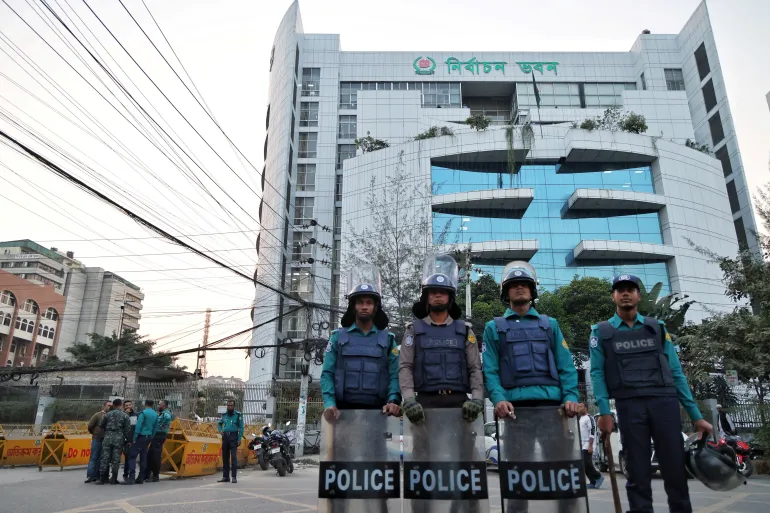
Bangladesh has entered a decisive phase of its political transition as the Election Commission announced that the long-awaited parliamentary election will take place on February 12, marking the country’s first national vote since the dramatic student-led uprising that toppled former prime minister Sheikh Hasina. The announcement comes amid widespread uncertainty, renewed street mobilisations and heightened expectations from a population eager for democratic restoration after a year of upheaval. For the interim administration led by Nobel laureate Muhammad Yunus, the upcoming election represents both a test of legitimacy and a critical opportunity to stabilise a country that has endured institutional turmoil, economic strain and shifting regional alliances.
Interim Government Seeks Direction as Election and Referendum Aim to Rebuild Democratic Credibility
The election date was confirmed in a televised address by chief election commissioner AMM Nasir Uddin, who also announced that a national referendum on political reforms would be held on the same day. This dual process reflects an effort by the caretaker government to consolidate institutional changes promised after Hasina’s ouster, when millions of young protesters demanded structural reforms to combat authoritarian rule, corruption and centralised political control.
However, the transition has been far from smooth. The Yunus-led administration has faced persistent demonstrations accusing it of delaying the reform agenda. Many protesters believe the interim government has struggled to balance competing pressures: stabilising governance while designing lasting political reforms, managing economic turbulence while preventing further unrest and navigating diplomatic sensitivities while attempting to redefine Bangladesh’s regional role.
Hasina’s Awami League remains barred from contesting the election, a move that has fuelled political tensions. Party leaders have warned that excluding one of the country’s major political forces risks delegitimising the electoral process and could trigger fresh waves of confrontation. Their criticism underscores a deeper debate in Bangladesh over the extent to which the transition should incorporate or isolate remnants of the previous government.
Yunus, however, characterised the election announcement as a historic milestone, declaring that Bangladesh had “crossed an important threshold” in its quest to restore democratic norms. His framing reflects the caretaker administration’s message that the upheaval of the past year has cleared the way for a more transparent and accountable political order. Yet the success of this transition hinges on whether the February vote unfolds peacefully, inclusively and credibly, particularly in a polarised climate where mistrust in political institutions remains high.
The situation grew more complex when President Mohammed Shahabuddin announced he would resign after the election, citing humiliation under the interim government. Although the presidency is largely symbolic, his decision reflects the fractures left behind by the transfer of power. It also signals how deeply the transition has tested existing institutional relationships, raising questions about how future leadership structures will be recalibrated after the election.
With political parties preparing for a compressed campaign season, public sentiment is sharply focused on the restoration of democratic rule and the government’s ability to deliver on unmet demands. Long lines outside voter registration centres, heightened activity among civil society groups and energetic student mobilisation reflect a population determined to influence the direction of the next phase of governance.
Economic Pressures, Geopolitical Shifts and Public Expectations Shape the Road to February 12
Beyond politics, Bangladesh’s upcoming election unfolds at a moment of significant economic and geopolitical strain. The country’s vital garment-export sector, which supports millions of workers and forms the backbone of its economy, is still recovering from disruptions triggered by the uprising and global market fluctuations. Foreign investors and trade partners are watching closely for signs of stability, and a credible election could help rebuild confidence in Bangladesh’s growth trajectory.
Relations with India—historically complex but stabilised under Hasina—have entered a period of recalibration. Ties cooled significantly after Hasina fled to India following the uprising, sparking diplomatic discomfort on both sides. Observers expect the new Bangladeshi government to reassess the balance of engagement with India, China and regional partners as it seeks to re-anchor its foreign policy in a shifting geopolitical landscape.
At home, demands for institutional transparency, judicial reform and accountability mechanisms remain strong. The referendum on political reforms is widely seen as an attempt to codify some of these expectations into law, though sceptics argue that reforms must be shaped by broad consultation rather than executive decree. Questions also persist regarding the future of student-led political activism, which emerged as a crucial force during Hasina’s removal and now remains vigilant against any sign of authoritarian drift.
Despite the uncertainty, many Bangladeshis view the February election as a chance to reset the nation’s political foundations. After months of instability, they are eager for a return to predictable governance, functioning institutions and economic recovery. The stakes are high: a smooth election could propel the country toward renewed democratic consolidation, while a contested or chaotic process could deepen divisions and invite further unrest.
As Bangladesh approaches February 12, the world will watch how the country navigates this delicate transition. The months ahead will determine not only the success of the interim government’s efforts but also the trajectory of a nation seeking to reclaim stability, democratic legitimacy and its place in a rapidly evolving region.