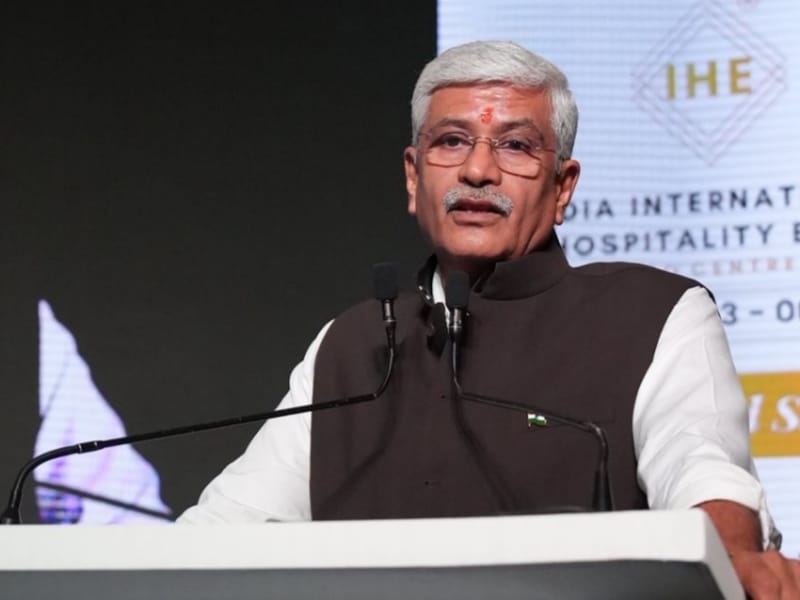
Union Minister Gajendra Singh Shekhawat on Monday emphasized that tourism has been deeply ingrained in India’s cultural fabric for thousands of years, asserting that the country has long embraced travel as an essential aspect of life. Speaking at an event organized by the Odisha tourism department in collaboration with the Federation of Indian Chambers of Commerce & Industry (FICCI), Gajendra Singh Shekhawat underscored India’s historical connection with tourism, citing examples from the country’s rich past.
Highlighting the deep-rooted tradition of pilgrimage and travel in India, Gajendra Singh Shekhawat stated that the Kedarnath Temple was built around 2,500 years ago, a time when the United States did not exist and Europe was still entering the Bronze Age. He pointed out that historically, Indians have always prioritized travel to temples and tourist destinations whenever they had disposable income, making tourism an intrinsic part of the nation’s cultural identity.
The minister also noted that this tendency has significantly increased in the post-pandemic era, as people now view travel not only as a leisure activity but also as a means of spiritual and personal rejuvenation. The shift in travel patterns and increased domestic tourism reflect a growing consciousness among Indians about their heritage and places of cultural significance.
Gajendra Singh Shekhawat lauded the efforts of the central government in bolstering tourism infrastructure, emphasizing that India’s global perception has transformed over the past decade under Prime Minister Narendra Modi’s leadership. He credited the rapid pace of development and large-scale infrastructural projects for positioning India as a top travel destination, both for domestic and international visitors.
Discussing the critical role of infrastructure in tourism growth, the minister stressed that the foremost requirement for a thriving tourism industry is a well-established and efficient commutation network. He highlighted how India has undergone a revolution in connectivity over the last ten years, citing advancements in roadways, railways, and air travel that have significantly improved accessibility to various tourist destinations across the country.
He further pointed out that initiatives such as improved highways, increased air connectivity to remote locations, and modernization of railway stations have played a crucial role in boosting domestic and international tourism. The expansion of these networks has enabled more people to explore India’s vast cultural and natural heritage, reinforcing the country’s status as a global tourism hub.
The minister’s remarks come at a time when India is witnessing unprecedented growth in its tourism sector, driven by government initiatives, infrastructural advancements, and a renewed interest among travelers in exploring historical, cultural, and spiritual sites. The event in Odisha served as a platform for stakeholders in the tourism industry to discuss strategies for further enhancing the sector and promoting India’s diverse attractions on the global stage.