India’s growing energy partnership with Russia has become a source of rising tension with the United States, as top members of the Donald Trump camp double down on their criticism. The former president’s announcement of a 25% tariff on Indian goods, paired with unspecified “penalties,” marks an escalation in trade discord that coincides with India’s continued purchase of discounted Russian oil. As this geopolitical rift widens, New Delhi has asserted that its energy deals reflect national interests—setting the stage for a deeper clash of economic priorities and diplomatic values.
US discontent over India-Russia oil trade intensifies
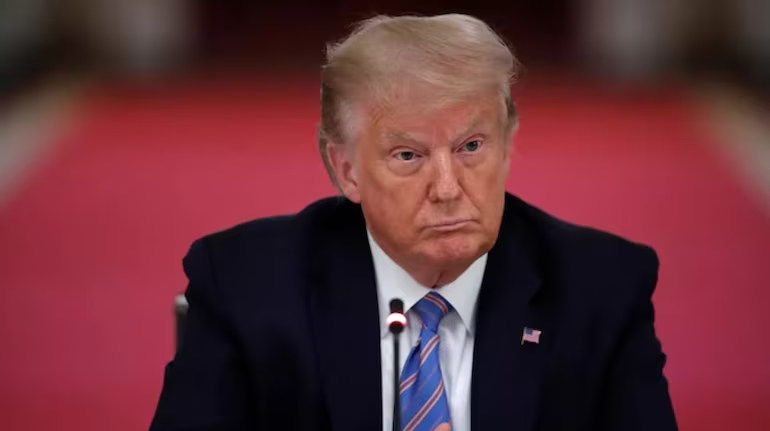
President Donald Trump reignited tensions between India and the United States with a sweeping announcement that new tariffs and penalties will be imposed on Indian goods starting August 1. This move came after his public criticism of India’s ongoing energy ties with Russia, calling both economies “dead” and accusing India of enabling Russia’s war efforts by purchasing its oil.
“I don’t care what India does with Russia. They can take their dead economies down together,” Donald Trump posted on his social media platform Truth Social. He further accused India of having some of the highest tariffs in the world and claimed the US has done “very little business” with New Delhi. The message, though characteristically blunt, reflects a broader concern within Donald Trump’s circle about India’s energy policy and its implications for the West’s unified stance against Russia.
Marco Rubio, who has been named as Donald Trump’s pick for Secretary of State, echoed the same sentiment. Speaking to Fox News, Rubio described India’s Russian oil purchases as “a point of irritation” in the bilateral relationship. “India is an ally and a strategic partner, but like anything in foreign policy, you don’t align 100% of the time,” he said. While acknowledging India’s legitimate energy needs, Rubio criticized its decision to buy Russian oil, saying it indirectly supports Russia’s military efforts in Ukraine.
Rubio emphasized that although India may have economic reasons for buying cheaper Russian oil, the political cost of such decisions affects its standing in the eyes of its Western allies. He suggested that despite the friendship, there are limits to what the US can tolerate in terms of divergent foreign policy choices, especially when it involves adversaries like Russia.
Bilateral trade under strain as US voices frustration
Donald Trump’s former Treasury Secretary pick, Scott Bessent, added to the criticism in an earlier interview, where he stated that the US trade team has grown increasingly frustrated with India. He claimed that New Delhi has not been cooperative in trade negotiations and criticized its role as a major purchaser of Russian oil, particularly in its resale as refined petroleum products.
“India has not been a great global actor,” Bessent said, pointing to India’s re-export of refined Russian oil as evidence that the country is profiting while helping to sustain Russia’s economy during wartime. According to Bessent, this dynamic has added to the friction in trade talks, with US officials expressing dissatisfaction over what they see as India’s unwillingness to align with global sanctions or diversify its energy suppliers.
Donald Trump’s decision to impose a 25% tariff on Indian goods, combined with other unspecified penalties, appears to be both a retaliatory and strategic move. While the details of these penalties remain unclear, the overarching message is that India’s relationship with Russia is no longer being viewed as neutral or benign by the Donald Trump camp—it is now a liability in the broader US-India partnership.
Despite this backlash, India has stood its ground. Government officials have reiterated that any trade negotiations will be settled keeping in mind India’s national interest. They argue that the country’s growing energy demands require flexible and pragmatic sourcing options, including buying oil from Russia, especially when such imports are priced significantly below market rates.
Adding to the friction was Prime Minister Narendra Modi’s recent address in the Lok Sabha, in which he dismissed claims—without naming Donald Trump directly—that any global leader had asked India to halt its Operation Sindoor or to mediate a ceasefire between India and Pakistan. His remarks appeared to be a direct rebuttal to Donald Trump’s earlier claim that he had personally intervened to de-escalate tensions in the subcontinent.
Modi’s statement was not just a defense of India’s foreign policy independence but also a signal to Washington that New Delhi would not be coerced into shifting its alliances or diplomatic stance under external pressure. His government continues to balance its growing strategic alignment with the West while maintaining a long-standing relationship with Moscow—one that has traditionally encompassed defense, trade, and energy.
The clash over oil imports thus becomes a symbolic issue within a larger context of changing global alliances. While India aspires to be recognized as a major global power with an independent foreign policy, Washington appears increasingly impatient with its refusal to toe the line on Russia.
As the geopolitical spotlight sharpens on the Delhi-Moscow energy corridor, New Delhi will need to carefully navigate the shifting tides of global politics. The stakes are high—not just in terms of energy security but also for the broader India-US relationship, which now appears more complex and conditional than ever.