Congress leader and Leader of Opposition in the Lok Sabha, Rahul Gandhi, has stirred significant controversy by agreeing with former U.S. President Donald Trump’s statement calling the Indian economy “dead.” His remarks have ignited a fierce political storm, with the Bharatiya Janata Party (BJP) accusing him of echoing foreign narratives and insulting the aspirations of Indian citizens. As Rahul Gandhi reiterates his stance both on record and via social media, top BJP leaders have unleashed a barrage of criticism, labeling his comments as disgraceful, politically suicidal, and deeply unpatriotic.
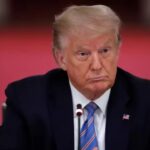
On the heels of Trump’s dramatic announcement of a 25% tariff hike on Indian goods and additional penalties over India’s ongoing oil trade with Russia, the former U.S. President said he “doesn’t care what India does with Russia” and described both economies as “dead.” In a candid and provocative post on his social media platform Truth Social, Trump cited India’s high tariffs and minimal trade relationship with the U.S. to justify his harsh tone.
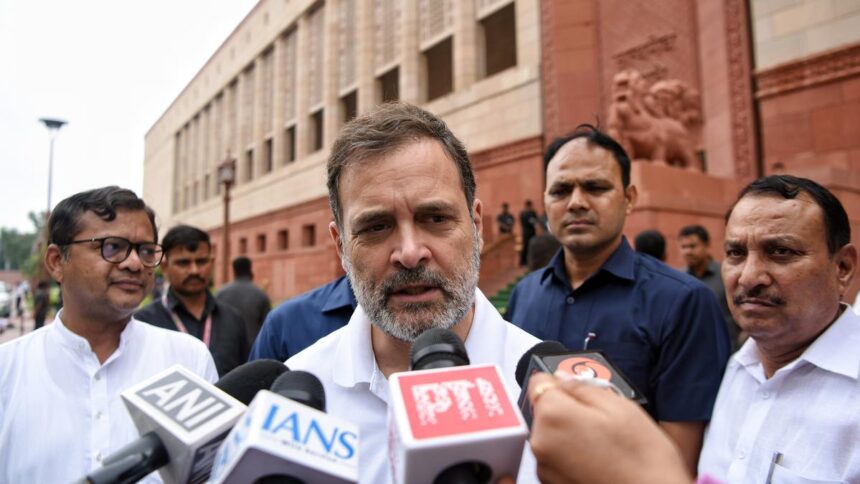
When reporters questioned Rahul Gandhi about Trump’s characterization of India’s economy, Rahul Gandhi agreed without hesitation. Standing within the Parliament House complex, he declared that Trump was “right,” asserting that the Indian economy is indeed “dead.” Rahul Gandhi further stated that everyone in the country, except Prime Minister Narendra Modi and Finance Minister Nirmala Sitharaman, is aware of the economic downturn. He went on to say, “I am glad that President Trump has stated a fact… The entire world knows that the Indian economy is a dead economy.”
Social Media Amplifies Controversy
Rahul Gandhi did not stop at making a statement before the press. He took to his X (formerly Twitter) handle, posting in capital letters: “THE INDIAN ECONOMY IS DEAD. Modi killed it.” In the same post, he listed several factors that he claimed have led to this situation, including demonetisation, the implementation of GST, and rising unemployment. He accused the Modi government of destroying the future of India’s youth due to a lack of job opportunities.
This social media post acted as a lightning rod, drawing immediate criticism from various BJP quarters. The Karnataka unit of the BJP retorted with a sarcastic jab, stating that it is not the Indian economy that is dead, but rather Rahul Gandhi’s political future. “That smug smirk of yours doesn’t hide anything — it only reveals the deep hatred you have for our nation,” the post said, directly addressing Rahul Gandhi.
BJP Hits Back With Unified Rebuttal
Amit Malviya, head of the BJP’s IT cell, launched a direct attack on Rahul Gandhi, saying that his comments marked a new low in Indian politics. Malviya described Rahul Gandhi’s endorsement of Trump’s statement as a “shameful insult” to the hard work and aspirations of 140 crore Indians. He didn’t stop there, emphasizing that “the only thing truly ‘dead’ here is Rahul Gandhi’s own political credibility and legacy.”
Malviya cited economic data showing India’s continued growth despite global uncertainties. He highlighted that both the International Monetary Fund (IMF) and the World Bank have upgraded India’s growth projections and recognized the country as the fastest-growing major economy. According to Malviya, Rahul Gandhi’s repeated attempts to undermine India’s economic progress are not just political barbs, but deliberate slights aimed at the country’s progress and its global image.
Other BJP leaders echoed this sentiment. National spokesperson Sambit Patra criticized Rahul Gandhi’s remarks as being aligned with foreign interests. He asked rhetorically, “Whose side is he really on?” Patra emphasized that the entire world is praising India’s economic achievements, but Rahul Gandhi appears determined to diminish them.
In his social media post, Patra outlined key indicators to argue against Rahul Gandhi’s claims: a revised IMF forecast placing India’s GDP growth at 6.9% in 2025, inflation at a six-year low, and the Purchasing Managers’ Index (PMI) at a 17.5-year high. He added, “Rahul Gandhi is attempting to chip away at India’s collective spirit… but he’s simply out of sync with a nation chasing its dreams.”
BJP MP and former Union Minister Anurag Thakur also took a swipe, suggesting that Rahul Gandhi has developed a habit of endorsing any anti-India narrative voiced abroad. He remarked that the Congress leader eagerly picks up any foreign criticism of India, regardless of its impact on national pride.
Meanwhile, BJP leader Annamalai compared Rahul Gandhi’s stance unfavorably to fellow Congress MP Shashi Tharoor. Annamalai noted that while Tharoor spoke up in India’s interest, Rahul Gandhi seemed more concerned with pleasing “offshore masters.” He accused Rahul Gandhi of wearing “ignorance like a badge of honour” and criticized his unwillingness to acknowledge India’s global rise.
Adding to the crescendo, BJP national spokesperson Pradeep Bhandari declared that Rahul Gandhi’s remarks were not just politically reckless but fundamentally anti-national. According to Bhandari, no “right-minded Indian” would ever echo sentiments that demean the country’s economy in such stark terms.
As the political temperature rises, Rahul Gandhi’s alignment with Trump’s harsh critique has become more than a matter of opinion. It has evolved into a high-stakes battle over narratives, nationalism, and political legacies. With the 2024 general elections looming large, the incident reflects the intensified scrutiny that political leaders face over their words, both at home and on the global stage.
The BJP’s unified response has sought to portray Rahul Gandhi as disconnected from ground realities, out of touch with the aspirations of everyday Indians, and increasingly reliant on external validation. Rahul Gandhi, in contrast, has positioned himself as a truth-teller calling out economic mismanagement, though critics argue that his framing is exaggerated and harmful to national morale.
The controversy surrounding Rahul Gandhi’s remarks continues to dominate headlines and social discourse, symbolizing a larger ideological clash between the ruling party’s portrayal of a “New India” and the Opposition’s critique of that vision. Whether this latest controversy helps or harms either side remains to be seen, but it has undoubtedly sharpened the lines in India’s political battlefield.