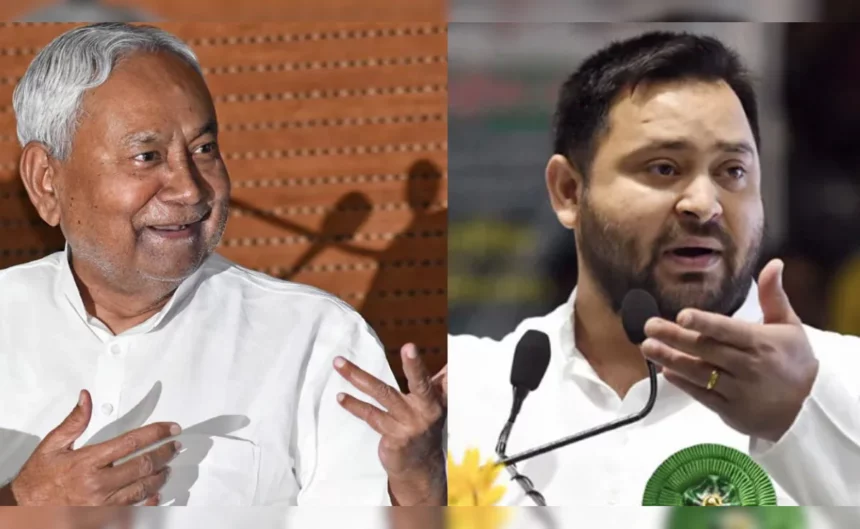
As Bihar gears up for a fiercely contested Assembly election, the state’s political landscape has heated up with a bold declaration from Rashtriya Janata Dal (RJD) leader Tejashwi Yadav. As the chief ministerial face of the Opposition Mahagathbandhan, Tejashwi Yadav has made one of his strongest assertions yet—stating unequivocally that Chief Minister Nitish Kumar “will not return” to power after the polls. Tejashwi Yadav declared that Nitish’s political career is nearing its end, claiming that both his health and political influence have waned, while the ruling NDA has lost faith in his leadership. His remarks have set the tone for what promises to be one of the most decisive electoral battles Bihar has seen in two decades.
Tejashwi Yadav’s Scathing Remarks on Nitish’s Leadership
In his conversation with Hindustan Times, Tejashwi Yadav did not mince words in describing Nitish Kumar’s current political and administrative standing. “CM Nitish Kumar is not in good health and has lost control over the administration. He is not coming back. He will be finished after the polls,” Tejashwi Yadav asserted. He further claimed that the NDA, despite currently being in power, is not interested in projecting Nitish as its chief ministerial face for the upcoming elections.
Tejashwi Yadav’s statements reflect a growing confidence within the Mahagathbandhan camp, which has recently formalized his position as the alliance’s CM candidate. The Opposition bloc, comprising RJD, Congress, and other regional allies, is aiming to end the two-decade-long rule of the NDA in Bihar. By directly attacking Nitish’s health, administrative control, and political influence, Tejashwi Yadav seems to be crafting a narrative that positions him as the energetic and youthful alternative to the veteran leader.
“It is clear that the NDA will not be making Nitish Kumar the chief minister again. They have not even announced their CM face, and that itself tells the story. There is no question of Nitish Kumar returning as chief minister. His party will cease to exist after the polls. I can vouch for it,” Tejashwi Yadav said, sounding confident of a political shift in the state’s leadership.
According to political analysts, Tejashwi Yadav’s direct attack on Nitish Kumar serves two purposes. First, it aims to highlight the perceived fatigue and instability within the JD(U) leadership, and second, it attempts to consolidate the anti-incumbency sentiment brewing among voters after years of NDA governance. The RJD leader has also sought to strengthen his public image as a decisive and self-assured leader capable of uniting the INDIA bloc in Bihar.
INDIA Bloc’s Unified Front and Strategic Positioning
The timing of Tejashwi Yadav’s statement is significant. It came just days after the Opposition INDIA bloc formally declared him the face of its campaign in Bihar. The decision was announced by senior Congress leader Ashok Gehlot in Patna after a series of deliberations among alliance partners. “All allies in the INDIA bloc, including our leader Rahul Gandhi, have decided that Tejashwi Yadav will be our CM face, and we will fight the election unitedly. The decision has been taken after consultation with all allies and our president Mallikarjun Kharge,” Gehlot said during a joint press conference.
This public show of unity comes after weeks of speculation about internal friction within the alliance over seat-sharing and leadership clarity. However, by projecting Tejashwi Yadav as the face of the alliance, the Opposition has sent out a clear message of consolidation ahead of the polls. The Mahagathbandhan also announced that Vikassheel Insaan Party (VIP) chief Mukesh Sahani would serve as the deputy chief ministerial face, a move intended to broaden the alliance’s social and regional appeal.
Tejashwi Yadav’s confidence in victory also stems from his belief that the alliance has learned from its mistakes in the 2020 elections. Reflecting on that experience, Tejashwi Yadav alleged that the NDA’s victory then was marred by “malpractices” and “poll discrepancies,” which prevented the Mahagathbandhan from forming the government despite strong electoral performance. “This time, we are fully vigilant. Every booth, every count will be monitored. We will ensure no manipulation or malpractice happens,” Tejashwi Yadav remarked during his interview.
His remarks also touched upon the growing discontent within Bihar over unemployment, migration, and governance issues, which have been recurring themes in his campaign narrative. The RJD leader has consistently argued that Nitish Kumar’s long tenure has failed to deliver sustainable development and employment opportunities for the youth. His campaign strategy appears focused on contrasting the perceived stagnation under Nitish’s administration with his own vision of progress and modern governance.
No Room for Reconciliation with Nitish Kumar
When asked whether there was any possibility of future political reconciliation with Nitish Kumar, Tejashwi Yadav dismissed the idea entirely. “First, there is no question of any realignment with the JD(U) or CM Nitish Kumar in the near future. As I told you, after the polls, the JD(U) will be finished and the party will cease to exist. So, where is the question of any realignment?” he said.
This categorical rejection signals the complete breakdown of political ties between the two leaders, who had once briefly shared power under the Mahagathbandhan government in 2015 before Nitish realigned with the BJP in 2017. Since then, their relationship has been marked by mutual distrust and public criticism. Tejashwi Yadav’s recent comments suggest that the RJD is now preparing to challenge the JD(U)-BJP combine not only electorally but ideologically—by positioning itself as the principal force of opposition and revival in Bihar politics.
Political observers note that Nitish Kumar, once seen as the “Sushasan Babu” of Bihar, now faces a formidable challenge to retain his grip on the state. His frequent shifts in political alliances—from partnering with the BJP to joining and later abandoning the Mahagathbandhan—have cost him credibility among sections of the electorate. Meanwhile, Tejashwi Yadav has been working to project himself as a symbol of consistency, youth, and progressive politics—attributes that could resonate with Bihar’s younger voters, who form a large portion of the electorate.
The RJD leader’s assertion that the NDA “won’t make Nitish CM again” also hints at possible internal divisions within the alliance. Analysts suggest that there may indeed be growing discomfort among BJP leaders regarding Nitish’s continued leadership, especially after recent reports of friction over administrative decisions and governance direction. If the NDA fails to present a unified front or clear leadership face before the elections, it could bolster the Opposition’s claim that the ruling coalition is losing coherence.
Bihar’s Political Crossroads Ahead of Polls
The upcoming Bihar Assembly elections, scheduled in two phases on November 6 and 11 with results on November 14, will be crucial in determining the political trajectory of both Nitish Kumar and Tejashwi Yadav. For Nitish, these polls could mark either the end of his long political dominance or a revival of his legacy as a seasoned leader who has weathered multiple storms. For Tejashwi Yadav, it is a defining moment to prove his political maturity and establish himself as the legitimate successor to Lalu Prasad Yadav’s legacy.
The Mahagathbandhan’s campaign has centered around promises of employment, education, healthcare, and governance reform, while the NDA continues to emphasize stability, infrastructure development, and welfare initiatives. However, as the campaign intensifies, personal credibility and leadership appeal may ultimately play a decisive role.
Tejashwi Yadav’s aggressive rhetoric against Nitish Kumar signals a generational shift in Bihar politics, one that pits the old guard against a younger, more assertive challenger. Whether this marks the beginning of a new political chapter for Bihar or merely another round of its cyclical power shifts remains to be seen.
But for now, Tejashwi Yadav’s claim that “Nitish Kumar is not coming back” has not only raised the stakes for the upcoming elections but has also redefined the narrative of Bihar’s evolving political battle—one that will test loyalty, leadership, and the appetite for change among its millions of voters.