In a significant political assertion ahead of the Tamil Nadu Assembly elections, Chief Minister and Dravida Munnetra Kazhagam (DMK) president MK Stalin reaffirmed his party’s firm commitment to its alliance with the Congress under the INDIA bloc. Emphasizing that the DMK and Congress were bound by a shared vision of development, unity, and secularism, MK Stalin dismissed all speculation regarding internal discord over ticket-sharing. His statement, delivered during a public address at a wedding event, came at a crucial juncture when reports suggested demands within the Tamil Nadu Congress unit for increased seat allocations in the upcoming polls.
MK Stalin Stresses Ideological Unity and Shared Vision
Speaking at the wedding of Sreeraja Chokkar, president of the Congress’ Virudhunagar East unit, MK Stalin underscored the historic and ideological bond between the DMK and Congress, stating that their alliance was not merely a political convenience but a partnership driven by mutual respect and national interest. “The DMK and the Congress once travelled separate roads. But today, for the welfare of the people, for Tamil Nadu’s development and India’s unity, we walk together with a shared vision,” MK Stalin remarked. He went on to say that the mutual understanding and trust between the two parties would safeguard the country’s democratic values and future.
MK Stalin’s remarks came amid growing chatter about the Congress seeking a larger share of seats in Tamil Nadu under the INDIA bloc seat-sharing arrangement. However, Tamil Nadu Congress Committee (TNCC) president K. Selvaperunthagai recently clarified that the Congress had made no formal demands for increased ticket allocation, reaffirming the alliance’s internal cohesion. MK Stalin’s speech was therefore seen as both a public reaffirmation of the DMK’s commitment and a signal to dispel doubts surrounding the alliance’s strength ahead of the election season.
The Tamil Nadu chief minister also highlighted how the DMK-Congress relationship had evolved over time—from once being political adversaries to now working hand in hand for the larger cause of Tamil Nadu’s welfare and India’s democratic unity. He stated that both parties share a commitment to preserving secularism, federalism, and social justice—principles that have long defined Tamil Nadu’s political identity. MK Stalin’s words were seen as a reassurance to the cadres of both parties that their partnership was based on enduring ideological foundations, not temporary political expediency.
Political observers note that MK Stalin’s emphasis on unity reflects his strategic intent to maintain a strong anti-BJP front in Tamil Nadu. With the BJP making gradual inroads in the southern state, MK Stalin’s alliance-building message was clearly aimed at consolidating the secular and regional forces within the INDIA bloc. His repeated references to “shared vision” and “mutual trust” also appeared to counter the narrative that regional allies within the bloc were divided over local political calculations.
Personal Equation with Rahul Gandhi Strengthens Alliance
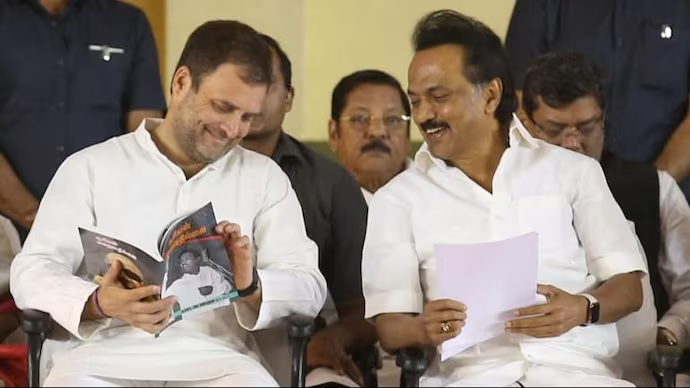
In his speech, MK Stalin also spoke warmly about his personal rapport with Congress leader Rahul Gandhi, describing their friendship as a symbol of genuine political camaraderie and respect between the two parties. “Rahul Gandhi, the young leader of the Congress, has always shown me personal affection. Whenever we meet or talk on the phone, he greets me as ‘my dear brother’,” said MK Stalin. He added that such warmth was rare in contemporary Indian politics, and that Rahul Gandhi’s sincerity and consistency reflected the true spirit of the alliance.
Political analysts see MK Stalin’s remarks as an attempt to reinforce the personal bond between the DMK and Congress leadership, which has been instrumental in maintaining the stability of the alliance in Tamil Nadu. The chief minister’s reference to Rahul Gandhi’s affectionate tone was not merely anecdotal—it was a subtle reminder that personal trust between leaders often translates into political stability and smoother coordination within alliances.
The DMK-Congress alliance has been a defining feature of Tamil Nadu politics since the 2004 Lok Sabha elections, where their partnership played a decisive role in securing electoral success against the AIADMK-led front. Over the years, despite occasional frictions over seat-sharing and local leadership differences, the two parties have maintained their partnership, bound by common opposition to the BJP’s policies and their shared ideological foundation of secularism and social justice.
MK Stalin’s latest affirmation of the alliance comes at a time when the INDIA bloc is facing internal challenges across several states, with seat-sharing talks proving to be contentious in places like Maharashtra and West Bengal. Against this backdrop, the DMK’s consistent backing of the Congress in Tamil Nadu offers a model of cooperation that the broader alliance seeks to emulate nationally. The DMK has not only reaffirmed its political alignment with Congress but also extended its support to Rahul Gandhi’s national political initiatives, including his Bharat Jodo Yatra and Bharat Jodo Nyay Yatra, both of which received enthusiastic participation from DMK cadres in Tamil Nadu.
Political commentators also interpret MK Stalin’s remarks as a preemptive move to strengthen the INDIA bloc’s narrative of unity before the upcoming Lok Sabha and state elections. His speech highlights how the DMK views the alliance as essential to countering the BJP’s rise, especially as national politics continues to polarize around issues of identity and ideology.
While internal speculation about seat-sharing persists in some quarters, both the DMK and Congress have repeatedly emphasized that such matters will be resolved through mutual consultation and respect. MK Stalin’s assertion that the two parties now “walk together with a shared vision” reinforces the notion that their alliance transcends electoral arithmetic and is rooted in a broader political philosophy.
The event where MK Stalin made his comments—a wedding of a local Congress leader—was itself symbolic, representing the bond between grassroots workers of both parties. His decision to use the occasion to reaffirm the alliance’s strength was seen as both politically astute and emotionally resonant, sending a message that unity must extend beyond party leadership to the rank and file.
In Tamil Nadu’s political context, where personality-driven politics often define alliances, MK Stalin’s warmth toward Rahul Gandhi reflects his effort to position the DMK-Congress relationship as one built on genuine partnership rather than mere electoral compulsion. As the chief minister continues to champion federalism and regional empowerment, his alliance with Congress also helps him maintain a strong voice in national politics within the INDIA bloc.
With elections approaching, the DMK’s renewed emphasis on unity, ideological consistency, and partnership with Congress is expected to shape the contours of Tamil Nadu’s political landscape in the coming months. For now, MK Stalin’s reaffirmation stands as a clear message to both allies and adversaries that the DMK remains steadfast in its alliance with the Congress—rooted in trust, shared ideals, and the common goal of strengthening India’s democratic fabric.