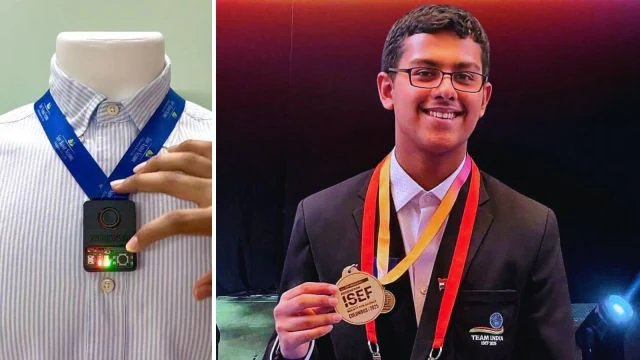
A school trip to a paralysis care centre changed the life of 11th-grade student Pranet Khetan and is now changing the lives of paralysis patients across India. Seeing patients struggle to communicate basic needs due to slurred speech deeply moved Khetan, inspiring him to develop ‘Paraspeak’ — a low-cost, AI-powered device that translates slurred speech into clear, understandable words, making conversations possible again for those who often feel silenced by their condition.
Khetan, a student at Shiv Nadar School, Gurgaon, created India’s first Automatic Speech Recognition (ASR) system specifically designed for Hindi dysarthric speech. Dysarthria, which affects patients with conditions like paralysis, Parkinson’s, COPD, and ALS, does not impair a person’s understanding or intent but limits their ability to articulate words due to weakened speech muscles. The need for a Hindi solution became clear to Khetan, as over 40% of India speaks Hindi, yet no dataset or working model existed for recognising dysarthric Hindi speech.
Building Paraspeak from Scratch
To build Paraspeak, Khetan first needed data, which did not exist in any form for Hindi dysarthria. He visited NGOs and care centres, collecting the first dataset of 42 minutes of recordings from 28 patients. Using advanced data augmentation, he expanded this to 20 hours of synthetic data to train the AI model. The emotional aspect of his project struck him as many patients, despite the difficulties, insisted on recording to help develop the device, hoping it would help others like them.
Paraspeak operates using a modified transformer architecture, similar to the technology powering ChatGPT, but adapted for speech recognition. The device, small enough to wear around the neck like a webcam, works by pressing a button, speaking into the microphone, and letting the AI process and play back clear speech. It requires only an internet connection and has a battery life of over 10 hours, allowing it to be used throughout the day without interruption.
Affordable, Scalable, and Life-Changing
Unlike many research solutions that are designed for a single patient, Paraspeak is scalable, working across multiple speakers with the same underlying system, addressing a crucial limitation in assistive speech technology. The device is also highly cost-effective, with a manufacturing cost of around Rs 2,000 and a monthly internet subscription cost of approximately Rs 200, making it accessible to many families across India.
Khetan’s efforts have led to the filing of a patent for Paraspeak, and the device has already been tested successfully with patients having conditions like congenital disorders, Parkinson’s, paralysis, and COPD, who expressed satisfaction with how the device restored their ability to communicate clearly. His innovation has earned recognition at the Regeneron International Science and Engineering Fair (ISEF) 2025 in Ohio, USA, and at India’s IRIS National Fair.
With dysarthria affecting over 75% of Parkinson’s patients and many late-stage ALS patients, Paraspeak offers new hope for these individuals to reconnect with their families and caregivers. Khetan remains driven by his passion for assistive technology, aiming to develop solutions that create immediate and tangible human impact by using technology to improve lives, one voice at a time.