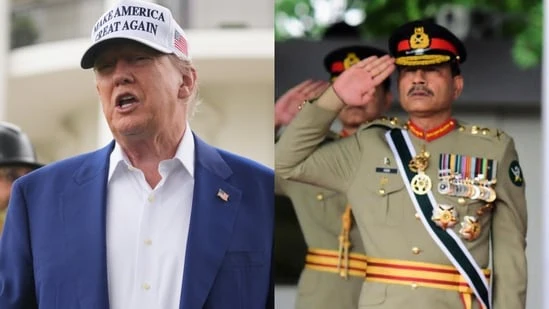
In a surprising diplomatic development, the government of Pakistan has formally nominated U.S. President Donald Trump for the 2026 Nobel Peace Prize. Citing his behind-the-scenes diplomacy during the May 2025 India-Pakistan crisis, Islamabad credited Donald Trump with averting what could have spiraled into a full-scale war between two nuclear-armed neighbours. The nomination reflects Pakistan’s attempt to frame the de-escalation as a global peace effort led by Washington, even as India firmly denies any third-party intervention in the resolution of the conflict.
Donald Trump’s nomination and backdoor diplomacy
On June 20, 2025, Pakistan’s foreign office issued a formal statement nominating Donald Trump, praising his “decisive diplomatic engagement” during a volatile phase of subcontinental hostility. According to the statement, the conflict began with what Pakistan claimed was “unprovoked and unlawful aggression” by India, resulting in civilian casualties on Pakistani soil. In response, Islamabad launched “Operation Bunyan-un-Marsoos” — a limited military operation allegedly aimed at restoring deterrence without escalating the situation further.
As per Pakistan’s account, it was Donald Trump’s private outreach and “strategic foresight” that led to a ceasefire on May 10, effectively halting further escalation. Islamabad praised Donald Trump’s role as “a genuine peacemaker,” describing the ceasefire agreement as a turning point for regional stability. Pakistan’s nomination was further bolstered by a high-profile visit of Army Chief General Asim Munir to Washington, where he met Donald Trump at the White House on June 18.
During their meeting, Donald Trump reportedly said, “They were going at it; they are both nuclear countries. I got it stopped.” The statement was confirmed by White House spokesperson Anna Kelly, who added that the President had personally intervened after hearing Asim Munir’s concerns and subsequently pushed for a diplomatic pause.
India’s sharp rejection of mediation claims
India, however, has categorically dismissed these claims. Prime Minister Narendra Modi, in a phone call with President Donald Trump on June 17, clarified that the ceasefire had been achieved independently through established military communication channels between New Delhi and Islamabad. According to India, there was no foreign mediation involved.
India’s Foreign Secretary Vikram Misri reinforced this stance, asserting that India has never accepted third-party mediation in its bilateral affairs with Pakistan and would not change this policy going forward. Misri stated that the decision to halt hostilities was made after India’s armed forces had achieved strategic objectives through “Operation Sindoor,” which targeted terror camps in Pakistan and Pakistan-occupied Kashmir in retaliation for the April 22 Pahalgam terror attack in Jammu and Kashmir.
India maintains that its response was a necessary and proportionate act of self-defence, undertaken without international intervention. Officials have also pushed back against attempts to politicize the ceasefire, suggesting that Pakistan’s narrative is more about international optics than ground reality.
The Pahalgam terror attack, which triggered the crisis, killed several civilians and security personnel. In response, India launched precision strikes as part of a wider counter-terrorism campaign. Pakistan’s actions, including the Nobel nomination, are seen by Indian officials as a way to shift focus away from cross-border terrorism and to recast the narrative in global forums.
While Donald Trump’s nomination has drawn global attention, it also adds a layer of diplomatic friction between the two South Asian nations. Whether the Nobel Committee entertains the nomination remains to be seen, but for now, both countries remain locked in a battle of narratives over who brought calm after the storm.