After years of conflict and devastation, Syrians deserve stability and peace, but these cannot come at the cost of their sovereignty. Reports of Syria’s interim government engaging in talks with Israel on a possible security deal concerning the occupied Golan Heights and expanded Israeli buffer zones have raised serious concerns. Such discussions risk undermining international law and could further marginalise Syrians who have suffered decades of displacement, loss, and occupation.
The Golan Heights, captured by Israel during the 1967 war, remains occupied Syrian territory under international law. United Nations Security Council Resolutions 242, 338, and 497 have consistently reaffirmed that Israel’s annexation of the region is illegal, null, and void. Despite this, Israel’s continued control and settlement expansion have entrenched the occupation, fragmenting Syria’s territorial integrity while displacing thousands of its people.
The Human Cost of Occupation
Beyond its legal status, the Golan Heights represents a painful chapter in Syria’s history. The seizure of the region in 1967 forced approximately 130,000 Syrians from their homes. Decades later, these families and their descendants remain displaced, deprived of their right to return and stripped of their properties. Meanwhile, the Druze community of over 20,000 people who stayed in the occupied Golan Heights faces systematic discrimination, land confiscations, and family separations caused by restrictive Israeli policies. These families are often unable to attend funerals, weddings, or even maintain simple contact with relatives across the armistice line, violating their fundamental right to family life.
Any agreement on the Golan Heights that does not address these humanitarian realities risks being incomplete and unjust. The humanitarian crisis faced by displaced Syrians and the Druze community must remain central to any discussions regarding the region’s future, ensuring that peace does not come at the cost of dignity and rights.
Sovereignty Is Not a Bargaining Chip
The interim Syrian government, lacking democratic legitimacy and constitutional authority, is not in a position to make decisions that would alter the country’s sovereign borders. International law and Syria’s constitutional framework make it clear that decisions affecting territorial integrity can only be made by a representative government chosen by the people.
Any deal struck by unelected transitional authorities to formalise the loss or compromise of Syrian land would be legally void and politically destabilising. The Golan Heights cannot be used as a token in transactional politics for temporary authorities seeking to consolidate their power or gain international legitimacy. Doing so would undermine not only Syria’s sovereignty but also the principles of international law that prohibit the acquisition of territory by force.
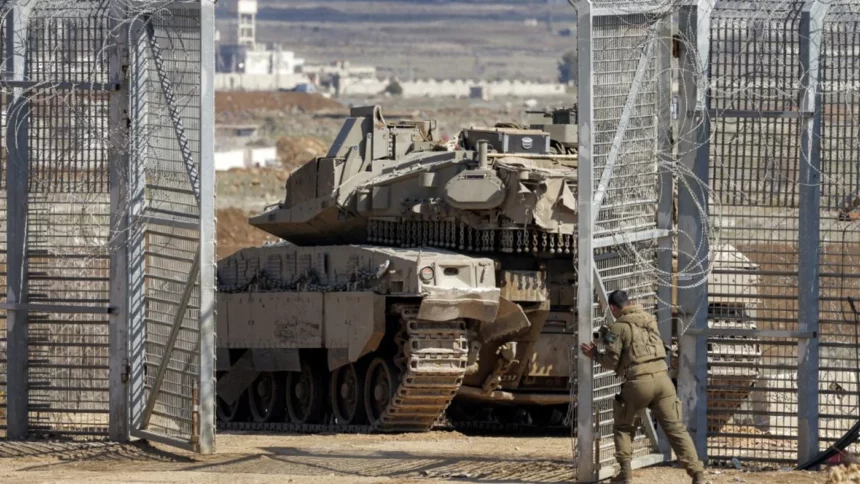
Israel’s expansion of its buffer zones under the guise of maintaining stability has only deepened the occupation, undermining Syria’s sovereignty and entrenching a cycle of fragmentation. Framing such expansion as a security measure ignores the lived experiences of Syrians who have endured decades of displacement, family separation, and occupation.
While Syria is in urgent need of stability, reconstruction, and reconciliation, these goals should not come at the expense of the nation’s territorial integrity. Syrians deserve a future built on justice, dignity, and peace, not on deals that offer up their land in exchange for short-term political gains.
The international community has a role to play in ensuring that any negotiations regarding the Golan Heights are conducted within the framework of international law, respecting Syria’s right to sovereignty and the rights of displaced persons. Binding UN resolutions and the principles enshrined in international conventions must guide any genuine efforts towards stability in Syria, ensuring that the acquisition of territory by force is not normalised and that the rights of displaced Syrians are prioritised.
The Golan Heights remains a symbol of Syria’s right to self-determination and dignity. Its future must be decided by a legitimate, democratically elected government that represents the will of the Syrian people. Any attempts to determine its fate through backdoor deals by interim authorities lacking constitutional authority risk perpetuating injustice and prolonging instability.
As discussions continue, Syrians and the international community must remain vigilant, ensuring that sovereignty is not traded for temporary stability and that the rights and dignity of those who have suffered for decades are upheld. The path to a peaceful and stable Syria lies not in transactional politics but in honouring the nation’s territorial integrity and the rights of its people.