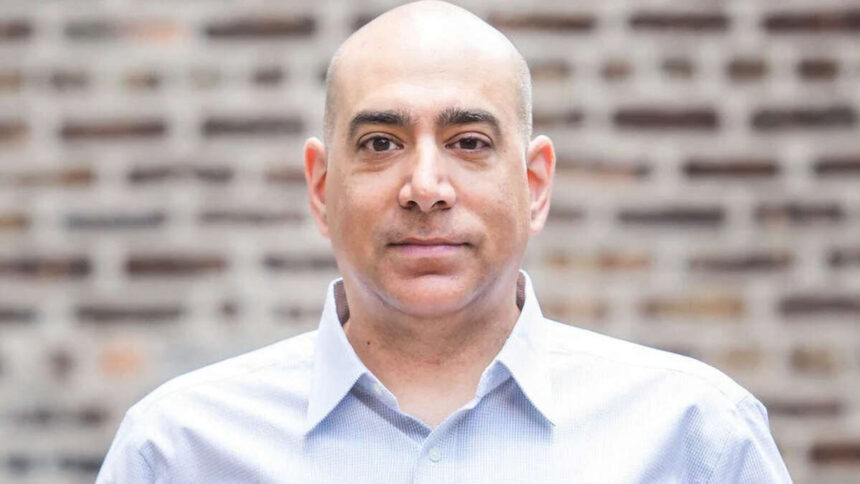
Palestinian American journalist Ali Abunimah has confirmed his release and deportation by Swiss authorities after being detained for three days. Ali Abunimah, the executive director of the Electronic Intifada, a prominent publication advocating for Palestinian rights, claimed that his detention was linked to his outspoken advocacy for Palestine and his criticism of Israel’s policies.
In a social media post on Monday, Ali Abunimah shared his perspective on the incident, describing it as a direct consequence of his activism. He wrote, “My ‘crime’? Being a journalist who speaks up for Palestine and against Israel’s genocide and settler-colonial savagery and those who aid and abet it.” He was arrested on Saturday in Zurich, where he was about to deliver a speech on Palestinian rights, an event that sparked widespread condemnation from Palestinian advocacy groups and supporters of free speech.
Ali Abunimah’s detention has raised significant concern, with many questioning the motives behind his arrest. According to reports, the Swiss police cited an entry ban and other immigration law violations as the reasons for his arrest. However, Ali Abunimah said that when questioned by the authorities, he was not informed of any specific charges. He recalled being confined in a cell for 24 hours a day, without any communication with the outside world, including his family. It wasn’t until he was taken to the airport for his deportation to Istanbul that he was allowed to retrieve his phone.
The arrest and subsequent deportation of Ali Abunimah occurred at a time when Switzerland had just welcomed Israeli President Isaac Herzog to the World Economic Forum in Davos. Herzog’s controversial remarks on the war in Gaza, which has claimed the lives of over 47,000 Palestinians, added fuel to the criticism of Swiss authorities’ handling of Ali Abunimah’s case. Herzog had previously stated that there are no “uninvolved civilians” in Gaza, a statement that has sparked outrage globally.
Reflecting on his ordeal, Ali Abunimah drew a comparison between his brief time in detention and the prolonged suffering of Palestinians incarcerated by Israeli authorities. He expressed his admiration for the Palestinian prisoners who endure months or even years of imprisonment under harsh conditions, often without due process or fair trials. “This ordeal lasted three days, but that taste of prison was more than enough to leave me in even greater awe of the Palestinian heroes who endure months and years in the prisons of the genocidal oppressor,” he said. He also emphasized that the debt owed to these prisoners could never be repaid and that their freedom must remain a central focus of the Palestinian struggle.
The United Nations quickly condemned Ali Abunimah’s detention as an assault on free speech and press freedom. Irene Khan, the UN special rapporteur for freedom of opinion and expression, called the arrest “shocking news” and urged for his immediate release. Similarly, Francesca Albanese, the UN special rapporteur on human rights in the occupied Palestinian territories, called for a thorough investigation into the circumstances of the arrest. She also raised concerns over the growing repression of free speech in Europe, particularly in relation to pro-Palestinian voices. Albanese expressed her worries in a social media post, warning that “the climate surrounding freedom of speech in Europe is becoming increasingly toxic, and we should all be concerned.”
Ali Abunimah’s arrest is part of a broader trend of increasing clampdowns on pro-Palestinian voices in Europe, especially in the wake of the ongoing war in Gaza. UN experts have compared Israel’s actions in Gaza to genocide, highlighting the severe humanitarian crisis unfolding in the region. This pattern of repression has been evident in other European countries as well. In April, German authorities shut down a conference for Palestinian rights advocates and denied entry to Dr. Ghassan Abu Sittah, a British doctor who had worked in Gaza. Activists have also accused Germany of cracking down on protests in solidarity with Gaza during the war.
In addition, British authorities have been accused of using counter-terrorism laws to target journalists critical of Israeli policies. In October 2024, British counterterrorism police raided the home of Asa Winstanley, an Electronic Intifada colleague of Ali Abunimah. The Committee to Protect Journalists (CPJ) denounced the raid as part of a disturbing pattern of using counter-terrorism laws to target reporters. Similarly, British authorities detained journalist Richard Medhurst for 24 hours when he arrived in London, a move that critics claimed was an attempt to silence dissenting voices.
In Gaza, the situation for journalists has become increasingly dangerous. Since the start of the war in October 2023, Israeli forces have killed at least 205 journalists, according to local authorities. This alarming figure underscores the risks faced by journalists covering the conflict and highlights the growing threat to press freedom in regions of geopolitical tension.
Ali Abunimah’s case has brought international attention to the growing crackdown on Palestinian advocacy and free speech. The condemnation from the UN and various human rights organizations underscores the importance of protecting journalists who speak out on issues of human rights and justice. As for Ali Abunimah, the ordeal has only strengthened his resolve to continue his work in highlighting the plight of the Palestinian people and holding those responsible for their suffering accountable.