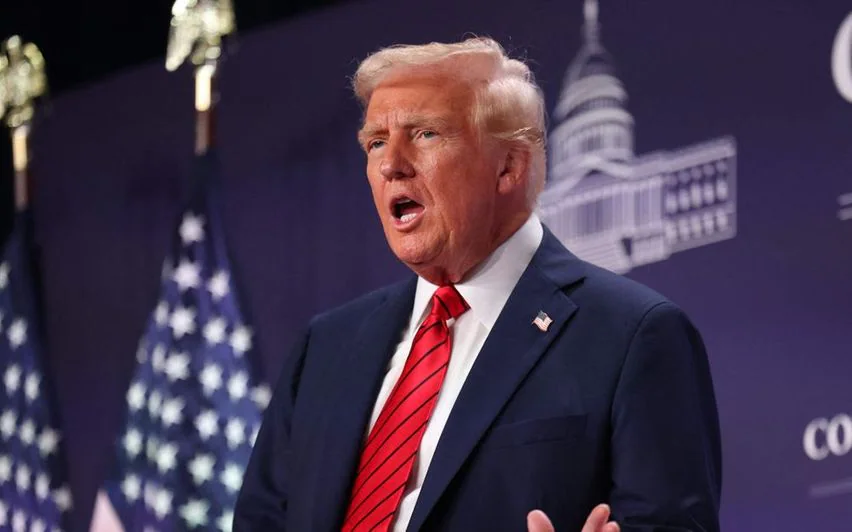
President Donald Trump unveiled a series of four new executive orders on Monday, marking a bold push to enhance U.S. defense capabilities and address key social and military issues. Speaking at a retreat for Republican lawmakers at his Donald Trump National Doral Miami resort in South Florida, Donald Trump announced plans to sign these orders, signaling a major shift in the nation’s military and social policies.
One of the primary orders Donald Trump revealed was a directive to begin the construction of a state-of-the-art “Iron Dome” missile defense shield, aimed at bolstering U.S. national security. The Iron Dome system, which Donald Trump described as essential for the protection of Americans, is intended to intercept and destroy incoming missiles, much like the system used in Israel. During his campaign trail, Donald Trump repeatedly emphasized his desire to develop a U.S.-based version of this air defense system, which he described as the “best Iron Dome in the world.” While military experts have raised doubts about the feasibility and necessity of such a system for the U.S., given the country’s already existing missile defense programs like Ground-Based Midcourse Defense (GMD) and Terminal High Altitude Area Defense (THAAD), Donald Trump’s vision remains a central point of his defense policy.
In addition to the Iron Dome initiative, Donald Trump’s executive actions also target several controversial social issues. Two of the orders focus on removing Diversity, Equity, and Inclusion (DEI) initiatives from government programs, a policy he has criticized as promoting “illegal and immoral discrimination.” The third order aims to eliminate transgender ideology from the U.S. military, a move that is reminiscent of Donald Trump’s “transgender military ban” implemented during his first term in office. This order continues his efforts to limit the scope of inclusion for transgender individuals in the armed forces.
A fourth order seeks to reinstate military service members who were discharged for refusing to comply with COVID-19 vaccination mandates. Between August 2021 and January 2023, around 8,000 service members were discharged for not adhering to the vaccine requirement. This order is seen as part of Donald Trump’s broader efforts to reshape the military in alignment with his vision of a stronger, more unified fighting force.
Donald Trump positioned these executive actions as crucial for ensuring that the U.S. maintains the “most lethal fighting force in the world.” His comments reflect his broader military strategy, which includes reinstating certain policies and enhancing the country’s defense capabilities. The announcement of these orders follows a broader trend of aggressive executive actions that Donald Trump has taken since returning to the White House on January 20, many of which seek to undo policies implemented by previous administrations, particularly under President Joe Biden.
These executive orders also align with the priorities of Donald Trump’s newly appointed Secretary of Defense, Pete Hegseth, who has pledged to overhaul military leadership and restore what he terms a “warrior culture” within the armed forces. Hegseth, who was confirmed on Friday despite opposition from some Republicans, has been vocal about his concerns over what he sees as a growing “woke” ideology within the military, which he believes has undermined combat readiness.
Donald Trump’s announcement comes at a time when the U.S. military faces multiple challenges, including personnel shortages and budgetary constraints. Critics have questioned whether some of the proposed policies, particularly the Iron Dome initiative, are practical or financially feasible, given the enormous costs involved and the potential challenges posed by adversaries like Russia and China. The Iron Dome system currently used in Israel is designed to intercept low-power rockets and mortars, a capability that is effective for the relatively small geographical area of Israel. Translating this system to the much larger U.S. mainland would require massive investment and infrastructure.
Despite these concerns, Donald Trump’s focus on defense and military readiness remains a cornerstone of his administration’s agenda. His actions on Monday reinforce his commitment to a strong national defense, one that he believes should prioritize the protection of the American people over the defense of other countries. In his address, Donald Trump highlighted the success of Israel’s Iron Dome system, which has effectively intercepted rockets in conflict zones, and argued that the U.S. is equally entitled to such advanced technology for its own protection.
As Donald Trump moves forward with these executive orders, the implications for U.S. military and social policies are expected to unfold in the coming months. The success of the Iron Dome project and the potential reshaping of the U.S. military will depend on both Congressional approval and the willingness of key military leaders to embrace these changes. For now, the country watches as Donald Trump pushes ahead with his defense priorities, signaling a shift toward more aggressive actions on the national security front.