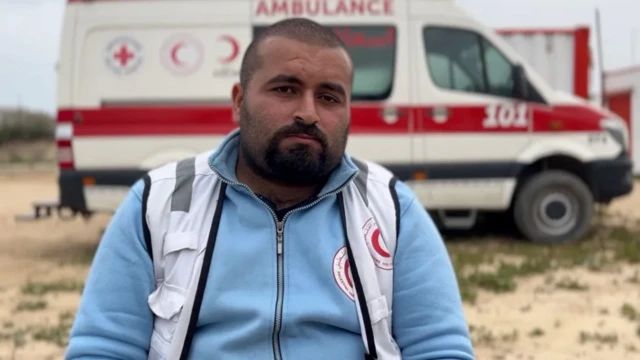
Munther Abed, the sole survivor of an Israeli attack that killed 15 emergency workers in Gaza, has challenged Israel’s version of events. Munther Abed, a paramedic, recounted how he survived by diving to the floor in the back of his ambulance while his two colleagues in the front were shot. The attack occurred in the early hours of March 23, when emergency teams from the Palestinian Red Crescent, Gaza’s Civil Defence agency, and the UN agency for Palestinian refugees (UNRWA) responded to reports of wounded individuals in Rafah.
Munther Abed detailed the timeline, explaining that by 4:30 AM, all Civil Defence vehicles were in place. By 4:40 AM, two vehicles had moved out, followed by the final one at 4:50 AM. Around 5:00 AM, an UNRWA vehicle was directly targeted by gunfire. The Israeli military defended its actions, stating that the vehicles were moving suspiciously toward soldiers without prior coordination and with their lights off. Israel also claimed that nine Hamas and Palestinian Islamic Jihad operatives were among those killed in the incident.
However, Munther Abed refuted these claims, insisting that the emergency vehicles had all their lights on, clearly identifying them as ambulances. He asserted that Israeli forces deliberately fired at them. After the attack, he was pulled from the wreckage, arrested, blindfolded, and interrogated for 15 hours before being released. The BBC has requested a response from the Israel Defense Forces (IDF), but they have yet to comment.
Israeli Foreign Minister Gideon Saar reiterated the military’s stance, asserting that the IDF did not randomly target an ambulance. He maintained that uncoordinated vehicles approached Israeli forces without headlights or emergency signals, prompting the attack. Saar further claimed that one of the deceased, Mohammed Amin Ibrahim Shubaki, was a Hamas militant involved in the October 7 attacks. However, Shubaki’s name does not appear on the list of the 15 emergency workers killed. Israel has also not provided evidence of his body’s whereabouts or any proof that the emergency workers posed a direct threat.
Munther Abed dismissed allegations that Hamas had used ambulances for military purposes, emphasizing that all emergency crews were civilians solely focused on providing medical assistance. The attack has sparked widespread grief, with paramedics carrying their fallen colleagues to their funerals amid growing calls for accountability. The remains of the victims were retrieved a week later, found buried in sand near the destroyed ambulances and other emergency vehicles.
Sam Rose, acting director of UNRWA’s Gaza office, condemned the incident, describing the hasty burials in shallow graves as a grave violation of international humanitarian law. He stressed the urgent need for a full investigation to determine the facts and ensure accountability. However, Israel has yet to commit to such an inquiry. According to UN estimates, over 1,060 healthcare workers have been killed since the conflict began, raising concerns over the safety of medical personnel in Gaza.
Munther Abed, still shaken, reflected on his lost colleagues. “They were not just co-workers; they were my friends, my second family. We shared everything – meals, laughter, and hardships. Now, I am the only one left to tell the world what happened. If not me, who would share their story?”