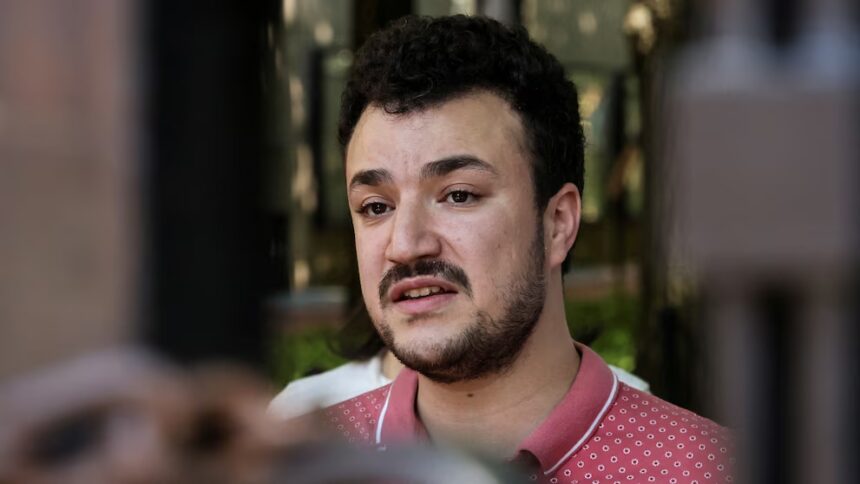
A U.S. federal judge has ruled that the court case of Palestinian activist Mahmoud Khalil will remain in New Jersey, rejecting a government motion to transfer it to Louisiana. The ruling marks a significant moment in Mahmoud Khalil’s legal fight against his detention, which his supporters claim is a politically motivated attempt to suppress pro-Palestinian activism in the United States. Mahmoud Khalil, a Columbia University graduate student and lawful permanent resident, was arrested by the Department of Homeland Security (DHS) in early March as part of a broader crackdown on pro-Palestinian student organizers. His legal team argues that his detention and transfer to Louisiana were an unlawful maneuver to complicate his defense, a move that has now been blocked by the court.
U.S. District Judge Michael Farbiarz stated in his 67-page decision that New Jersey retains jurisdiction over the case because Mahmoud Khalil was in the state when his attorneys filed a habeas corpus motion challenging his detention. Although the motion was initially filed in New York, the judge determined that it must be treated as having been filed in New Jersey, effectively keeping the case there. Mahmoud Khalil’s legal representatives have maintained that transferring the case to Louisiana would have been a strategic attempt by the government to obstruct justice by placing legal proceedings in a less favorable jurisdiction.
The ruling has provided a sense of relief to Mahmoud Khalil’s family, particularly his wife, Noor Abdalla, who is nine months pregnant with their first child. Expressing her emotions over the decision, Abdalla stated that while the ruling is a step in the right direction, the fight for her husband’s freedom is far from over. The next legal step for Mahmoud Khalil’s defense team is to seek a preliminary injunction that would allow his immediate release from detention. If granted, the injunction could also prevent future detentions under a controversial provision of the 1952 Immigration and Nationality Act, which the Trump administration has invoked to detain non-citizens involved in pro-Palestinian activism.
The government has already attempted twice to move Mahmoud Khalil’s case to Louisiana, with a prior ruling on March 19 also favoring New Jersey jurisdiction. Civil rights advocates argue that these legal battles highlight a growing trend of government actions targeting pro-Palestinian activists under the guise of national security. Donna Lieberman, executive director of the New York Civil Liberties Union, criticized Immigration and Customs Enforcement (ICE) for the emotional and legal hardship imposed on Mahmoud Khalil and his pregnant wife. The American Civil Liberties Union (ACLU) has also weighed in, with senior staff attorney Brett Max Kaufman emphasizing that the court’s decision sets an important precedent against government forum-shopping in immigration cases.
Mahmoud Khalil’s arrest stems from his role as a negotiator for pro-Palestinian student protesters during last year’s Gaza solidarity encampment at Columbia University. His detainment aligns with a broader effort by federal agencies to suppress student activism on Palestine, with similar cases emerging across the country. When DHS agents arrested him on March 8 outside his Columbia University apartment, they claimed to have revoked his student visa. However, when his wife pointed out that Mahmoud Khalil is a U.S. green card holder, agents allegedly revoked that as well. He was then transported to a Louisiana immigration detention center without prior notice to his legal team or his family.
Mahmoud Khalil’s habeas petition argues that his arrest and detention violate both the First and Fifth Amendments, positioning his case as a significant legal challenge against the Trump administration’s efforts to criminalize pro-Palestinian activism. His detention is part of a broader crackdown, with student activists at various universities facing suspensions, detentions, and deportation threats for their support of Palestinian rights. Another high-profile case involves Tufts University student Rumeysa Ozturk, a Turkish national who was detained in Massachusetts before being moved to a remote ICE facility in Louisiana. A federal judge has since intervened, temporarily blocking her removal from the U.S. while her case proceeds.
Mahmoud Khalil’s supporters continue to push for his immediate release, emphasizing the urgency of reuniting him with his family ahead of the birth of his child. His case, along with others, has raised alarms among civil rights groups about the use of immigration enforcement as a tool to suppress political dissent. The court’s ruling to keep his case in New Jersey represents a critical legal victory, but the fight for his freedom remains ongoing.