A festive atmosphere at the Surajkund International Crafts Mela in Faridabad turned into chaos and tragedy on Saturday when a large amusement ride collapsed during operation, resulting in the death of a police inspector and injuries to several visitors. The incident occurred in the presence of hundreds of fairgoers and was captured on a mobile phone, sending shockwaves across the region and triggering urgent questions about safety protocols at public events.
The Surajkund Mela, one of the most prominent cultural fairs in northern India, attracts thousands of visitors daily. The accident unfolded in the evening hours when a ride popularly known as the “Tsunami swing” malfunctioned while descending, causing panic among those seated and onlookers nearby. Eighteen people were reportedly on the ride at the time of the incident.
Initial accounts indicate that the swing experienced technical trouble while ascending, after which some riders were evacuated. However, soon after operations resumed, the ride began moving at an unusually high speed before collapsing abruptly. The sudden mechanical failure led to riders being thrown violently, resulting in serious injuries.
Among those injured was a police inspector deployed at the fair for security and crowd management. He sustained critical injuries while participating in rescue operations and later succumbed, marking the incident as not just a mechanical failure but also a fatal lapse during an emergency response. Several injured individuals were rushed to a private hospital via ambulance.
Following the incident, district authorities moved swiftly to evacuate the fairground. The district administration reached the site to assess the situation, and all rides were shut down as a precautionary measure. The tragedy has since ignited a debate over administrative oversight, ride certification, and enforcement of safety standards at large public gatherings.
Sequence of Events, Mechanical Failure, and On-Ground Rescue Efforts
According to preliminary information, the Tsunami swing had reached an elevated position when it suddenly got stuck mid-air. Riders began screaming as the ride halted unexpectedly, prompting immediate concern among operators and nearby staff. In response, efforts were made to manually bring down some passengers, and several individuals were safely evacuated during this phase.
Witnesses reported that after this partial evacuation, the ride was restarted. Shortly thereafter, it began moving at a speed that appeared uncontrolled. Within moments, the structure failed catastrophically, collapsing from the top downwards and slamming into the ground with riders still seated.
Video footage that later emerged showed the swing plunging downward, followed by scenes of confusion as people ran in different directions. The footage, widely circulated, became a visual representation of the suddenness and severity of the incident.
Eyewitnesses described a scene of panic and confusion. Shopkeepers, visitors, and fair staff rushed towards the collapsed structure to help those trapped. Several individuals attempted to lift debris and pull out injured riders before emergency services arrived.
One shopkeeper at the fair recounted how he climbed onto the malfunctioning swing during the initial breakdown to help evacuate passengers. He managed to assist several individuals to safety before the final collapse occurred. During the collapse, parts of the railing reportedly struck him, causing minor injuries.
Police personnel stationed at the fair quickly joined rescue efforts. Amid the chaos, a police inspector assisting in the operation was struck by falling parts of the ride. Despite immediate medical attention, his injuries proved fatal, casting a pall over the entire rescue operation.
Ambulances were called to the scene, and injured individuals were transported to a nearby private hospital. Medical teams confirmed that several victims sustained fractures and head injuries, while others were treated for shock and minor wounds. The death of the inspector was later confirmed, prompting senior officials to arrive at the site.
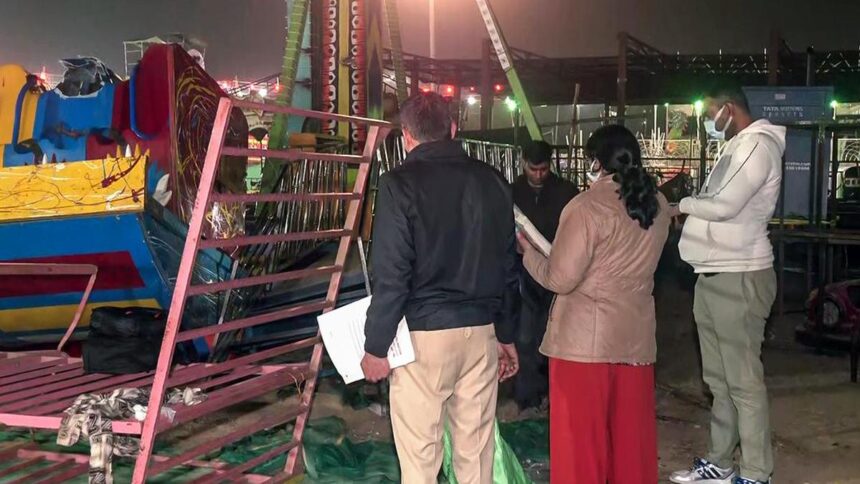
The fairground was subsequently evacuated to prevent further harm and to allow investigators unrestricted access to the accident site. Visitors were asked to leave calmly, and security personnel cordoned off the area surrounding the collapsed ride.
Administrative Response, Safety Oversight, and Accountability Concerns
In the immediate aftermath of the accident, senior district officials reached the Surajkund Mela premises to oversee the response. The district administration ordered the suspension of all amusement rides pending a comprehensive safety review. Officials assured that a detailed investigation would be conducted to determine the cause of the collapse.
The incident has raised critical questions about the regulatory framework governing temporary amusement rides at large fairs. Such rides are typically assembled on-site and are required to undergo safety inspections before being made operational. The failure of the Tsunami swing has brought into focus whether these inspections were conducted adequately and whether operational protocols were followed.
Public safety experts have long warned about the risks associated with large mechanical rides at temporary venues, particularly when crowds are high and oversight is fragmented across multiple agencies. The Surajkund Mela, while culturally significant, operates under a complex administrative structure involving local authorities, fair organisers, contractors, and law enforcement.
The death of a police inspector has added a serious dimension to the incident, highlighting the risks faced by frontline personnel during emergency situations. Questions have been raised about whether adequate training and protective measures were in place for responders dealing with mechanical failures and crowd control simultaneously.
There is also scrutiny over the decision to restart the ride after it initially got stuck. Investigators are expected to examine whether proper technical clearance was obtained before resuming operations and whether the ride operator followed established safety norms.
The administration has indicated that responsibility will be fixed once the inquiry is complete. This includes examining the role of ride operators, maintenance contractors, fair organisers, and supervisory officials. Any negligence, officials have stated, will invite strict action.
The tragedy has cast a shadow over the ongoing Surajkund Mela, prompting discussions on whether such events require stricter national-level guidelines for amusement ride safety. Families of the injured and the deceased are seeking answers, while visitors and residents alike are questioning how a cultural celebration turned into a scene of fatal disaster.