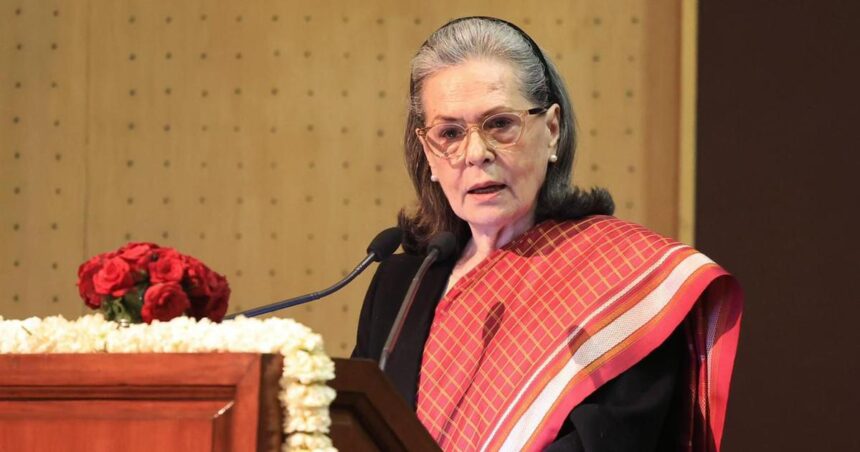
Congress leader Sonia Gandhi has strongly opposed a plea seeking the registration of a criminal case against her over allegations related to the inclusion of her name in the electoral roll prior to her acquisition of Indian citizenship. In a detailed response filed before a Delhi court, Gandhi described the complaint as frivolous, speculative, politically motivated, and a clear abuse of the judicial process.
The case, which has resurfaced decades after the events it references, revolves around claims that Gandhi’s name appeared on the electoral roll of the New Delhi constituency in 1980, despite her becoming an Indian citizen only in April 1983. The plea seeking an FIR has revived long-settled political controversies from the early 1980s, bringing them back into judicial scrutiny more than forty years later.
Gandhi’s response comes in the context of a revision petition filed by the complainant after an earlier dismissal by a magistrate. The sessions court has now taken cognisance of the revision plea and listed the matter for arguments, setting the stage for a legal examination not only of the factual allegations but also of the broader constitutional and jurisdictional questions raised by the complaint.
In her reply, Gandhi has questioned the very maintainability of the plea, arguing that it relies on conjecture, media speculation, and imaginary documentation rather than verifiable evidence. She has further asserted that the attempt to criminalise matters relating to citizenship and electoral rolls through a private complaint amounts to a misuse of criminal law for political ends.
The legal stance adopted by the former Congress president reflects a broader concern over the increasing tendency to revive historical political issues through criminal litigation, particularly when such cases intersect with electoral processes and constitutional authorities.
Legal Challenge to Allegations and Questioning of Evidentiary Basis
At the core of Sonia Gandhi’s defence is a direct challenge to the evidentiary foundation of the allegations made against her. In her submission to the court, she has argued that the complainant has failed to produce a single primary document to substantiate the serious claims being advanced.
The plea alleges that Gandhi’s name was included in the electoral roll in 1980, removed in 1982, and reinserted in 1983. However, Gandhi’s reply points out that no copies of alleged voter registration applications, citizenship records, or electoral roll documents have been placed on record. She has described the complaint as being based entirely on “speculative assumptions, media reports and imaginary applications.”
Gandhi has contended that criminal law cannot be invoked on the basis of conjecture or political narratives. She has characterised the allegations as reckless, arguing that the complainant has relied on his own imagination, opinions, and unwarranted presumptions rather than legally admissible evidence.
A particularly pointed aspect of her response concerns the complainant’s claim that there was a public outcry in 1982 that led to the deletion of her name from the electoral roll. Gandhi has questioned how, after more than four decades, the complainant claims direct knowledge of such events without producing any contemporaneous records or evidence.
According to Gandhi, raising allegations related to events from 1980 to 1983 at this stage creates an insurmountable evidentiary challenge. She has argued that the passage of time makes it impossible to reliably verify or refute claims, thereby rendering the proceedings inherently unjust and oppressive.
This, she has submitted, amounts to malicious prosecution and violates her fundamental right to life and personal liberty under Article 21 of the Constitution. By reopening decades-old controversies without any fresh material, the complainant is, according to Gandhi, attempting to subject her to harassment under the guise of legal action.
Gandhi has also highlighted that the complaint was initially dismissed by a magistrate after due consideration. The revival of the matter through a revision petition, she argues, does not cure the fundamental defects in the complaint, particularly the absence of foundational documents.
Her response frames the plea as an attempt to transform historical political debates into criminal accusations, bypassing the safeguards built into criminal jurisprudence to prevent abuse of process.
Constitutional Limits, Separation of Powers and Electoral Jurisdiction
Beyond contesting the factual allegations, Sonia Gandhi’s reply raises significant constitutional and jurisdictional objections to the plea. She has argued that the issues raised by the complainant fall squarely outside the domain of criminal courts.
According to Gandhi, questions relating to citizenship are exclusively within the authority of the Central government, governed by statutory procedures and executive determinations. Similarly, disputes concerning the preparation, revision, and correction of electoral rolls fall solely under the jurisdiction of the Election Commission of India.
By seeking criminal prosecution over such matters, Gandhi contends, the complainant is attempting to bypass constitutionally designated authorities and undermine the doctrine of separation of powers. Allowing criminal courts to entertain private complaints on citizenship or electoral roll issues would, she argues, create a dangerous precedent.
Gandhi has invoked Article 329 of the Constitution, which bars judicial interference in electoral matters except through election petitions. She has submitted that entertaining a criminal complaint related to electoral rolls would violate this constitutional bar and disrupt the carefully balanced framework governing elections in India.
Her reply further asserts that the complaint seeks to disguise administrative and constitutional questions as offences under the Indian Penal Code or the Bharatiya Nyaya Sanhita. Such an approach, she argues, is legally impermissible and reflects a misuse of criminal law to achieve political objectives.
The response also situates the plea within a broader pattern of politically motivated litigation. By reviving issues that were debated in the public domain decades ago, the complainant, according to Gandhi, is attempting to reopen settled matters for political mileage rather than legal redress.
Gandhi has emphasised that criminal courts are not forums for adjudicating historical political controversies or speculative allegations unsupported by evidence. She has urged the court to recognise the plea as an abuse of process aimed at harassment rather than justice.
The matter now awaits arguments before the sessions court, where the court will consider not only the merits of the allegations but also the wider constitutional questions raised by Gandhi’s defence. The outcome is likely to have implications beyond the immediate case, particularly in defining the limits of criminal litigation in matters touching upon citizenship, elections, and political history.