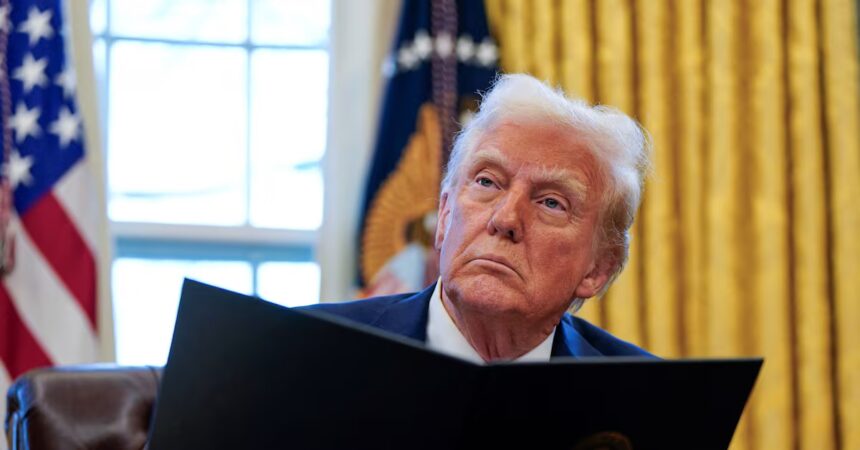
US President Donald Trump has reignited global attention on the BRICS bloc, claiming that the group’s efforts to reduce reliance on the US dollar have been thwarted by his tariff threats. Speaking during a bilateral meeting with Argentine President Javier Milei, Donald Trump asserted that BRICS, which includes India among its members, initially aimed to challenge the dominance of the US currency but quickly reconsidered after the United States imposed potential punitive measures. According to Donald Trump, nations that had contemplated replacing the dollar in international trade are now backing away from such initiatives, highlighting the enduring influence of the US dollar and America’s ability to safeguard its economic interests through assertive foreign and trade policies. This development also underscores ongoing global debates about de-dollarization, currency sovereignty, and geopolitical leverage in international economic relations, raising questions about how BRICS members balance strategic autonomy with practical trade considerations.
BRICS and the US Dollar: Donald Trump’s Perspective
Donald Trump framed BRICS as a direct challenge to the US dollar, describing the bloc as having launched an “attack” on America’s financial dominance. He claimed that following warnings of potential tariffs on all BRICS exports to the United States, member nations began reconsidering their plans to develop an alternative currency. During his remarks, Donald Trump emphasized that anyone dealing in the US dollar benefits from a substantial advantage over countries attempting to circumvent it, portraying the dollar as a cornerstone of international economic stability.
In his discussion, Donald Trump specifically referred to India’s membership in BRICS, alongside Brazil, Russia, China, South Africa, and newer entrants such as Egypt, Ethiopia, the UAE, Iran, and Indonesia. He stated that the United States’ willingness to impose punitive tariffs has led member nations to abandon any concrete moves toward replacing the dollar in international trade settlements. According to Donald Trump, the attempt by BRICS to de-dollarize international transactions faced insurmountable challenges due to the economic leverage of the United States and the central role of the dollar in global financial systems. He also credited his own 2024 election victory as pivotal in preventing any substantial threat to the dollar’s supremacy, suggesting that the geopolitical and economic calculations of the bloc had shifted as a result of his administration’s policies.
Donald Trump’s statements drew attention to BRICS’ discussions about creating a common currency for trade among member nations, a concept often referred to as “BRICS currency.” According to him, these initiatives were curtailed immediately after he threatened the bloc with 100 percent tariffs on all imports into the United States, indicating that the US would actively safeguard its currency’s global dominance. Donald Trump framed this as a clear example of US economic leverage and asserted that the member nations “dropped out” of pursuing alternatives to the dollar, demonstrating the limitations of bloc-level initiatives against established financial powers.
Historically, the BRICS coalition has explored reducing reliance on the dollar to mitigate vulnerabilities associated with exchange rate fluctuations and the dominance of US monetary policy in global trade. Brazilian President Luiz Inacio Lula da Silva first floated the idea of a BRICS currency in 2023, advocating for enhanced payment options and reduced exposure to dollar fluctuations. While these proposals were seen as politically ambitious and potentially transformative, they also invited concerns about economic feasibility and global market acceptance. Donald Trump’s response underscores the geopolitical sensitivity of currency initiatives and highlights the tension between sovereign economic experimentation and the entrenched role of the dollar in international finance.
India’s Position and Strategic Calculations
India, a founding member of BRICS, has consistently maintained a cautious stance regarding any move to challenge the dollar’s supremacy. External Affairs Minister S. Jaishankar has repeatedly emphasized that New Delhi has no intention of weakening the US dollar, recognizing Washington as India’s largest trade partner and underscoring the practical implications of currency stability for economic planning. In statements made at the Doha Forum and other international platforms, Jaishankar highlighted that while BRICS explores financial cooperation among its members, India does not endorse de-dollarization or the creation of a BRICS-specific currency at this stage.
The Indian government’s position is rooted in a strategic assessment of global economic stability and bilateral trade priorities. Jaishankar noted that India’s interests lie in strengthening the international financial system and ensuring that global economic operations remain predictable and resilient. By prioritizing cooperation with the United States and maintaining reliance on the dollar, India seeks to balance its participation in BRICS with broader economic and strategic imperatives. The minister has repeatedly stressed that any deviation from this approach could create uncertainty in trade and investment flows, underscoring India’s pragmatic approach to economic diplomacy.
India’s stance also reflects the diverse perspectives within BRICS. While the bloc includes nations with varying economic policies and priorities, it does not possess a unified approach toward de-dollarization. The disparity in positions among members such as Russia, China, Brazil, and India highlights the challenges of translating collective policy proposals into actionable financial mechanisms. For India, supporting a stable dollar-based system aligns with domestic economic stability, access to international capital, and predictability in bilateral trade relations, particularly with the United States. This position has allowed India to maintain constructive engagement with both BRICS partners and the broader international financial system.
Experts note that India’s decision to refrain from challenging the dollar serves multiple purposes. It allows India to engage in BRICS discussions without committing to radical monetary experiments, maintains investor confidence, and avoids unnecessary friction with the United States. Moreover, India’s pragmatic approach complements its broader foreign policy objectives, including promoting multipolarity while safeguarding national economic interests. As Jaishankar has highlighted, the ultimate goal is economic stability and functional cooperation rather than ideological confrontations over currency dominance.
At the same time, India’s measured stance does not preclude participation in discussions on financial integration within BRICS. Initiatives such as cross-border trade settlements, investment cooperation, and banking collaboration remain on the agenda, demonstrating that India prioritizes practical economic measures over political signaling. By engaging selectively, India can help shape bloc-level discussions while ensuring that any policy decisions are compatible with its broader economic and strategic objectives.
The global response to Donald Trump’s statements reflects the complexities of de-dollarization debates. While Donald Trump frames the issue as a geopolitical victory for the United States, analysts point out that BRICS’ ambitions are more nuanced, driven by a combination of economic pragmatism, diversification of reserves, and mitigation of exposure to external financial shocks. India’s stance embodies this pragmatic approach, emphasizing stability, bilateral cooperation, and cautious experimentation.
From the broader perspective, Donald Trump’s warnings illustrate how geopolitical power and economic influence remain intertwined with monetary policy. By threatening tariffs and signaling a willingness to penalize countries attempting to challenge the dollar, the United States reinforces its central role in global trade and finance. For BRICS members, including India, navigating these dynamics requires careful assessment of risk, strategic foresight, and alignment of national priorities with bloc-level aspirations.
The evolving discourse also highlights the tensions between economic sovereignty and global interdependence. Countries within BRICS seek to assert financial autonomy, reduce exposure to dollar fluctuations, and explore alternative settlement mechanisms, yet the entrenched role of the US dollar complicates these ambitions. Donald Trump’s public statements underscore how major powers can influence policy trajectories through trade instruments and geopolitical signaling, impacting decision-making even within ostensibly independent coalitions like BRICS.
India’s approach, as articulated by Jaishankar, remains focused on balancing international engagement with domestic priorities. While recognizing the potential benefits of financial innovation and regional cooperation, India emphasizes the need for global economic stability and adherence to widely accepted financial norms. This strategy ensures that India can participate constructively in BRICS dialogues while minimizing exposure to currency volatility or trade disruption.
Additionally, India’s stance reflects a recognition that the dollar’s dominance provides a source of global economic stability, underpinning predictable trade flows, investment confidence, and cross-border financial operations. By acknowledging the continued centrality of the dollar, India positions itself as a pragmatic and responsible participant in both BRICS and global financial systems. Analysts argue that this calculated approach strengthens India’s credibility as a reliable partner while maintaining strategic flexibility in pursuing its national economic interests.
Donald Trump’s rhetoric also sheds light on the broader interplay between domestic politics and international economic policy. By framing BRICS as a threat and highlighting his tariff threats as the reason for countries’ withdrawal, Donald Trump positions himself as a defender of American financial interests and the dollar’s global primacy. These statements reinforce the United States’ capacity to project power through economic measures and underscore the interconnectedness of international relations, monetary policy, and trade strategy.
The debate over BRICS and the US dollar is likely to continue as member nations weigh the benefits of financial diversification against the practical realities of global trade. While BRICS members explore mechanisms for enhanced intra-bloc cooperation, India’s focus on stability, predictability, and strategic alignment with the United States provides a clear framework for balancing ambition with caution. This dual approach allows India to engage meaningfully in regional and global financial dialogues without jeopardizing its core economic interests.
The discourse surrounding BRICS and the US dollar, amplified by Donald Trump’s statements, underscores the intricate relationships between geopolitical power, currency dominance, and international cooperation. India’s policy of maintaining stability and cooperation with the United States, while participating selectively in BRICS initiatives, exemplifies a pragmatic balancing act in an increasingly complex global economic landscape. The tension between aspirational financial sovereignty and practical economic engagement continues to shape decisions within the bloc, highlighting the challenges of navigating multipolarity, trade policy, and currency debates in the contemporary world.