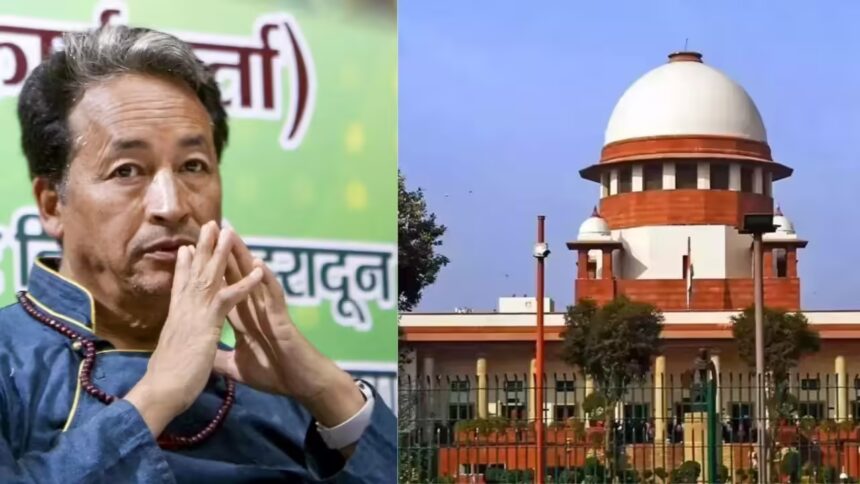
The Supreme Court has once again urged the Central government to reconsider the continued detention of climate activist Sonam Wangchuk, stressing concerns over his health while examining the legality and urgency of a habeas corpus petition.
The detention of Sonam Wangchuk has returned to the centre of judicial scrutiny as the Supreme Court reiterated its concern over the activist’s health and the prolonged nature of his custody. Wangchuk, a well-known climate advocate and education reformer from Ladakh, was detained on September 26 last year, days after violent protests erupted in the region over demands for statehood and inclusion under the Sixth Schedule of the Constitution. The apex court’s renewed intervention reflects the delicate balance between individual liberty, national security, and the constitutional duty of courts to act swiftly in habeas corpus matters.
During the latest hearing, the bench made it clear that petitions questioning personal liberty cannot be treated like routine cases. When the Centre sought an adjournment of a week, citing the unavailability of the Additional Solicitor General due to professional commitments elsewhere, the judges reminded the government that habeas corpus petitions require urgent attention. The court underscored that any delay in such matters directly affects fundamental rights guaranteed under the Constitution.
The Centre informed the court that Wangchuk is currently undergoing treatment at AIIMS Jaipur, asserting that the medical facilities there are superior to those available in Ladakh. However, this assurance did not fully allay the court’s concerns, especially in light of earlier observations that his medical reports were not satisfactory. The divergence between the government’s claim that Wangchuk’s health is stable and the defence counsel’s assertion that his condition remains poor has become a focal point in the proceedings.
The Supreme Court has now listed the matter for further hearing on Wednesday, keeping alive the question of whether Wangchuk’s detention should be reconsidered on humanitarian grounds. The case has once again ignited debate on the use of preventive detention laws, particularly in politically sensitive and strategically important regions such as Ladakh.
Health Concerns and Habeas Corpus Scrutiny by the Supreme Court
At the heart of the Supreme Court’s repeated intervention is the issue of Wangchuk’s health and the constitutional importance of a habeas corpus plea. Justice Aravind Kumar, while questioning the Centre, sought to know whether there had been any concrete progress on the possibility of releasing Wangchuk due to his medical condition. The bench emphasized that health considerations cannot be treated casually, especially when a person is under preventive detention.
The Centre maintained that Wangchuk is receiving appropriate medical care at AIIMS Jaipur and that his health is fine. Government representatives argued that shifting him from Ladakh to a premier medical institute demonstrates the administration’s concern for his well-being. According to the Centre, the decision to provide treatment outside Ladakh was taken precisely because of better healthcare infrastructure and specialist availability.
Wangchuk’s legal team, however, contested this claim before the court. His lawyer argued that despite being moved to a medical facility, his condition has not shown any significant improvement. The defence stressed that continued detention, even in a hospital setting, places physical and mental strain on the detainee, which could worsen his health rather than stabilize it. The argument sought to frame the issue not merely as one of medical treatment, but as a question of personal liberty and humane handling.
Earlier hearings had already seen the Supreme Court express dissatisfaction with the medical reports submitted by the authorities. The bench had instructed the Additional Solicitor General to seek clear instructions from the government on whether Wangchuk’s detention could be reviewed in light of his health. This direction indicated the court’s expectation that the executive should actively reconsider its stance instead of mechanically defending the detention.
The insistence on urgency is also tied to the nature of habeas corpus itself. Traditionally regarded as a powerful constitutional remedy against unlawful detention, habeas corpus petitions demand swift judicial attention. The court’s refusal to allow prolonged adjournments reflects its view that delays undermine the very purpose of such proceedings. By repeatedly flagging this aspect, the bench has sent a strong signal that the state must justify continued detention with compelling and current reasons.
National Security, Ladakh Protests, and the Centre’s Justification
While health concerns dominate one aspect of the case, the Centre has consistently defended Wangchuk’s detention on grounds of national security and regional sensitivity. The government has argued that Wangchuk was detained following violent protests in Ladakh that resulted in four deaths and injuries to nearly 90 people. According to the authorities, the protests posed a serious threat to public order in a border region with strategic importance.
The Centre has alleged that Wangchuk played a role in instigating the protests, an accusation he and his supporters strongly deny. Government submissions before the Supreme Court have emphasized that Ladakh’s geographical and geopolitical context necessitates a stricter approach to law and order. Officials have argued that any unrest in such areas can have wider implications, including cross-border security concerns.
On February 3, the Centre and the Union Territory administration of Ladakh informed the Supreme Court that Wangchuk’s activities were seen as provocative in nature, particularly in a region where stability is considered critical. The government maintained that preventive detention was ordered only after following all procedural safeguards laid down under the National Security Act. It asserted that the detention was not arbitrary but based on an assessment of potential threats to public order.
Solicitor General Tushar Mehta, appearing for the Centre in earlier hearings, strongly defended the use of the NSA in this case. He told the bench that all legal requirements were meticulously followed and that Wangchuk was provided fair treatment throughout the process. According to Mehta, the detention order complied with every provision of the NSA, leaving no scope for procedural lapses.
The Centre further alleged that Wangchuk attempted to mobilize younger generations for protests by drawing parallels with movements in other countries. Government submissions claimed that he referred to protest movements in Nepal and Bangladesh and even invoked the idea of Arab Spring–style agitations. The authorities argued that such rhetoric, when used in a sensitive border region, could fuel unrest and destabilize public order.
Mehta also told the court that Wangchuk’s statements went beyond peaceful dissent and entered the realm of incitement. The government’s position is that freedom of expression cannot extend to actions or speech that may encourage violence or undermine security. By framing the detention within this narrative, the Centre has sought to justify its decision as a preventive measure rather than a punitive one.
At the same time, the case has sparked broader discussions on the limits of preventive detention laws and their application to activists and dissenters. Critics argue that invoking the NSA against a climate activist raises serious questions about proportionality and democratic freedoms. Supporters of Wangchuk contend that his long-standing advocacy for environmental protection and regional rights should not be conflated with incitement to violence.
As the Supreme Court continues to hear the matter, the tension between individual rights and state security remains at the forefront. The court’s repeated urging for reconsideration suggests a concern that prolonged detention, particularly amid health issues, may not withstand constitutional scrutiny. The Centre, however, remains firm in its stance that regional sensitivity and security considerations justify its actions, setting the stage for a closely watched judicial examination in the days ahead.