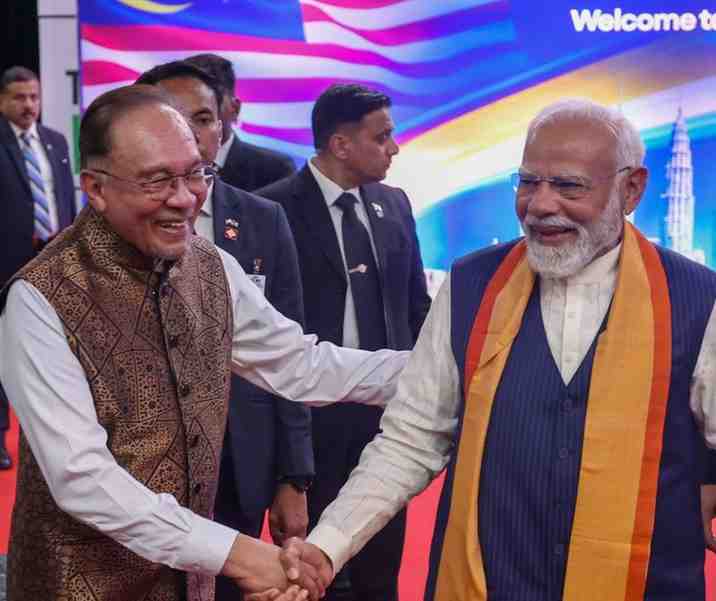
Prime Minister Narendra Modi began his first foreign visit of 2026 with a strong emphasis on digital connectivity, cultural diplomacy, and people-to-people engagement, announcing that India’s Unified Payments Interface (UPI) will soon be introduced in Malaysia. Addressing a large gathering of the Indian diaspora in Kuala Lumpur alongside Malaysian Prime Minister Anwar Ibrahim, Modi framed the upcoming UPI rollout as part of a broader vision to deepen economic cooperation and strengthen civilisational bonds between the two nations.
The two-day visit underscored India’s strategic focus on Southeast Asia and reaffirmed the growing importance of Malaysia as a key partner in India’s Act East policy. Coming less than two years after both countries elevated their relationship to a comprehensive strategic partnership, the visit highlighted how bilateral ties have steadily expanded beyond traditional diplomacy to encompass digital innovation, education, cultural exchange, and defence cooperation.
Modi’s remarks were aimed not only at policy-makers but also at the Indian-origin community in Malaysia, which he described as a living bridge between the two countries. By combining announcements on digital payments with outreach to the diaspora, the prime minister positioned India–Malaysia ties as a partnership rooted in shared values, mutual trust, and future-oriented collaboration.
UPI Rollout and Strategic Economic Vision for India–Malaysia Relations
The announcement that UPI will soon be launched in Malaysia marked a significant milestone in India’s global digital outreach. By extending its flagship digital payments system to another major Southeast Asian economy, India signalled its ambition to export homegrown technological solutions while facilitating smoother financial transactions for businesses, tourists, and diaspora communities.
UPI’s introduction in Malaysia is expected to benefit Indian travelers, students, and professionals by enabling seamless cross-border payments. It also holds potential advantages for Malaysian businesses and consumers, particularly those engaged in trade, tourism, and services linked to India. The move reflects a broader trend of India leveraging digital public infrastructure as a tool of economic diplomacy, positioning itself as a provider of scalable, inclusive technology solutions.
Modi’s visit came at a time when India and Malaysia have been seeking to diversify economic engagement beyond conventional trade. Digital payments, fintech collaboration, and innovation-driven partnerships have emerged as new pillars of bilateral cooperation. The prime minister’s emphasis on UPI underscored confidence in India’s digital ecosystem and its adaptability across borders.
Beyond digital payments, the visit focused on strengthening economic and defence ties. Discussions during delegation-level meetings were expected to cover trade facilitation, investment flows, maritime security, and defence collaboration. The comprehensive strategic partnership framework provided a foundation for these conversations, allowing both sides to align their long-term interests in regional stability and economic resilience.
Modi also highlighted India’s commitment to maintaining close ties with the Indian-origin community in Malaysia, announcing several initiatives aimed at deepening engagement. The extension of Overseas Citizen of India (OCI) card eligibility to Malaysian citizens of Indian origin up to the sixth generation was presented as a historic decision, reflecting India’s desire to maintain enduring connections with its diaspora.
Educational cooperation featured prominently in the prime minister’s address. Continued support for the Indian Scholarship Trust Fund and the introduction of the Thiruvalluvar Scholarship for students studying in India were positioned as steps to strengthen academic and cultural links. By encouraging participation in programmes such as ‘Know India,’ Modi sought to foster a deeper understanding of India among younger generations of the diaspora.
These initiatives were framed as part of a broader vision in which the diaspora plays an active role in strengthening bilateral ties. Modi emphasised that India views its overseas communities not merely as cultural ambassadors but as stakeholders in its global partnerships.
The visit also carried diplomatic significance in its symbolism. Modi noted that Malaysian Prime Minister Anwar Ibrahim personally received him at the airport and accompanied him to the community event, gestures that were highlighted as reflections of mutual respect and warmth in bilateral relations. Such moments were presented as reinforcing trust at the leadership level, which in turn supports deeper institutional cooperation.
Cultural Bonds, Diaspora Diplomacy, and Shared Civilisational Values
A central theme of Modi’s address was the role of culture and shared heritage in shaping India–Malaysia relations. He described the Indian-origin community in Malaysia as a vibrant and integral part of the country’s social fabric, noting how cultural traditions, language, cuisine, music, and cinema have created enduring links between the two societies.
Modi praised a large-scale cultural performance staged by members of the diaspora, calling it a record-setting display of unity and artistic excellence. The performance, featuring hundreds of dancers in coordinated harmony, was portrayed as a symbol of the depth and vitality of cultural ties that transcend borders. According to Modi, such expressions of heritage not only preserve traditions but also strengthen mutual understanding between nations.
The prime minister spoke about shared culinary traditions and linguistic connections, highlighting how Indian food, festivals, and artistic forms have become familiar elements in Malaysian society. He also referenced the popularity of Indian films and music, particularly among Malaysian audiences, as evidence of cultural affinity.
In a personal touch, Modi noted Malaysian Prime Minister Anwar Ibrahim’s fondness for Indian songs, including Tamil classics associated with legendary actor and statesman M.G. Ramachandran. This reference underscored how cultural appreciation operates at both popular and leadership levels, contributing to a sense of closeness that goes beyond formal diplomacy.
Anwar Ibrahim, for his part, publicly highlighted his personal rapport with Modi, describing their friendship as rooted in shared experiences and mutual respect. Such statements reinforced the narrative of strong leader-to-leader ties, which both sides have sought to project as a stabilising factor in bilateral relations.
Diaspora diplomacy formed a key component of the visit’s messaging. Modi reiterated that India will always remain connected to its overseas communities, emphasising inclusivity and continuity across generations. By extending OCI eligibility and expanding scholarship opportunities, the government aimed to institutionalise these bonds rather than rely solely on sentiment.
The visit also took place against the backdrop of sensitive issues, including India’s intention to once again raise the matter of extraditing controversial preacher Zakir Naik during discussions with Malaysian authorities. While not addressed directly in public remarks, the issue formed part of the broader diplomatic agenda, reflecting the complex dimensions of bilateral engagement.
Overall, Modi’s Kuala Lumpur address blended policy announcements with cultural outreach, reflecting a diplomatic approach that integrates economic ambition with civilisational identity. By linking digital innovation such as UPI with diaspora engagement and cultural symbolism, the visit projected India–Malaysia relations as multidimensional and forward-looking.
The emphasis on shared values, mutual respect, and people-centric cooperation suggested that both countries view their partnership not merely through transactional lenses but as a long-term relationship shaped by history, culture, and evolving strategic interests.