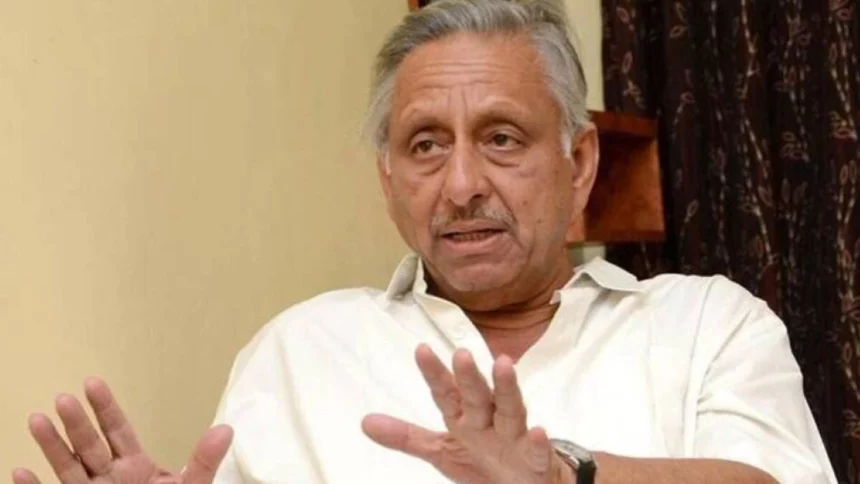
The Congress party’s internal strains returned to public focus after veteran leader Mani Shankar Aiyar launched a sharp critique of its leadership, questioning unity, discipline and electoral credibility.
Senior Congress leader Mani Shankar Aiyar reignited debate within the party after publicly distancing himself from what he described as a culture built around personalities rather than ideology. Declaring himself a Gandhian, Nehruvian and Rajivian, Aiyar said he did not identify as a “Rahulian,” a remark that underscored his dissatisfaction with the current direction of the Congress under Rahul Gandhi. His comments, delivered amid discussions on upcoming elections and party cohesion, have once again highlighted the widening gap between senior voices and the present leadership style.
Ideological identity, leadership culture and Aiyar’s criticism of Congress
Aiyar’s remarks were framed as a reflection on ideological lineage rather than a personal attack, yet they carried unmistakable political weight. He invoked the legacies of Mahatma Gandhi, Jawaharlal Nehru and Rajiv Gandhi to argue that dissent and debate were once integral to the Congress tradition. According to him, the party historically accommodated differences of opinion, even when they were sharp, without branding critics as disloyal. By contrast, he suggested that the present leadership is intolerant of internal disagreement and overly dependent on loyalty to individuals.
In explaining why he does not consider himself a “Rahulian,” Aiyar said Rahul Gandhi had forgotten that senior leaders and long-time workers remain members of the same party, entitled to voice their perspectives. He compared the current situation to earlier eras, pointing out that even towering disagreements existed during the freedom movement and the early years of independent India. Jawaharlal Nehru, he noted, was himself a rebel against Gandhi at times, while Subhas Chandra Bose openly challenged the Congress leadership, yet dissent was handled through dialogue rather than marginalisation.
Aiyar also took aim at what he described as inflated comparisons within the party, criticising the elevation of organisational figures to iconic status. His remarks about KC Venugopal reflected a deeper frustration with what he sees as a distortion of historical perspective, where contemporary leaders are measured against figures like Sardar Patel without comparable stature or contribution. For Aiyar, such comparisons symbolise a leadership culture more concerned with optics than substance.
The former minister also defended his recent assessment of political trends in Kerala, where he predicted that the Congress-led opposition would struggle due to internal disunity. He argued that acknowledging ground realities should not be seen as betrayal, but as an honest appraisal aimed at reform. In his view, denial of weaknesses has become a defining feature of the party’s present functioning, eroding its credibility among voters.
Electoral implications, Kerala politics and reactions from rivals
Aiyar’s sharpest criticism centred on electability. Speaking in Thiruvananthapuram, he questioned how voters could be expected to support a party whose leaders appear publicly divided. He contrasted the Congress’s internal disputes with what he described as the disciplined functioning of the ruling Left Democratic Front in Kerala, led by Chief Minister Pinarayi Vijayan. According to Aiyar, ordinary voters are acutely aware of leadership infighting, and such perceptions directly influence electoral outcomes.
Referring to Kerala’s political landscape, Aiyar suggested that the Congress-led United Democratic Front risks defeat if it fails to project unity and coherence. He praised the Left Democratic Front’s organisational discipline, arguing that internal disagreements there are managed without spilling into the public domain. His remarks drew attention to a recurring theme in Indian politics: the balance between internal democracy and outward cohesion.
The comments triggered swift reactions from across the political spectrum. From the ruling Bharatiya Janata Party, CR Kesavan seized upon Aiyar’s remarks to argue that they exposed deeper leadership failures within the Congress. Kesavan claimed that the veteran leader’s criticism amounted to a vote of no confidence in Rahul Gandhi’s leadership and reinforced the perception that the party is disconnected from voters’ aspirations. He further suggested that internal polarisation and negative politics have limited appeal among the electorate.
From the Left, reactions were more measured. CPI(M) leader and former Kerala finance minister Thomas Isaac described Aiyar as a long-time admirer of Kerala’s decentralisation initiatives and governance model. Isaac noted that while Aiyar continues to identify as a Congressman, he has repeatedly expressed appreciation for the achievements of the Left-led state government. This response framed Aiyar’s remarks less as ideological defection and more as admiration for administrative outcomes.
Within the Congress ecosystem, Aiyar’s comments reopened uncomfortable questions about the party’s ability to manage dissent and adapt to changing political realities. His reference to spokespersons and communication strategy reflected dissatisfaction with how the party represents itself in public discourse. By expressing contempt for certain figures elevated as official voices, he underscored his belief that credibility cannot be manufactured through appointments alone.
The episode illustrates a broader challenge facing the Congress as it navigates leadership transition, generational change and electoral pressure. Senior leaders like Aiyar, shaped by earlier eras of the party, often measure today’s Congress against its historical role as a broad-based, ideologically anchored movement. Younger leaders and strategists, meanwhile, emphasise mass mobilisation, narrative control and personality-driven politics in a highly competitive environment.
Aiyar’s critique, rooted in nostalgia but sharpened by contemporary concerns, reflects this tension. His insistence on ideological identity over personal allegiance raises questions about whether the Congress can reconcile its legacy of internal debate with the demands of modern electoral politics. As the party prepares for crucial state and national contests, the challenge will be to transform such criticism into introspection rather than further fragmentation.