Union Home Minister Amit Shah has begun a three-day visit to Jammu and Kashmir amid heightened focus on security, governance and development in the region. The visit is being seen as part of a broader strategic approach by the Centre to reinforce stability, improve administrative coordination and sustain development momentum in a region that remains politically and strategically sensitive.
The tour comes against the backdrop of evolving security challenges and the need for sustained political engagement. Alongside security assessments, the Home Minister is expected to review development initiatives and engage with local leadership to assess ground realities.
Security assessment in jammu, border inspection and political engagement
In the first phase of the visit, Amit Shah will arrive in Jammu and hold meetings with political leaders and senior administrative officials. Discussions at Lok Bhavan are expected to focus on law and order, internal security, political conditions and the pace of development works. The administration will brief the Home Minister on the implementation of centrally sponsored schemes and key administrative challenges.
On February 6, the Home Minister will visit the International Border in the Hiranagar sector of Kathua district, considered a strategically sensitive area due to infiltration concerns. During the visit, advanced surveillance systems deployed by the Border Security Force, including drones, night-vision equipment and thermal imaging technology, will be reviewed.
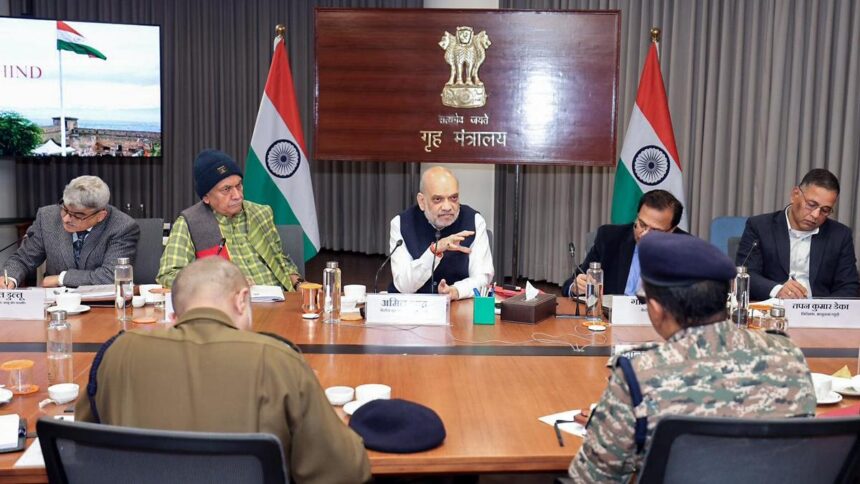
Later the same day, Amit Shah will chair a high-level security review meeting in Jammu, attended by senior officials from the armed forces, central paramilitary forces, intelligence agencies and the Jammu and Kashmir administration. The meeting will focus on counter-terrorism operations, border management, inter-agency coordination and enhanced monitoring of sensitive areas.
Review of development projects, administrative meetings and investment focus in srinagar
In the second phase of the visit, Amit Shah will travel to Srinagar on February 7, where the emphasis will shift towards development projects and administrative reforms. He is expected to review initiatives aimed at strengthening infrastructure, improving public services and boosting economic activity.
Meetings with senior officials will assess progress in sectors such as road connectivity, urban infrastructure, healthcare, education and employment generation. Implementation timelines, utilisation of funds and on-ground impact of projects are likely to be closely examined, with corrective measures suggested where required.
Officials have indicated that the Centre’s approach extends beyond security alone. Development is being pursued as a parallel and essential pillar for ensuring lasting peace and normalcy, a balance that is reflected in the Home Minister’s visit.