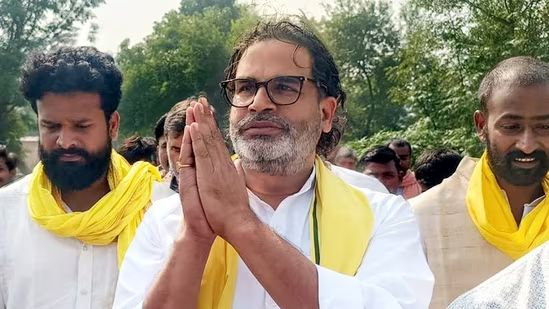
Prashant Kishor, co-founder of the Jan Suraaj Party, has publicly taken responsibility for the party’s humiliating performance in the 2025 Bihar assembly elections, where it failed to win even a single seat despite contesting nearly all constituencies. In his first reaction since the results, Kishor announced that he would observe a vow of silence as an act of personal repentance, while promising to work with greater intensity to revive his political mission for Bihar’s development. His remarks signal that, despite widespread disappointment and electoral failure, he intends to remain deeply involved in politics and in the long-term evolution of his party.
Kishor Acknowledges Defeat, Promises Renewed Effort and Announces Day-Long Silence as Moral Reflection
Prashant Kishor addressed his supporters soon after the results confirmed that the Jan Suraaj Party had failed to make any electoral impact in its debut contest. He accepted full responsibility for the setback and made it clear that neither the defeat nor the magnitude of the loss would deter him from continuing his political experiment. Kishor said he would observe a one-day vow of silence at the Gandhi Bhitiharwa Ashram on November 20 as a symbolic gesture, describing it as an act of self-reflection rather than a retreat.
In his speech, Kishor emphasised that the loss had only strengthened his determination. He said that if his supporters believed he had worked hard over the past three years, he would now work twice as hard and commit all his strength to fulfilling his promise of improving Bihar. His tone was not of despair but of renewed resolve, making it clear that he would not abandon his mission.
Kishor told supporters that mistakes may have been made in strategy or execution, but the party had not committed any wrongdoing. He stressed that Jan Suraaj had run its campaign without engaging in caste-based or religion-based rhetoric, and without using money to manipulate voters. He said the party’s choices had sometimes put it at a disadvantage in a political environment where transactional practices and identity politics often determine outcomes. Yet, he argued that remaining ethical and principled was essential to his vision of transforming Bihar.
His vow of silence, he explained, was not a dramatic gesture but a moment of introspection in the footsteps of Gandhian philosophy. It was meant to help him process the disappointment, understand where the party had faltered and regain clarity for the path ahead. According to Kishor, this pause would allow him to recommit himself to the long struggle he believes Bihar desperately needs.
His remarks carried a subtle message for detractors who claimed Jan Suraaj was a temporary experiment or personal project. He insisted that the movement was rooted in a long-term vision rather than immediate electoral success. For him, the purpose remained unchanged: to reshape Bihar’s governance and empower citizens through participation, accountability and community-driven politics.
Jan Suraaj Party’s Setback, Internal Response and the Road Ahead for Bihar’s New Political Experiment
In the immediate aftermath of the election results, Jan Suraaj president Uday Singh confirmed that Prashant Kishor would continue to remain active in politics and in the party’s organisational direction. Singh praised Kishor’s commitment and dismissed speculation that the electoral defeat might prompt a withdrawal from public life. Instead, he stated that the party would regroup, assess its mistakes and continue working toward its long-term goal of building a more accountable political culture in Bihar.
The party’s failure to win even a single seat, despite contesting nearly all 243 constituencies, has been interpreted by analysts as a sign of how deeply entrenched Bihar’s traditional political structures remain. Jan Suraaj attempted to position itself as a people-centric alternative that rejected caste mobilisation and financial inducements—two factors that have historically driven electoral outcomes in the state. Its focus on development, governance reforms and transparent campaigning resonated with some sections of voters but lacked the organisational machinery, grassroots penetration and caste alignments that define Bihar’s electoral behaviour.
Prashant Kishor’s political brand carries significant weight due to his reputation as a strategist who engineered multiple high-profile victories across India. However, translating strategic expertise into electoral success for his own party proved far more challenging. Electoral analysts argue that Bihar’s political culture is resistant to rapid disruption and that new parties require years of patient groundwork to gain trust.
Kishor’s own journey over the past several years reflects this struggle. After leaving his career as a political consultant, he walked across the state for months, engaging directly with citizens and attempting to build a platform driven by public feedback. His large-scale outreach efforts brought attention, but critics say that local-level organisation, caste networks and booth-level mobilisation were not adequately developed for a statewide debut.
Despite the electoral humiliation, Kishor’s rhetoric makes it clear he does not see the defeat as a failure of vision. He considers it a necessary stage in a longer struggle, comparing it to early setbacks experienced by political movements that later reshaped their regions. His supporters argue that this resilience is one of his key strengths and that the defeat might deepen rather than dilute his commitment.
Uday Singh’s comments reinforce this perspective. He emphasized that the party would not dissolve or change its foundational philosophy due to one electoral outcome. Instead, it would increase its outreach, strengthen its state-wide networks and continue building a political platform rooted in development, governance and citizen participation.
Political observers note that the next phase will be crucial. Kishor must convert his personal appeal into organisational strength, build cadre-level loyalty and create a sustainable political structure that can survive setbacks. The Bihar electorate, historically accustomed to alliances shaped by caste arithmetic, may take time to warm to a party that positions itself as an ideological alternative.
Furthermore, Bihar’s fragmented politics, dominated by long-standing parties, gives limited space to new entrants. Kishor’s challenge will be to overcome cynicism, build trust and demonstrate tangible change at the local level.
The silence vow at Gandhi Bhitiharwa Ashram symbolizes both humility and determination. It reflects Kishor’s understanding that transformative politics requires deep reflection, moral clarity and long-term dedication. By framing the electoral defeat as an opportunity for introspection rather than a moment of withdrawal, he is attempting to retain the confidence of supporters who joined Jan Suraaj because they believed in a different vision for Bihar.
For now, Prashant Kishor’s political journey remains at a crossroads. The election results may have delivered a harsh verdict, but his reaction indicates that he sees the loss not as an ending but as the beginning of a more intense phase of struggle. Whether Jan Suraaj can convert this setback into future momentum will depend on how Kishor reshapes the party’s strategy, strengthens its grassroots network and maintains its commitment to clean, transparent politics while navigating Bihar’s complex electoral realities.