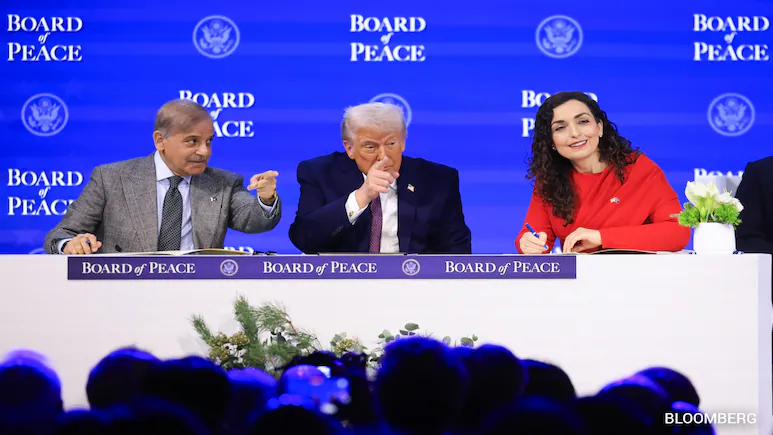
The signing ceremony of the newly proposed Board of Peace, unveiled by former United States president Donald Trump at an international gathering, drew unexpectedly low attendance, with the audience consisting largely of loyal supporters rather than a broad cross-section of world leaders, exposing the fragile international reception of the initiative.
The event, promoted as a major diplomatic milestone intended to reshape global conflict resolution, was expected to attract significant participation from influential nations. Instead, the limited presence of senior global figures turned the spotlight onto the challenges faced by new, personality-driven international frameworks in gaining legitimacy. While the ceremony proceeded with formal speeches and symbolic gestures, the absence of many key allies and multilateral stakeholders became the defining feature of the occasion, raising questions about the viability and credibility of the proposed peace mechanism.
The Board of Peace was presented as an alternative platform for addressing post-conflict governance and reconstruction, particularly in regions affected by prolonged instability. However, the muted response from the international community suggested hesitation toward embracing a structure perceived as operating outside established diplomatic institutions. The visual contrast between the grand ambition of the announcement and the modest turnout underscored a deeper unease about the direction and intent of the initiative.
Vision behind the board of peace and reasons for diplomatic hesitation
The concept of the Board of Peace was framed as a bold attempt to overcome what its proponents describe as the inefficiencies of traditional multilateral institutions. The proposed body was designed to bring together selected nations under a new framework aimed at managing ceasefires, reconstruction efforts and long-term peacebuilding in conflict zones. Supporters argued that existing systems had failed to deliver timely results and that a streamlined, results-oriented structure could fill critical gaps in global diplomacy.
Despite these claims, many governments expressed reservations about the board’s structure and leadership model. Central to these concerns was the perception that the initiative was closely tied to the personal authority and political legacy of its founder, rather than being grounded in a neutral, consensus-driven process. Diplomats privately questioned whether the board would function as a genuinely multilateral institution or as an extension of a single political vision, raising doubts about its durability beyond individual leadership.
Another source of hesitation lay in the board’s relationship with existing international organisations. Many countries are deeply invested in frameworks such as the United Nations, which, despite their limitations, provide recognised legal and diplomatic legitimacy. The Board of Peace, by contrast, appeared to operate parallel to these institutions, prompting fears of duplication, fragmentation and reduced coherence in global peace efforts. For nations accustomed to working through established channels, committing to a new and untested body carried political and strategic risks.
Financial and procedural aspects of the initiative also drew scrutiny. The proposed membership structure, reportedly involving significant commitments, raised concerns about equity and inclusiveness. Smaller or less affluent nations questioned whether the board would genuinely represent diverse global interests or primarily reflect the priorities of a select group. These uncertainties contributed to a cautious approach, with several governments choosing to observe developments rather than participate publicly at the signing stage.
The subdued turnout at the ceremony reflected these underlying doubts. While some countries signalled interest or conditional support, their absence from the event itself spoke volumes about the prevailing mood. Diplomacy often relies as much on symbolism as substance, and the reluctance of key players to appear alongside the initiative’s founder sent a clear signal that consensus had not yet been built.
Political symbolism and what the turnout reveals about global alignments
The composition of the audience at the signing ceremony became a focal point of commentary. The presence of enthusiastic supporters, contrasted with the absence of many traditional allies, transformed the event into a study of political symbolism. For observers, the scene illustrated the divide between domestic political enthusiasm and international diplomatic acceptance, highlighting the limits of personal influence in global affairs.
Supporters in attendance viewed the moment as a demonstration of conviction and independence from entrenched diplomatic norms. They framed the board as an innovative response to global fatigue with slow and often inconclusive peace processes. For this audience, the lack of widespread participation was less a failure and more a reflection of resistance from established powers reluctant to embrace change.
However, from a broader international perspective, the sparse turnout reinforced concerns about unilateralism and credibility. Diplomacy is built on trust, predictability and shared rules, and many governments remain wary of initiatives perceived as bypassing these foundations. The absence of leading European powers, along with cautious signals from other major players, suggested that alignment with the board carried reputational considerations that many were unwilling to assume at this stage.
The event also highlighted shifting global alignments. Some nations outside traditional Western blocs appeared more open to engaging with the initiative, viewing it as an opportunity to influence emerging diplomatic structures. This selective interest pointed to a fragmented international environment in which new groupings form around specific issues rather than broad ideological alliances. Even so, interest did not translate into visible endorsement at the signing, underscoring the gap between exploratory dialogue and formal commitment.
Beyond the immediate reaction, the ceremony raised larger questions about how new diplomatic ideas gain traction in an increasingly complex world. The era when a single leader could command automatic global attention has largely passed, replaced by a multipolar landscape where legitimacy is negotiated rather than assumed. The Board of Peace, in this context, entered an arena crowded with competing priorities, institutions and scepticism shaped by past experiences.
The limited attendance also carried implications for the future trajectory of the initiative. Without early, high-profile backing, momentum becomes harder to sustain. Diplomatic projects often rely on initial enthusiasm to generate follow-up engagement, funding and institutional development. The subdued launch suggested that significant effort would be required to broaden support and clarify the board’s purpose, governance and relationship with existing global systems.
As images of the ceremony circulated, they became a talking point not for the substance of the proposal but for what they revealed about contemporary diplomacy. The contrast between ambition and reception illustrated how global influence is increasingly contingent on collaboration rather than proclamation. Whether the Board of Peace can evolve beyond this tentative beginning remains uncertain, but its debut has already offered insight into the challenges facing new diplomatic ventures in a cautious and divided international landscape.