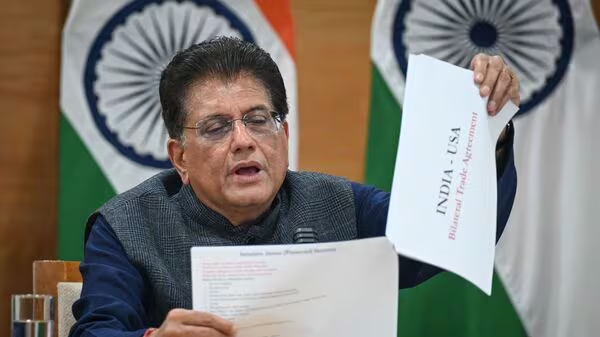
India’s interim trade agreement with the United States marks a calibrated shift in bilateral economic engagement, one that seeks to unlock new export opportunities while maintaining firm safeguards for politically and socially sensitive sectors at home. Commerce and Industry Minister Piyush Goyal has positioned the framework as a carefully negotiated arrangement that advances India’s global trade ambitions without compromising the interests of farmers, dairy producers, or food security.
Announced as a guiding framework for a full Bilateral Trade Agreement, the interim deal reflects India’s evolving trade philosophy—one that prioritises strategic openness over blanket liberalisation. Speaking after the framework was unveiled, Goyal stressed that the agreement has been structured with clear boundaries, ensuring that no concession would expose Indian agriculture or the dairy sector to unfair competition.
The announcement comes at a critical juncture in India–US relations. Trade ties between the two countries have expanded rapidly over the past decade, with the United States emerging as one of India’s largest trading partners. At the same time, negotiations have often been slowed by disagreements over agricultural market access, tariffs, and regulatory standards. The interim framework represents an attempt to bridge these differences incrementally while building momentum toward a comprehensive trade pact.
According to government officials, discussions for the full Bilateral Trade Agreement were launched in February 2025 and are progressing with the expectation that negotiations could be concluded by March. Until then, the interim deal is intended to deliver immediate gains for Indian exporters, particularly in labour-intensive and high-value sectors, while reassuring domestic stakeholders that core interests remain protected.
By explicitly excluding sensitive farm and dairy products and focusing tariff concessions on non-sensitive or under-supplied imports, the agreement reflects a balance between outward-looking trade policy and domestic economic realities. For New Delhi, the message is clear: export growth and global integration will proceed, but not at the expense of rural livelihoods or strategic autonomy.
Safeguarding Agriculture and Dairy in a Sensitive Trade Landscape
A central pillar of the interim India–US trade framework is the explicit protection afforded to India’s agricultural and dairy sectors, which together support millions of livelihoods and remain deeply embedded in the country’s socio-economic fabric. Piyush Goyal was unequivocal in stating that no item has been included in the agreement that could harm Indian farmers.
The minister confirmed that India has not offered any tariff concessions on key agricultural commodities such as meat, poultry, dairy products, soybean, maize, rice, wheat, sugar, millets, oilseeds, ethanol and tobacco. Several fruits and pulses, often subject to price volatility and sensitive domestic supply dynamics, have also been kept outside the scope of the agreement.
By excluding these items, India has sought to avoid the risk of exposing small and marginal farmers to competition from heavily subsidised or large-scale agricultural producers in the United States. The decision reflects long-standing concerns within India that rapid agricultural liberalisation could destabilise rural incomes and undermine food security.
Goyal also reiterated India’s firm position on genetically modified products, stating that no genetically modified agricultural items will be allowed to enter the country under the interim deal. This assurance is consistent with India’s cautious regulatory approach toward GM food imports and addresses concerns raised by farmer organisations and consumer groups.
The dairy sector, which is dominated by small producers and cooperative structures, has received similar protection. India has not offered any tariff relief on dairy products, insulating the sector from external competition that could disrupt domestic price structures and cooperative networks.
On the import side, India’s tariff reductions have been limited to items that are either not produced domestically or are produced in insufficient quantities. These include apples, distillers dried grains with solubles, wines and spirits—subject to minimum import price conditions—select nuts, certain medicines, medical equipment, industrial inputs and information and communication technology products.
Even within this limited opening, tariff reductions are being implemented through a mix of immediate cuts, phased reductions and quota-based mechanisms. This approach allows domestic industries time to adjust while ensuring access to essential inputs that support manufacturing, healthcare and technological growth.
Goyal’s emphasis on agricultural protection reflects the political sensitivity of trade policy in India, where farming remains both an economic backbone and a powerful electoral issue. By drawing clear red lines in the interim agreement, the government has sought to reassure farmers that trade engagement with the United States will not come at their expense.
Export Expansion, MSME Gains and Strategic Trade Signalling
While agriculture and dairy have been firmly shielded, the interim deal delivers substantial benefits for Indian exporters across a wide range of sectors. According to Goyal, several Indian products will now enter the US market at zero duty or significantly reduced tariffs, in some cases cut from levels as high as 50 per cent.
Key beneficiaries include gems and diamonds, pharmaceutical products and generic drugs, smartphones, aircraft parts, machinery components, select auto parts, platinum, clocks and watches, essential oils, and home décor items such as chandeliers and lamp parts. Select chemical, paper, plastic and wood products are also covered, offering relief to manufacturers facing high tariff barriers.
Labour-intensive sectors stand out as major gainers. Goyal highlighted tariff reductions to 18 per cent for certain handicraft exports, noting growing optimism among artisans and small exporters. He cited the example of a handicrafts producer who expressed confidence that lower tariffs would translate into new orders and business growth.
For micro, small and medium enterprises, improved access to the US market could be transformative. Many MSMEs operate on thin margins and are particularly sensitive to tariff costs. Reduced duties enhance their competitiveness, allowing them to scale up exports and integrate more effectively into global value chains.
Agricultural exports, despite the protection of sensitive domestic products, also stand to benefit in selected categories. The agreement provides for zero reciprocal tariffs on spices, tea, coffee, copra, coconuts and coconut oil, areca nut, cashew nuts and other nuts, as well as fruits and vegetables such as mangoes, guavas, kiwis, papaya and mushrooms. These products already enjoy strong demand in the US, and tariff-free access is expected to further boost exports.
Beyond goods, the agreement has strategic implications in technology and supply chains. Goyal described assured access to US information and communication technology products as a “big win” for India, noting their importance for economic growth and national security. Reliable access to advanced technology inputs strengthens India’s manufacturing ecosystem and digital infrastructure.
The joint statement accompanying the interim framework also made references to “non-market policies of third parties,” a phrase that Goyal addressed obliquely when asked for clarification. His remark—“Those who understand, they know”—was widely interpreted as a signal of shared concerns over unfair trade practices, adding a geopolitical dimension to the agreement.
Taken together, the interim deal serves multiple purposes. It provides immediate tariff relief to Indian exporters, supports MSMEs and labour-intensive industries, secures access to critical inputs, and signals India’s willingness to engage constructively with major trading partners while defending core domestic interests.
By framing the agreement as balanced and firmly in the national interest, Goyal has sought to position the interim framework not as a concessionary compromise but as a strategic stepping stone toward a comprehensive India–US trade partnership.