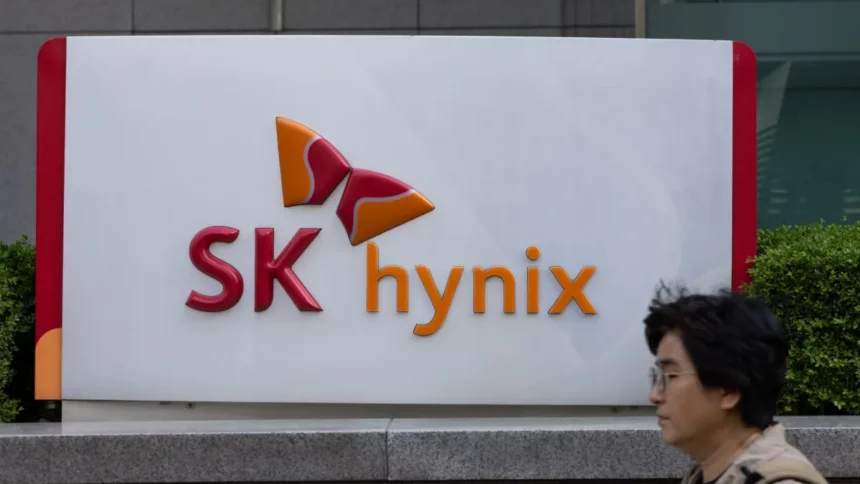
SK Hynix, South Korea’s leading memory chip manufacturer, reported an exceptional performance in the fourth quarter of 2024, posting record-breaking earnings fueled by strong sales of high-bandwidth memory (HBM) chips, which are increasingly in demand for generative artificial intelligence (AI) applications. The company’s revenue for the quarter reached an impressive 19.77 trillion won (approximately $13.7 billion), slightly under analysts’ expectations of 19.91 trillion won, while its operating profit surged to a staggering 8.08 trillion won ($5.6 billion), surpassing expectations and marking a massive 2,236% increase year-on-year.
The results reflect the significant role SK Hynix has played in the AI sector, especially as demand for AI servers continues to soar. The company’s HBM technology, which allows chips to be stacked vertically to optimize space and reduce power consumption, is a critical component in the development of AI chipsets, particularly for industry giant Nvidia, a leading U.S.-based AI chip designer. Alongside strong AI demand, SK Hynix also saw a 12% rise in revenue from the previous quarter and a 15% increase in operating profit, which set a new record.
Despite the robust quarterly results, SK Hynix’s shares experienced a decline of 2.7%, reflecting investor concerns about the uncertain outlook for the memory chip market in 2025. During the company’s earnings call, Chief Financial Officer Kim Woohyun cautioned that memory demand in 2025 could face challenges, including inventory adjustments by PC and smartphone manufacturers, along with the effects of heightened trade protectionism and geopolitical risks. Kim emphasized that while the outlook for next year remained uncertain, the company still anticipates continued growth in AI-driven memory demand, including DRAM (dynamic random access memory) and NAND (flash memory) products, as large tech companies maintain heavy investments in AI server infrastructure.
For 2024, SK Hynix achieved remarkable milestones, exceeding its 2022 revenue by over 21 trillion won, establishing a new annual revenue record. The operating profit also reached unprecedented levels, surpassing the previous record set during the semiconductor industry’s “super boom” in 2018. The company’s ability to capitalize on the boom in artificial intelligence is evident, as HBM has quickly emerged as a core technology for powering AI servers and applications.
Looking ahead, SK Hynix forecasts continued growth in both DRAM and HBM products, driven by the sustained demand for AI servers and the increasing use of AI models for training purposes. The consumer market for AI-equipped PCs and smartphones is also expected to see growth, particularly in the latter half of the year. According to Kim, the memory industry is undergoing a shift, transitioning from a volume-driven commodity market to a more specialized market focused on high-performance, high-quality products.
In addition to this positive outlook, SK Hynix also indicated that its capital expenditure in 2025 could see a slight increase, marking continued investments in expanding its technological capabilities to maintain its competitive edge. Despite concerns regarding potential market adjustments, analysts, such as SK Kim from Daiwa Capital Markets, remain optimistic about the company’s leadership in the HBM market.
For the year 2024, SK Hynix’s shares have increased by 29%, showcasing the company’s strong performance in a rapidly evolving memory chip market. However, as the company faces potential demand uncertainties in the coming year, investors will be watching closely for how the global memory market adjusts to the shifting dynamics of AI and consumer electronics.