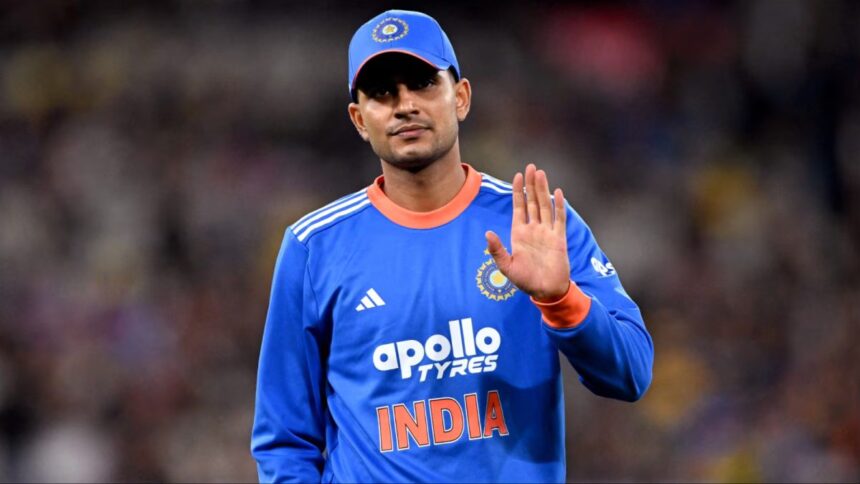
The omission of Shubman Gill from India’s T20 World Cup 2026 squad has triggered widespread debate, with fresh reports suggesting that strategic considerations around pitch conditions and powerplay demands played a decisive role beyond the officially stated reasons of form and team combination.
Gill’s exclusion came as a major surprise when the Board of Control for Cricket in India announced the 15-member squad for the upcoming global tournament. The shock was heightened by the fact that Gill had recently been named vice-captain of India’s T20 side under Suryakumar Yadav and had been backed as a regular opener alongside Abhishek Sharma. Instead, the Ajit Agarkar-led selection committee chose to leave him out entirely, signalling a significant shift in thinking just months before a major international event.
*Pitch conditions, powerplay priorities, and the shift away from Gill*
While official communication maintained that Gill missed out due to form and combinations, reports indicate that the nature of pitches expected during the T20 World Cup 2026 weighed heavily on the selectors’ minds. With matches scheduled across multiple venues, surfaces are expected to slow down as the tournament progresses, increasing the importance of aggressive starts and maximum utilisation of the powerplay overs.
According to the report, the selectors felt that Gill’s batting style, which is built around timing, placement, and tempo control, may not offer the same explosive impact in the early overs as some of the other options available. In contrast, batters such as Sanju Samson, Abhishek Sharma**, and **Ishan Kishan were seen as better suited to extracting maximum runs when fielding restrictions are in place.
This emphasis on powerplay dominance appears to have reshaped the pecking order. With India expected to play each match at a different venue, adaptability to varying conditions became a core selection criterion. The belief within the selection group was that fast starts could prove decisive on slower tracks, where chasing or setting totals becomes increasingly difficult as the ball grips and stroke-making grows tougher.
Gill, despite his technical excellence and consistency in other formats, was perceived to have fallen behind in this specific tactical race. His recent T20 outings did not sufficiently convince the selectors that he could consistently deliver the explosive starts they believe will be required. As a result, the second opening slot was reassigned to Sanju Samson, whose aggressive approach and ability to clear boundaries early were valued more highly in the context of projected tournament conditions.
Another factor influencing the decision was India’s growing concern about over-reliance on **Hardik Pandya** as the primary finisher. In recent matches, India’s middle and lower order has shown vulnerability when Hardik has been unable to finish games single-handedly. To address this imbalance, selectors decided to recall **Rinku Singh**, whose reputation as a reliable finisher has grown rapidly.
The inclusion of Rinku was seen as a way to redistribute responsibility in the death overs, but it also tightened the competition for batting slots. With only 15 places available, the selectors prioritised players who fit clearly defined roles, even if that meant leaving out someone of Gill’s stature.
*Communication gaps, official stance, and implications for Gill’s future*
The manner in which Gill learned of his omission has also attracted attention. According to reports, he was not informed in advance and only became aware of his exclusion when the squad was officially announced. While the selection committee had reportedly made up its mind several days earlier, the lack of prior communication added to the sense of shock surrounding the decision.
From the selectors’ perspective, the choice was framed as a difficult but necessary call. Ajit Agarkar, speaking after the squad announcement, emphasised that Gill’s omission was not a reflection of his quality as a cricketer. He described the decision as one driven purely by combinations, noting that when the squad is restricted to 15 players, some strong performers inevitably miss out.
The official explanation also highlighted Ishan Kishan’s inclusion as a backup opener and wicketkeeper, crediting his strong performances in domestic T20 competitions, including the Syed Mushtaq Ali Trophy. Kishan’s dual role added flexibility to the squad, a factor that worked against Gill, who does not offer wicketkeeping as an additional skill.
For Gill, the exclusion represents a significant setback in his T20 ambitions, especially given his recent leadership elevation. However, many observers believe that this decision does not mark a permanent shift away from him. At 26, Gill remains one of India’s most technically gifted batters and a long-term prospect across formats. The current call appears to be more about immediate tactical needs than a broader loss of faith.
The episode also underscores the increasingly specialised nature of T20 selection. Modern squads are being built with hyper-specific roles in mind, often prioritising situational impact over overall batting averages or reputations. In this environment, even established players can find themselves sidelined if their skill set does not align precisely with the team’s strategic blueprint.
As India prepares for the T20 World Cup, the focus will remain on whether this gamble on power hitters and finishers delivers the desired results on slow and unpredictable pitches. For Gill, the coming months will be about responding with performances that force a rethink, reminding selectors that adaptability and explosiveness can coexist with classical batting foundations.