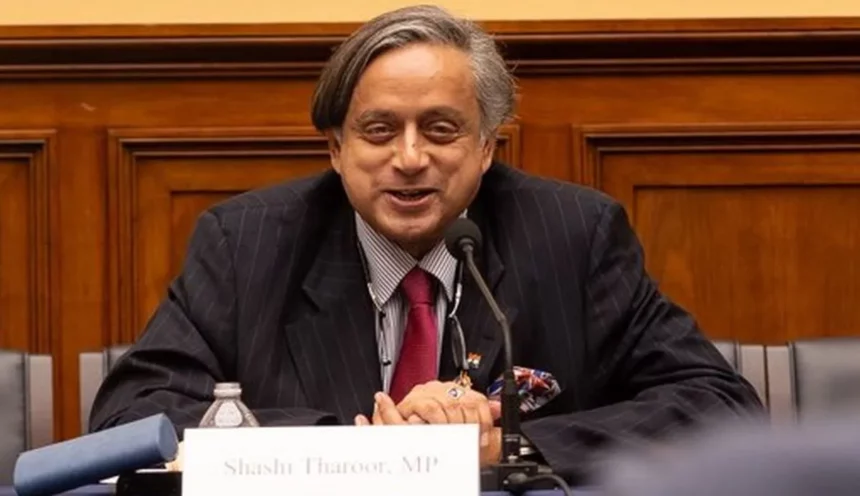
Senior Congress leader and Member of Parliament Shashi Tharoor has delivered a pointed critique of former US President Donald Trump’s trade policies, holding them responsible for job losses in India and highlighting their disruptive impact on long-standing diplomatic norms between the two nations. Speaking at a high-level policy discussion on global trade and international diplomacy, Shashi Tharoor elaborated on how Trump’s “America First” economic strategy, especially his aggressive tariff hikes and protectionist policies, adversely affected export-driven Indian industries, from automotive components to textiles and information technology services. Shashi Tharoor also condemned the former president’s undiplomatic style, warning that it undermined the mutual trust and respect that have historically guided India-US relations.
Impact of Trump’s Trade Policies on Indian Industries
Shashi Tharoor emphasised that Trump’s protectionist stance created a contraction of opportunities for Indian businesses by disrupting global supply chains. “By imposing higher tariffs on key imports and targeting outsourcing, his administration contributed to significant job losses in India’s export-dependent sectors,” Shashi Tharoor stated. He pointed out that industries such as automotive components, textiles, and IT services, which rely heavily on cross-border trade and global partnerships, experienced substantial setbacks during this period.
Under Trump’s presidency, the US implemented higher import duties on steel and aluminium, which directly affected Indian manufacturers. In response, India raised tariffs on several US products, resulting in a prolonged trade dispute. The situation escalated further in 2019 when Trump revoked India’s Generalized System of Preferences (GSP) status, which had previously allowed India duty-free access to the US market for approximately $6 billion worth of exports. This move particularly impacted small and medium-sized enterprises across India, many of which struggled to adapt to the sudden increase in costs and market uncertainties. Shashi Tharoor emphasised that while India-US trade volumes continued to grow, reaching $146 billion in 2019, the instability created by such policy shifts undermined long-term planning and confidence in bilateral trade relationships.
Shashi Tharoor also highlighted how these trade disruptions intersected with broader global economic shifts. Companies reliant on predictable supply chains and international contracts faced unexpected barriers, forcing Indian businesses to recalibrate strategies, absorb financial losses, or scale down operations. The cumulative effect, according to Shashi Tharoor, was widespread job loss, particularly in export-heavy sectors that form the backbone of India’s economic engagement with the world. These consequences, he argued, reflect a broader problem: when economic nationalism is pursued at the expense of multilateral agreements and cooperative diplomacy, even long-standing trade partners can experience friction that reverberates across domestic economies.
Diplomatic Concerns and the Undermining of Mutual Respect
Beyond the economic fallout, Shashi Tharoor strongly criticised Trump’s style of diplomacy, arguing that it eroded the foundation of trust and mutual respect that had traditionally guided India-US relations. “Diplomacy is not about bluster and tweets,” he remarked, underscoring that effective international engagement requires sustained dialogue, patience, and the cultivation of relationships based on shared values and strategic cooperation. In Shashi Tharoor’s assessment, the Trump administration’s approach—often confrontational and impulsive—disrupted decades of careful diplomatic engagement, leaving both countries to navigate heightened tensions even as trade and strategic interests continued to intersect.
Shashi Tharoor’s critique also reflected broader concerns in Indian policy circles regarding the direction of US foreign policy under Trump. While India has long sought to maintain strong ties with the United States, balancing trade relationships, strategic cooperation, and geopolitical priorities, sudden policy shifts and undiplomatic conduct introduced a degree of unpredictability that complicated long-term planning. Analysts noted that the combination of trade friction, tariff escalation, and diplomatic strain threatened to slow the deepening of a bilateral strategic partnership that had been steadily growing over decades.
He further elaborated that diplomatic relations are built over years of consistent engagement and mutual respect, and when these principles are undermined, even robust economic partnerships face challenges. Shashi Tharoor underscored the contrast between traditional diplomacy, which relies on negotiation and collaboration, and the more transactional, unilateral approach exemplified by Trump’s policies. He suggested that the erosion of trust had tangible implications for India’s global economic positioning, particularly in industries dependent on predictable bilateral arrangements and cross-border cooperation.
Shashi Tharoor’s comments also highlighted the broader human and social impact of policy uncertainty. Workers in export-driven sectors, particularly in manufacturing hubs and IT services, experienced the ripple effects of trade disputes, from reduced orders and layoffs to delayed projects and financial strain. The removal of GSP benefits, for example, disproportionately affected small and medium-sized enterprises that lacked the resources to absorb sudden increases in costs or market access limitations. This, according to Shashi Tharoor, underscores the need for international economic policies that consider the ripple effects on labor markets and communities dependent on global trade.
While India-US trade continued to grow despite these challenges, the unpredictability of policy decisions introduced risk and hesitancy into investment and business planning. Shashi Tharoor stressed that while economic pragmatism requires nations to protect domestic interests, protectionist measures that disregard established bilateral frameworks can create systemic disruptions with long-term consequences. He further argued that a collaborative, rules-based approach to trade and diplomacy would have mitigated many of the negative outcomes experienced by Indian businesses and workers.
Moreover, Shashi Tharoor emphasized the symbolic significance of mutual respect in diplomacy. He argued that when international leaders adopt confrontational rhetoric or unilateral measures, it undermines the credibility and stability of relationships, even when economic metrics appear positive. The erosion of trust, according to Shashi Tharoor, can have cascading effects on security cooperation, intelligence sharing, and regional strategic alignment, all of which are critical elements of India-US relations.
In addition to critiquing the economic and diplomatic dimensions, Shashi Tharoor provided context for understanding the broader implications of Trump-era policies for India’s role in the global economy. He argued that the unpredictability of the US approach required India to reassess supply chains, diversify export markets, and seek alternative avenues for economic engagement. This period also highlighted the importance of maintaining strong multilateral ties and reinforcing domestic resilience to absorb external shocks.
Shashi Tharoor’s observations reflect an understanding of the interconnected nature of global trade and diplomacy, where decisions made unilaterally by a major power can have far-reaching consequences for trading partners. He suggested that Indian policymakers must remain vigilant and proactive in mitigating the impacts of external policy shifts while advocating for cooperative solutions that preserve long-term bilateral interests.
Finally, Shashi Tharoor’s critique serves as a reminder that economic policy and diplomacy are inseparable in their impact. Trade decisions that disregard diplomatic norms can create uncertainty, affect domestic labor markets, and weaken strategic partnerships. By highlighting the consequences of Trump’s tariffs and aggressive policies, Shashi Tharoor underscored the need for careful, considered engagement that balances national priorities with long-term international commitments. His remarks signal a call for sustained dialogue, responsible policy-making, and respect for established norms, emphasizing that global leadership requires more than short-term economic gains—it demands credibility, trust, and strategic foresight.
Shashi Tharoor’s analysis also reflects broader discussions in India regarding the future of trade relations with the United States. While the bilateral trade relationship continues to expand, policymakers and industry stakeholders must navigate the uncertainties introduced by unilateral policy shifts. The lessons from Trump-era decisions may shape India’s approach to future trade negotiations, emphasizing diversification, risk management, and the pursuit of agreements grounded in mutual respect and predictability.
By combining critique of economic policy with an examination of diplomatic conduct, Shashi Tharoor presents a holistic perspective on the multifaceted challenges India faced during Trump’s tenure. His remarks not only shed light on specific disruptions, such as the loss of GSP benefits and the imposition of tariffs, but also highlight the broader strategic implications for bilateral relations, regional stability, and India’s global positioning.
Shashi Tharoor’s reflections serve as both an analysis of past policy failures and a guidepost for how India might navigate future economic and diplomatic challenges. His insights call for a careful balance between protecting domestic interests and maintaining strong, trust-based international relationships.
The discourse also emphasizes the importance of understanding the human and economic consequences of unilateral policies. By framing trade disputes in terms of their impact on workers, businesses, and communities, Shashi Tharoor reinforces the notion that diplomacy and economic policy must work hand in hand to ensure both domestic prosperity and global cooperation.
Ultimately, Shashi Tharoor’s observations underscore the interconnectedness of global trade, diplomacy, and domestic economic health. The critique of Trump-era policies serves as a reminder that effective leadership on the international stage requires foresight, adherence to established norms, and a commitment to maintaining stable, predictable, and mutually respectful bilateral relations.
This perspective invites policymakers, industry stakeholders, and the broader public to consider the long-term consequences of policy decisions, emphasizing that short-term economic nationalism should not come at the cost of strategic partnerships, economic stability, or the livelihoods of millions.
By addressing both economic and diplomatic dimensions, Shashi Tharoor presents a comprehensive evaluation of the Trump administration’s impact on India, highlighting lessons that will inform future policy decisions and bilateral engagements. His remarks reinforce the necessity of combining strategic foresight with practical, human-centered policy considerations to navigate the complexities of modern international relations.