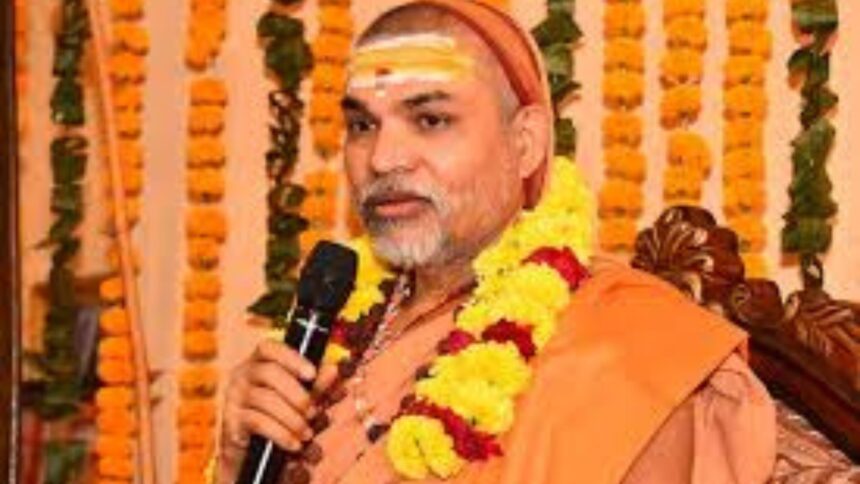
The ongoing controversy surrounding Shankaracharya Swami Avimukteshwaranand at the Prayagraj Magh Mela has escalated into a broader religious and political flashpoint, drawing strong reactions from senior spiritual leaders, government officials, and civil servants. Dwarka Sharada Peeth Shankaracharya Swami Sadanand Saraswati publicly declared that all three Shankaracharyas stand firmly in support of Avimukteshwaranand, sharply criticising administrative actions and alleging a systematic attempt to humiliate religious authority. As protests continue and tensions intensify, the episode has triggered resignations, political statements, and renewed debate over the relationship between religious institutions, state power, and public administration.
Unified shankaracharya support and sharp criticism of administrative authority
Speaking at the Narmada Janmotsav programme in Jabalpur, Swami Sadanand Saraswati stated unequivocally that Swami Avimukteshwaranand enjoys the full support of all three Shankaracharyas. He questioned the authority of the administration to demand any form of certification from Avimukteshwaranand, asserting that no governmental body holds the right to validate or delegitimise the position of a Shankaracharya. According to him, such actions reflect a dangerous misunderstanding of spiritual traditions and constitutional boundaries.
Swami Sadanand strongly condemned the alleged police action during the Magh Mela, describing the reported assault on Brahmin disciples as deeply reprehensible. He argued that the use of force against religious followers not only violated basic human dignity but also risked inflaming sentiments among millions who hold the Shankaracharya institution in deep reverence. His remarks added significant weight to the controversy, elevating it from a local administrative dispute to a matter of wider religious concern.
The confrontation traces back to events on January 18 during Mauni Amavasya, when Swami Avimukteshwaranand arrived at the Sangam for the ritual bath. Police officials stopped his palanquin and instructed him to proceed on foot due to crowd management concerns. His disciples objected, insisting that the Shankaracharya be taken with traditional protocol. The situation quickly escalated into scuffles, detentions, and allegations of assault, ultimately preventing the ritual bath and triggering a prolonged standoff.
In response, Swami Avimukteshwaranand began a dharna outside his camp, declaring that he would not take a holy dip until the administration escorted him with dignity and respect. He maintained that increased pressure would only strengthen his resolve. The administration, meanwhile, stated that security concerns necessitated restrictions and accused supporters of breaking barricades and clashing with police.
As the standoff continued, the controversy expanded beyond the Magh Mela grounds. Golden Baba alleged that anti-sanatan forces were actively attempting to divide Hindus and deliberately dragging political leaders into a purely administrative dispute. He argued that invoking the chief minister’s name was part of a broader conspiracy designed to create discord within the Hindu community rather than resolve the immediate issue.
Resignation, political responses and rising religious sentiment at magh mela
The controversy took a dramatic turn when Alankar Agnihotri resigned from his post, citing moral anguish over the alleged beating of Avimukteshwaranand’s disciples. In his resignation letter, the magistrate wrote that seeing the disciples’ hair forcibly grabbed during the incident deeply disturbed him and left him unable to continue serving under a system where such actions occurred. Swami Avimukteshwaranand expressed sorrow over the resignation, noting that relinquishing a senior administrative position after years of effort would cause immense personal pain.
The incident has also drawn political attention, particularly from Uttar Pradesh Deputy Chief Minister Keshav Prasad Maurya, who appealed for calm and urged the Shankaracharya to end the protest and take a holy dip at the Sangam. Maurya described the Shankaracharya as a revered spiritual figure rather than a political personality and said he could only pray and request him to resolve the dispute peacefully.
Swami Avimukteshwaranand, however, alleged that Maurya was being restrained from intervening meaningfully and claimed that a sensible leader was being suppressed. He further criticised the state leadership, asserting that contradictory statements and administrative silence had worsened the situation. At one point, he remarked that the ritual bath would take place only when Yogi Adityanath desired it, suggesting that the resolution lay beyond local administration.
Amid rising tension, incidents of protest and counter-protest unfolded near the Shankaracharya’s camp. Groups chanting slogans both for and against the government clashed with disciples, prompting police intervention. Complaints and counter-complaints were filed, and the State Human Rights Commission ordered a probe into the alleged assault on disciples. Lawyers and civil society voices demanded impartial investigations and clear guidelines to prevent similar confrontations during large religious gatherings.
Despite the turmoil, patriotic symbolism marked Republic Day at the Magh Mela. Swami Avimukteshwaranand hoisted the national flag outside his camp, while devotees raised slogans of national pride. Elsewhere, members of the Kinnar Akhara also celebrated the occasion with cultural performances and the national anthem, drawing large crowds and momentarily shifting focus from conflict to unity.
As the dispute enters its ninth day, it has evolved into a complex intersection of faith, governance, and political perception. Statements from senior Shankaracharyas, resignations by civil servants, and allegations of conspiracies have amplified its significance, ensuring that the controversy continues to resonate far beyond the banks of the Sangam.