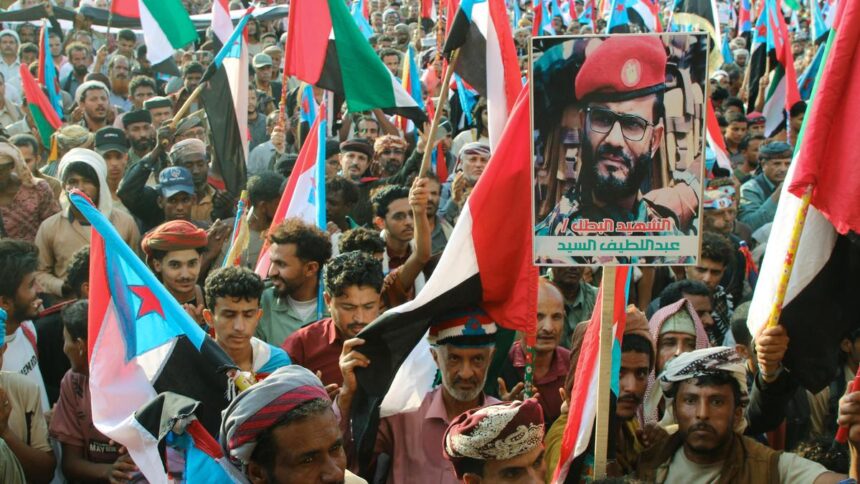
Several people have been killed in Yemen after airstrikes carried out by the Saudi-led coalition hit positions held by UAE-backed forces in the country’s south, marking a sharp escalation that exposes widening fractures within the alliance that has dominated Yemen’s conflict for years.
The strikes, which targeted camps and military sites linked to the Southern Transitional Council, underscore how Yemen’s war has entered a more complex and volatile phase. What began as a unified intervention against the Houthi movement has gradually fragmented into overlapping conflicts shaped by competing regional interests, local power struggles, and unresolved questions about Yemen’s political future. The latest violence has not only resulted in fatalities but has also intensified fears that infighting among former allies could prolong instability in a country already devastated by more than a decade of war.
Yemen’s conflict has long been defined by shifting alliances, but the decision by the Saudi-led coalition to strike UAE-backed forces represents a particularly stark rupture. It highlights the growing divergence between Riyadh and Abu Dhabi over how Yemen should be governed and who should wield power in its strategically vital southern regions. As casualties mount and tensions rise, the strikes have drawn renewed attention to the fragile balance holding together the anti-Houthi front.
Airstrikes on southern forces expose fractures within the anti-Houthi alliance
The airstrikes reportedly hit military camps and positions in eastern and southern parts of Yemen, including areas of Hadramaut, a vast and resource-rich region that has become increasingly contested. Officials aligned with the Southern Transitional Council said that dozens of fighters were killed or wounded in the attacks, which they described as unexpected and destabilising. The STC has accused the Saudi-led coalition of undermining local security arrangements and attacking forces that had previously coordinated with coalition partners.
The STC, which seeks autonomy or independence for southern Yemen, has enjoyed political and military backing from the United Arab Emirates for several years. Emirati support helped the group consolidate control over key southern cities and ports, positioning it as a powerful actor alongside the internationally recognised Yemeni government. Saudi Arabia, while initially tolerating this arrangement as part of a broader anti-Houthi strategy, has grown increasingly wary of the STC’s ambitions, particularly as they threaten to fragment Yemen and weaken central authority.
By launching airstrikes against UAE-backed forces, Saudi Arabia has signalled a determination to reassert its vision for Yemen’s future. Riyadh has consistently argued that maintaining territorial unity under a single recognised government is essential to counter the Houthis and secure Saudi Arabia’s southern border. The STC’s recent moves to expand influence into Hadramaut and outline a political roadmap for southern autonomy appear to have crossed a red line for Saudi decision-makers.
The strikes have also complicated relations between Saudi Arabia and the UAE, two Gulf powers that have cooperated closely on regional security issues but increasingly diverged in Yemen. While Abu Dhabi has scaled back its direct military presence and emphasised a more limited role, its political alignment with the STC has remained a source of tension. The airstrikes thus reflect not only a battlefield calculation but also a broader contest over influence and outcomes in Yemen’s fractured political landscape.
Regional rivalry, humanitarian risks, and uncertain paths ahead for Yemen
The escalation comes at a time when Yemen’s war is already marked by humanitarian catastrophe and political paralysis. Millions of Yemenis remain dependent on aid, infrastructure is in ruins, and basic services are scarce. Renewed fighting among anti-Houthi factions risks worsening conditions for civilians, particularly in contested areas where airstrikes and ground clashes disrupt daily life and access to assistance.
International observers have warned that infighting among former allies could inadvertently strengthen the Houthis, who control large parts of northern Yemen and have proven resilient despite years of military pressure. A divided opposition weakens any coordinated effort to negotiate or enforce a sustainable ceasefire, further delaying prospects for peace. The latest strikes underscore how Yemen’s conflict has evolved beyond a binary struggle into a multi-layered war with competing agendas.
The political implications are equally profound. The STC’s push for southern autonomy taps into historical grievances dating back to Yemen’s unification in 1990, when many southerners felt marginalised. Saudi Arabia’s opposition to these ambitions reflects fears that Yemen’s breakup would create long-term instability and invite further regional interference. The UAE, meanwhile, has framed its engagement with southern forces as support for local security and counterterrorism, even as critics argue it has encouraged fragmentation.
As airstrikes hit former allies, questions are mounting about the future of the anti-Houthi coalition and the feasibility of any unified peace process. Diplomatic efforts to stabilise Yemen have repeatedly faltered amid shifting alliances and unmet political demands. The latest violence suggests that without a clear and inclusive political framework, military actions will continue to reshape realities on the ground, often at the expense of civilians.
For Yemenis, the renewed escalation is a grim reminder that the war’s end remains elusive. Each new front and internal rupture deepens uncertainty about governance, security, and reconstruction. The strikes on UAE-backed forces have thus become more than a tactical episode; they symbolise the unraveling of old alliances and the emergence of a more fragmented and unpredictable conflict, with consequences that will likely reverberate across Yemen and the wider region