Bangladesh is witnessing one of the most consequential elections in its history as nearly 127 million citizens head to the polls in the first national vote held without Sheikh Hasina or her Awami League on the ballot in more than fifteen years. This election follows the dramatic political upheaval of August 2024, when mass protests triggered by an anti-quota movement, and later supported by Islamist groups, forced Hasina from office and ended her long dominance over the country’s political landscape. The vote is not only about choosing a new government but also about deciding whether Bangladesh should fundamentally redesign its constitutional framework through a nationwide referendum on the proposed July Charter.
The scale and symbolism of this election are immense. Nearly forty-four percent of voters are between the ages of eighteen and thirty-seven, and about five million are voting for the first time. For a generation that has known only uninterrupted Awami League rule since childhood, this election represents their first experience of what they perceive as an open and competitive democratic process. The idea of a “notun byabostha,” or new system, has become a rallying cry among voters disillusioned with past governance and eager for political accountability, economic opportunity, and institutional reform.
Voting is taking place in 299 constituencies, with polling in one seat postponed due to the death of a candidate. Polls opened at 7:30 am and are scheduled to close at 4:30 pm, after which counting will begin immediately. While preliminary results are expected by midnight, official confirmations may take longer amid heightened security concerns. Authorities have identified around half of the country’s 42,779 polling centres as high or medium risk, reflecting anxieties over violence, intimidation, and administrative strain. These fears have been amplified by recent incidents, including arson attacks on polling booths, arrests of armed suspects in Dhaka, and the killing of a Hindu businessman in Mymensingh days before the vote.
Against this backdrop of tension and anticipation, voters are casting two ballots. One determines which political party or coalition will form the next government. The other asks citizens to approve or reject the July Charter, a proposed package of constitutional reforms championed by the interim administration led by Muhammad Yunus. Together, these choices will shape not only who governs Bangladesh but also how power is distributed and exercised in the years ahead.
A contest reshaping Bangladesh’s political order
At the heart of the electoral contest are two major forces: the Bangladesh Nationalist Party and the Jamaat-e-Islami, each leading rival alliances that reflect sharply different visions of Bangladesh’s future. With the Awami League barred from contesting, the BNP has emerged as the perceived frontrunner, seeking to reclaim national leadership after years of boycotts, repression, and political marginalisation under Hasina’s rule.
The BNP is led by Tarique Rahman, the son of former prime minister Khaleda Zia, who died in December 2025. Despite never having served as a member of parliament, Tarique Rahman has positioned himself as the central figure of the party’s revival, appealing to voters who associate the BNP with competitive politics and an end to what they describe as authoritarian governance. The party heads an eight-member pre-poll alliance and has benefited from a significant consolidation of former Awami League supporters. Surveys suggest that a large share of voters who once backed Hasina are now shifting toward the BNP, seeing it as the most viable alternative to both Islamist dominance and prolonged instability.
Challenging the BNP closely is the Jamaat-e-Islami, led by its Ameer, Shafiqur Rahman. Once banned and suppressed under Hasina’s government, the Islamist party has staged a notable comeback since the interim administration lifted restrictions on its activities. Shafiqur Rahman, who was previously jailed on charges related to terrorism and sabotage, now heads an eleven-party alliance that includes the National Citizen Party, a relatively new formation born out of the anti-Hasina protest movement. For Jamaat, this election is historic. A strong showing would mark its full return to parliamentary politics and potentially place it in a decisive role as kingmaker or even principal challenger to the BNP.
The National Citizen Party, while lacking deep organisational roots, has attracted attention for its appeal among younger voters and reform-minded citizens. Emerging from street protests and online activism, it represents a new strand of politics that seeks to translate public anger into legislative power. Whether its popularity on social media can convert into actual votes remains uncertain, but in a fragmented electoral landscape, even limited gains could influence outcomes in closely fought constituencies.
Other actors also populate the electoral field, including factions of the Jatiya Party, left-leaning alliances, and smaller Islamist groups such as Islami Andolan Bangladesh. With 300 directly elected seats in the Jatiya Sangsad and an additional 50 reserved for women allocated proportionally, the distribution of power could hinge on narrow margins. In the absence of the Awami League, the election has become a contest over who will define Bangladesh’s post-Hasina political order, whether through a BNP-led restoration, an Islamist resurgence, or a more complex coalition arrangement.
Security concerns have loomed large throughout the campaign. BNP leader Tarique Rahman urged supporters to guard polling booths from before dawn, reflecting fears of sabotage and voter suppression. Authorities have acknowledged shortages in police personnel and the strain placed on law enforcement by the scale of the election. These conditions have underscored the fragility of Bangladesh’s democratic transition and the high stakes involved for all contenders.
Youth power and the battle over constitutional reform
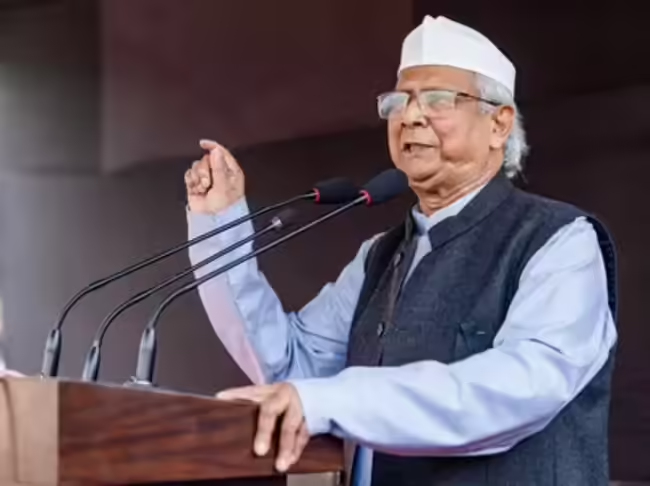
Beyond party politics, the simultaneous referendum on the July Charter has added an unprecedented dimension to the election. The Charter emerged from the political vacuum created after Hasina’s ouster and is presented as a blueprint to prevent the return of concentrated executive power. Spearheaded by interim leader Muhammad Yunus, the proposed reforms aim to recalibrate governance by altering executive authority, strengthening election oversight, and enhancing accountability mechanisms.
Supporters of the Charter argue that it represents a necessary reset for Bangladesh’s democracy, addressing structural weaknesses that allowed authoritarian tendencies to flourish. Yunus has thrown his full moral weight behind the campaign for a “Yes” vote, urging citizens to seize the opportunity to lock in reforms that could safeguard democratic norms. Jamaat-e-Islami, the National Citizen Party, and several smaller parties have openly endorsed the Charter, framing it as a foundation for a more balanced and transparent political system.
The BNP, while widely expected to perform strongly in the parliamentary vote, has adopted a more cautious stance on the Charter. Although it has not rejected the reforms outright, its measured endorsement reflects internal debates about how constitutional changes might affect executive authority if the party returns to power. Some traditional Awami League supporters, disenchanted but not fully aligned with the opposition, are believed to be leaning toward a “No” vote, seeing the Charter as a repudiation of the political legacy they once supported.
For young voters, the referendum carries particular significance. Many of them were at the forefront of the protests that destabilised Hasina’s government, and they now face the challenge of translating protest energy into institutional change. With nearly half of the electorate under thirty-seven, youth participation is expected to play a decisive role in both the election and the referendum. These voters are confronting stark realities, including economic stagnation, limited job prospects, rising living costs, and deep scepticism about political accountability.
Foreign media outlets have framed the election as a defining generational moment, noting that for many young Bangladeshis, this is the first time they feel their vote genuinely matters. Surveys indicate that youth preferences are fragmented, with some gravitating toward established parties like the BNP for stability, others drawn to Islamist groups promising moral governance, and still others supporting newer movements that emphasise reform and systemic change.
Institutionally, Bangladesh’s parliamentary democracy places executive power in the hands of the prime minister, who leads the majority party or coalition in the Jatiya Sangsad. The president, currently Mohammad Shahabuddin Chuppu, serves as a ceremonial head of state with limited authority. Under the first-past-the-post system, small swings in voter behaviour can produce outsized effects on seat distribution, making turnout and local dynamics especially critical.
As ballots are cast and counted, Bangladesh stands at a crossroads. This election is not merely about replacing a long-standing leader but about redefining the country’s political culture, balancing power among institutions, and responding to the aspirations of a young and restless population. Whether the outcome delivers a BNP comeback, an Islamist surge, or a more pluralistic arrangement, and whether the July Charter is approved or rejected, the decisions made today will shape Bangladesh’s trajectory for years to come.