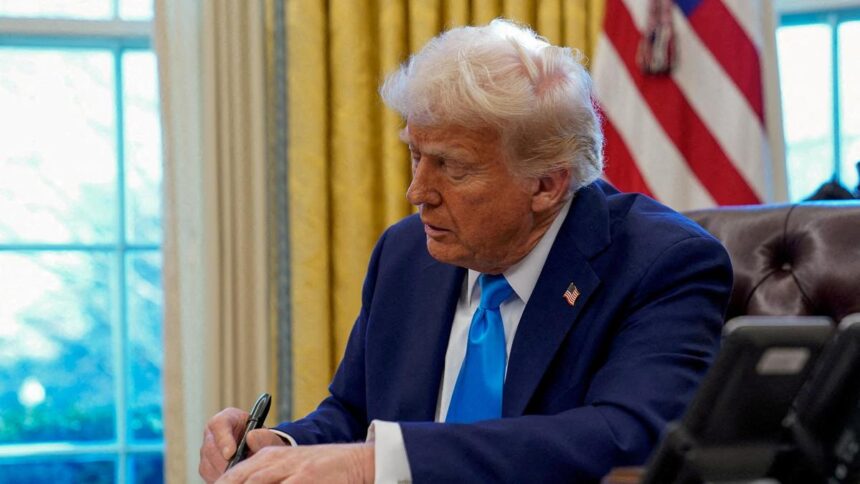
Former United States President Donald Trump has issued a stark warning to Tehran, saying the United States would intervene if Iranian authorities violently suppress peaceful protests, a statement that has amplified diplomatic tensions as unrest spreads across Iran amid deepening economic and political stress.
The warning comes as large-scale protests continue to unfold across multiple Iranian cities, driven initially by economic hardship but increasingly shaped by broader political frustration. Demonstrations that began as expressions of anger over rising prices, inflation, and currency collapse have evolved into sustained public mobilisation, drawing a forceful response from Iranian security agencies. Trump’s comments, delivered through a public statement, place the United States squarely into the unfolding crisis, reviving long-standing questions about foreign intervention, sovereignty, and human rights in one of the world’s most geopolitically sensitive regions.
For Iran, the protests represent one of the most serious challenges to domestic stability in recent years. For Washington, Trump’s declaration signals a confrontational posture that recalls decades of antagonism between the two countries. As images of street clashes circulate globally and diplomatic rhetoric escalates, the situation has become a focal point for debates over how far external powers should go in responding to internal unrest within sovereign states.
Trump’s warning and the internationalisation of Iran’s domestic unrest
Trump’s statement framed the protests in Iran as a human rights issue, warning that violent repression of peaceful demonstrators would prompt a response from the United States. His remarks were uncompromising, suggesting that Washington would not remain passive if Iranian security forces resorted to lethal force. By positioning the US as a potential protector of protesters, Trump injected an international dimension into what Iranian authorities have repeatedly described as an internal matter.
The language used in the warning resonated strongly across diplomatic circles. Supporters viewed it as moral backing for civilians facing state violence, while critics cautioned that such rhetoric risks inflaming tensions and escalating conflict. Iran’s leadership has historically rejected any form of foreign interference, particularly from the United States, which it accuses of exploiting internal challenges to weaken the country politically and strategically. Trump’s statement therefore touched a sensitive nerve, reinforcing narratives within Iran that external actors are seeking to destabilise the state.
The backdrop to this exchange is a relationship marked by decades of hostility, sanctions, and intermittent confrontation. The possibility of US intervention, even if largely rhetorical, carries significant symbolic weight. It signals to both protesters and authorities that Iran’s domestic actions are being closely watched beyond its borders. At the same time, it raises complex questions about the feasibility and legality of intervention, as well as the consequences for regional stability.
Iranian officials have responded by condemning the remarks as provocative and irresponsible, asserting that maintaining order is a sovereign right. They argue that security measures are necessary to prevent chaos and protect public safety, while denying allegations of indiscriminate violence against peaceful demonstrators. This clash of narratives has widened the diplomatic gap between Tehran and Washington, with each side framing the situation in starkly different terms.
The internationalisation of Iran’s protests also places pressure on allies and global institutions. Governments and multilateral bodies have been forced to weigh in cautiously, balancing concerns about human rights with respect for national sovereignty. Trump’s warning has thus become more than a bilateral issue, shaping how the global community interprets and responds to Iran’s internal crisis.
Protests, governance challenges, and the wider regional impact
Inside Iran, the protests reflect accumulated economic and social strain. Years of inflation, unemployment, and currency depreciation have eroded living standards, leaving many households struggling to meet basic needs. What began as anger over prices has expanded into broader dissatisfaction with governance and accountability. Demonstrations have drawn participants from diverse backgrounds, highlighting how widespread the sense of frustration has become.
President Masoud Pezeshkian has acknowledged the legitimacy of economic grievances and called for restraint, dialogue, and unity. His statements suggest awareness within the government that force alone cannot resolve the crisis. However, clashes between protesters and security forces have continued in several areas, underscoring the difficulty of managing unrest without triggering further escalation.
The protests have also revived memories of earlier episodes of mass dissent in Iran, each of which reshaped the political landscape in different ways. Observers note that the current unrest is unfolding in a regional environment already fraught with conflict, from Yemen to Gaza, making any escalation in Iran potentially destabilising beyond its borders. The Middle East’s interconnected security dynamics mean that unrest in one country often reverberates widely.
Trump’s intervention warning adds another layer of complexity. For some protesters, international attention offers reassurance that abuses will not go unnoticed. For others, it raises fears that foreign involvement could overshadow domestic demands and strengthen hardline positions within the state. Iranian officials have long argued that external threats tend to consolidate internal power rather than weaken it, a dynamic that could complicate the protesters’ objectives.
Regionally, the rhetoric heightens uncertainty. Neighbouring states and global energy markets are sensitive to instability in Iran, a major regional actor. Any perception of impending confrontation between Tehran and Washington can affect diplomatic calculations, security planning, and economic expectations across the Middle East. Even absent direct action, the language of intervention can shift behaviour on the ground.
As protests continue and responses harden, Iran stands at a critical juncture. The interplay between domestic dissent and external pressure will shape the trajectory of the crisis in unpredictable ways. Trump’s warning has ensured that the unrest is no longer viewed solely as an internal Iranian affair but as a flashpoint with potential international consequences, testing the boundaries between advocacy, diplomacy, and intervention in a volatile region.