People’s Conference chairman Sajad Lone has reignited a contentious political debate by calling for Jammu and Kashmir to be formally divided into two separate states, arguing that the time has come for a peaceful, balanced, and dignified administrative separation that reflects shifting regional sentiments and counters what he describes as persistent mislabelling and alienation of Kashmiris within the national discourse.
Lone asserts Kashmir’s dignity, challenges stereotyping and calls for fresh administrative thinking
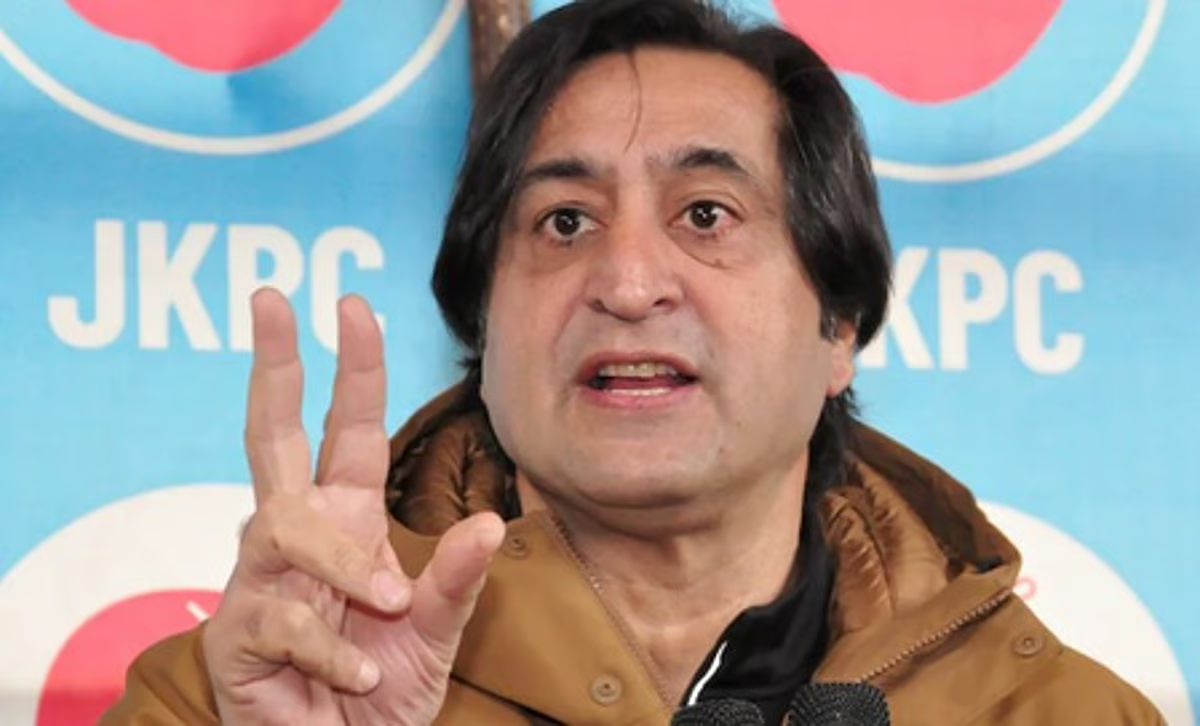
At a recent press conference in Srinagar, People’s Conference chairman and former state minister Sajad Lone delivered one of his strongest political statements in years, urging policymakers and the public to consider a thoughtful bifurcation of Jammu and Kashmir into two states. According to Lone, the current administrative structure has become unsustainable, not because of mere developmental issues, but because the political and social narratives surrounding the two regions have grown increasingly polarised.
Lone argued that Kashmir has repeatedly been portrayed through a narrow and damaging lens, one that unfairly labels the entire population as a source of militancy. He said that this stereotypical depiction has not only defamed Kashmiris but has also influenced national opinion, often positioning Jammu as the “patriotic” counterpart while reducing Kashmir to a centre of suspicion. He emphasised that this narrative is deeply hurtful, inaccurate, and harmful, perpetuating a sense of humiliation among ordinary Kashmiris who have no connection to extremist activity.
He accused certain political actors and intermediaries of worsening this divide by using inflammatory language and framing Kashmir as a perpetual security threat. According to Lone, these intermediaries weaken the bond between Kashmir and the rest of India by creating mistrust and propagating misleading narratives. He stressed that meaningful integration cannot take place through individuals who build their careers by maligning Kashmiris and portraying the region as synonymous with terrorism.
Lone’s remarks came shortly after BJP MLA Shyam Lal Sharma from Jammu North publicly demanded a separate state for Jammu, asserting that Jammu could no longer “bear the burden” of Kashmir. Sharma’s statement triggered a wave of political reactions, ultimately prompting the BJP’s state president to clarify that Sharma’s comments did not reflect the official party stance. Still, the demand highlighted long-standing regional tensions that continue to simmer beneath the surface.
Responding to these developments, Lone said the emotional climate within Kashmir has changed dramatically. He shared that people now feel increasingly sidelined in decisions related to reservations, governance, and representation. According to him, Kashmiris believe their concerns are being overlooked and that administrative decisions often appear biased or strategically used to erode Kashmir’s political voice.
Lone reiterated that Kashmiris deserve respect and fair treatment, and that policies should not be shaped through intermediaries whose narratives harm the region’s dignity. He stated that blaming or stigmatising Kashmiris as a collective is both unjust and counterproductive, and that continued stereotyping will only deepen alienation, not reduce it.
Political climate, shifting sentiments and debate on Kashmir’s institutional commitments intensify separation discourse
Along with the call for bifurcation, Lone also raised a separate but significant issue: the establishment of a National Law University in Budgam, Kashmir. He appealed directly to Chief Minister Omar Abdullah, insisting that the government honour its election promise to set up the university in Budgam as pledged. Lone said this was a matter of dignity and credibility, not merely infrastructure development, and warned that shifting or delaying the university would further damage trust.
Lone argued that the administrative system governing Jammu and Kashmir must now be carefully reassessed in light of changing political, social, and cultural dynamics. He emphasised that the question is no longer limited to development or resource distribution. Instead, the underlying issue is one of growing regional divide, exploited frequently by political rhetoric that positions Jammu as loyal and Kashmir as problematic. According to Lone, such framing encourages hostility and deepens the perception that Jammu is frequently weaponised to invalidate Kashmir’s voice.
He suggested that a peaceful and mutually agreed separation of the two regions might be necessary to restore dignity, balance, and harmony. Lone indicated that many Kashmiris now feel that separation is a reasonable path forward, and that their sentiments have shifted firmly in favour of redefining regional governance.
Lone also criticised the reliance on political middlemen who claim to represent Kashmir but often fuel divisive narratives. He insisted that Kashmir’s relationship with India must be built through honesty, transparency, and mutual respect, not through individuals who gain prominence by repeatedly questioning the region’s loyalty or painting its people as security risks.
He maintained that the political leadership in Kashmir must now speak clearly about the aspirations of the people. According to Lone, the demand for separation carries stronger conviction today than at any time in recent years, and ignoring these sentiments would only worsen the disconnect between the two regions.
The discourse surrounding bifurcation also arises against the backdrop of national controversies and identity debates. Statements like those made by MLA Shyam Lal Sharma highlight a political environment in which regional identities are being invoked to justify administrative restructuring. While Sharma’s party later distanced itself from his remarks, the very fact that such statements draw public attention reveals the depth of long-standing grievances.
Lone’s intervention effectively positions the People’s Conference at the forefront of a sensitive and far-reaching debate. His comments highlight an increasingly vocal sentiment that Kashmiris do not want to be defined by stereotypes or by actors who portray them negatively for political benefit. He argued passionately that continued labelling of Kashmir as a “terrorist region” must end if the region is to move toward a more respectful and constructive relationship with the rest of the country.
The idea of separating Jammu and Kashmir has profound political implications. It would reshape administrative boundaries, reconfigure demographic and economic calculations, and alter the region’s future political structure. While Lone proposes this as a peaceful and balanced measure, the debate inevitably touches upon core questions of identity, representation, resource sharing, and historical grievances.
Lone’s remarks remind political observers that while the constitutional reorganisation of Jammu and Kashmir in 2019 brought formal changes, many underlying regional issues remain unresolved. The persistent perception of imbalance, mistrust, and misrepresentation continues to fuel demands for structural change.
This internal rift among regional perspectives now drives a renewed conversation around governance and coexistence. Lone’s call has therefore intensified public debate, drawing attention from both Jammu and Kashmir constituencies as well as national political watchers seeking to understand the evolving sentiments within the union territory.