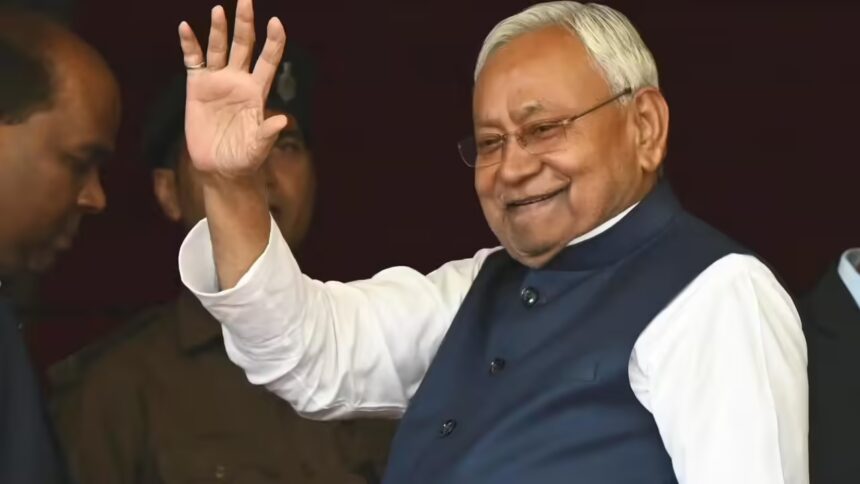
Bihar chief minister Nitish Kumar has launched a comprehensive statewide initiative called the Samriddhi Yatra, beginning on January 16, with the purpose of reviewing the implementation of government schemes, evaluating on-ground development progress, and directly interacting with citizens across districts to understand challenges and ensure accountability within the state’s administrative system.
Statewide tour focuses on reviewing development schemes, governance performance and public grievances
The Samriddhi Yatra marks another major public engagement initiative by chief minister Nitish Kumar, who has long used such state tours as a governance tool to assess the effectiveness of welfare programmes and connect directly with residents. Starting from West Champaran, the journey is structured to cover several districts over multiple phases, giving the chief minister a firsthand view of the condition of government projects and the performance of district officials.
During this yatra, Kumar plans to visit key development sites, inspect infrastructure works, interact with local communities, and evaluate whether ongoing projects are progressing according to their intended timelines. The tour includes evaluations of welfare schemes related to health, education, social security, agriculture, drinking water, industrial development, and rural connectivity. By assessing these programmes personally, Kumar aims to ensure that bureaucratic delays, administrative lapses, or gaps in implementation are identified and rectified quickly.
Senior government officials, district magistrates and departmental representatives have been instructed to accompany the chief minister at various stages of the yatra. They are required to present detailed status reports, respond to public grievances in real time, and demonstrate improvements made in their respective jurisdictions. This framework reflects Nitish Kumar’s approach to governance, in which field visits are used not as symbolic exercises but as direct mechanisms to strengthen administrative responsibility.
The first leg of the yatra is set to span nine districts between January 16 and January 24. One of the first major stops on the route is the Kumarbagh industrial area in West Champaran, where Kumar will review ongoing industrial activities and speak to business owners and local workers about employment trends, industrial growth, and infrastructure needs. This focus highlights the broader economic component of the initiative, which aims to identify bottlenecks affecting investment and expand opportunities for small and medium enterprises across Bihar.
Along with development reviews, cultural and heritage sites have also been included in the itinerary. Nitish Kumar is expected to visit significant historical locations such as the Virat Ramayana Temple during the tour. The visit underscores the state’s commitment to promoting cultural tourism as part of its wider economic strategy, integrating heritage conservation with local development.
The timing of the Samriddhi Yatra holds political significance as it follows the National Democratic Alliance’s electoral victory in the 2025 Bihar assembly elections, where Nitish Kumar and his allies secured a strong mandate. The yatra serves as both a continuation of the government’s commitment to development and a demonstration of accountability to voters who endorsed the administration’s governance model. Rather than pausing after the election, the chief minister’s decision to immediately undertake a statewide assessment signals a deliberate effort to translate political confidence into administrative action.
This yatra also builds upon previous initiatives such as the Pragati Yatra, conducted as part of the CM’s review of nearly four hundred development projects during 2024–25. Many of these projects have advanced into final stages of implementation, making the current yatra a follow-up opportunity to assess progress, address delays, and push for timely completion.
For local residents, the Samriddhi Yatra provides a direct platform to communicate issues such as poor service delivery, infrastructure deficiencies, welfare scheme delays, and grievances related to agriculture, education or public health. Nitish Kumar’s visits typically include public meetings or community interactions where citizens can raise concerns without bureaucratic barriers. These engagements are valued for their immediacy and for the chief minister’s reputation for listening to on-ground realities.
The tour reflects an administrative style that prioritises field-based inspection over desk-based assessment. By observing conditions firsthand, Bihar’s leadership seeks to reduce the gap between government planning and implementation, ensuring that schemes created for public welfare achieve visible and measurable results.
Political symbolism and long-term governance strategy behind Nitish Kumar’s outreach model
The Samriddhi Yatra is part of a long tradition of governance-focused journeys undertaken by Nitish Kumar since he assumed office in 2005. These yatras have evolved over time, reflecting changing development needs, political circumstances and administrative priorities. What began years ago with tours such as Parivartan Yatra and Vikas Yatra has grown into a structured model of governance that emphasises public accountability, transparency and continuous oversight.
Nitish Kumar’s outreach initiatives serve a dual purpose. On the one hand, they function as administrative reviews, enabling the state government to monitor progress on schemes, evaluate infrastructure needs and identify systemic gaps. On the other hand, they strengthen public trust by maintaining regular communication between the government and the people. This approach has played a significant role in shaping Bihar’s governance narrative over the last two decades.
The political significance of the yatra lies in its timing and scale. Following a strong electoral mandate, the chief minister’s decision to embark on a comprehensive review tour reinforces the message that governance improvements remain a central priority. Rather than limiting communication to campaign periods, the yatra signals ongoing engagement with citizens and sustained accountability across departments.
The presence of senior bureaucrats during the yatra also underscores the expectation that administrative systems must respond efficiently to issues highlighted by local communities. This approach reduces the distance between top-level decision-making and ground-level realities, ensuring that policy remains connected to lived experiences.
Furthermore, the Samriddhi Yatra represents an effort to strengthen developmental momentum across Bihar’s districts. Many rural areas continue to face challenges related to employment, health infrastructure, agricultural productivity and education quality. Field reviews conducted during the tour allow the government to identify location-specific solutions and adapt its policy interventions accordingly.
Industrial development is another major pillar of the tour. By visiting industrial zones and meeting with entrepreneurs, the chief minister aims to understand barriers to investment, such as land acquisition issues, power supply constraints, road connectivity, skill shortages and regulatory delays. These interactions provide valuable insights for refining Bihar’s economic strategy and attracting more industries to the state.
Education and healthcare schemes are also central to the yatra’s agenda. The chief minister’s visits to schools, hospitals, anganwadi centres and community health facilities allow the government to evaluate service quality, adequacy of staffing, distribution of resources and overall performance. These evaluations often lead to policy corrections that address staffing gaps, improve infrastructure and expand accessibility for disadvantaged communities.
Public welfare schemes—ranging from financial assistance for the elderly and disabled to support programmes for women, children and students—are also examined. Beneficiaries often use such visits to report grievances or highlight delays, leading to immediate administrative action when necessary.
Beyond the governance objectives, the yatra carries symbolic meaning. It demonstrates that the chief minister remains openly accessible and that governance oversight is a continuous process rather than an occasional exercise. Such visibility helps maintain public confidence and reinforces the idea that elected leaders remain accountable beyond elections.
As Bihar continues navigating the challenges of economic development, social inequality and population growth, initiatives like the Samriddhi Yatra highlight the role of an active governance model. The tour emphasises that development is not solely dependent on policy design but also on sustained evaluation, direct engagement and the willingness of leaders to maintain constant oversight.