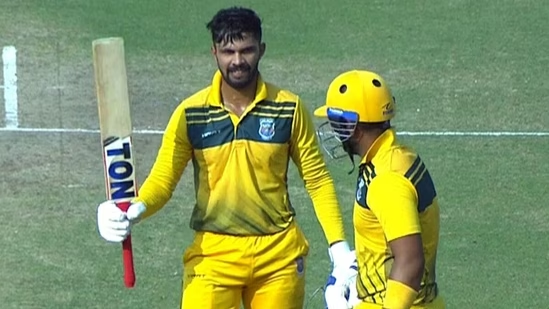
In a gripping Vijay Hazare Trophy encounter that showcased both resilience and remarkable individual brilliance, Maharashtra emerged victorious over Goa in a tightly contested Group C fixture at the Dr. Soni Stadium in Jaipur. The game will be remembered most for Maharashtra captain Ruturaj Gaikwad’s commanding century, a mature and powerful innings that stabilised a faltering batting order and ultimately proved decisive in a match where both teams battled fluctuating fortunes. Gaikwad’s performance not only anchored his team’s recovery from an early collapse but also highlighted his growing stature in domestic cricket as a batsman capable of extraordinary consistency and match-winning influence.
This match unfolded in front of keen spectators who had anticipated an exciting clash between two teams eager to make an impact in India’s premier domestic one-day competition. Goa, boasting players with growing reputations and solid team depth, had hoped to tighten their grip on Group C standings, while Maharashtra, led by Gaikwad and supported by experienced campaigners, looked to harness its potential and keep its qualification hopes alive. What followed was a riveting duel between bat and ball, marked by dramatic twists, fluctuating momentum, and ultimately, a testament to the value of grit and leadership under pressure.
Despite losing early wickets and being reduced to a precarious position in their innings, Maharashtra managed to rally thanks to Gaikwad’s masterful knock and crucial contributions from the lower order. Goa’s bowlers exploited early swing and variations to create pressure, but Gaikwad’s temperament and timing gradually shifted the balance. When Goa’s batters took to the crease in pursuit of a competitive target, they were met with determined bowling and fielding from Maharashtra that chipped away at key partnerships and ultimately sealed their victory by a narrow margin.
The context of the match went beyond the result itself; it was about narratives that define contemporary Indian domestic cricket. Ruturaj Gaikwad, a player with experience in international and franchise cricket, has often been at the centre of selection debates, and his performance in this game underscored his ability to deliver when his team needed it most. His innings was not just about runs on the board, but about timing, patience, authority and a clear sense of intent to plunder opportunities while guarding against collapse. On the other side, Goa’s spirited performance also reflected a side rich with ambitions and talent, coming close yet falling short in a game that will linger in the memory of fans and pundits alike.
A captain’s knock: Gaikwad’s commanding century and Maharashtra’s revival
The outset of Maharashtra’s innings was anything but ideal. Encouraged by favorable conditions for bowlers in the early phase of the match, Goa rattled the top and middle order with disciplined lines and persistent pressure. At one point, Maharashtra found themselves teetering after losing several key wickets for a modest score, prompting concerns about an imminent batting collapse. However, in cricket, momentum can shift in an instant — and on this day, it was Ruturaj Gaikwad who seized that opportunity with unwavering resolve and technical finesse.
Entering the crease when his team was struggling and hope seemed distant, Gaikwad adopted a composed yet aggressive approach, blending caution with calculated aggression. His innings was constructed over a long period, marked by judicious shot-selection, solidity against good deliveries, and an ability to find boundaries when the situation demanded. Gaikwad’s century brought with it not just runs, but a stabilising influence that allowed Maharashtra to regroup and rebuild after early setbacks. His commanding presence at the crease meant that Goa’s bowlers had to constantly adapt their strategies, only for Gaikwad to counter them patiently and effectively.
While Gaikwad held one end firm, the supporting cast played their roles to perfection around him. Partnerships were built with respect to the situation — small yet critical stands that contributed valuable runs and helped widen the margin of error for the later stages of the innings. The Maharashtra lower order, often under pressure in such scenarios, found an unexpected resurgence thanks to the platform laid by their captain. By the time Gaikwad was dismissed, the scoreboard reflected a total that was competitive and defendable, transforming what could have been a meagre score into one that challenged Goa’s batting lineup.
From Goa’s perspective, their bowlers deserve praise for exploiting early conditions and creating pressure. They struck at crucial junctures and held an advantage over Maharashtra’s batters in the initial overs. Their ability to make early breakthroughs highlighted the importance of disciplined bowling in white-ball formats, where patience and precision can yield significant dividends. Yet, sport often hinges on individual brilliance — and in this case, a single innings changed the course of the game. Gaikwad’s performance not only helped Maharashtra post a strong total but also served as a statement about his calibre and temperament as a batsman when the stakes are high.
As Goa began their chase, the target set by Maharashtra required them to balance aggression with caution. An attacking approach was necessary to keep up with the required run rate, but it had to be tempered with the need to preserve wickets. This phase of the match saw some exciting exchanges between batsmen looking to assert their dominance and bowlers aiming to exploit any weakness. Goa’s innings featured its own moments of promise and threat, with batters demonstrating glimpses of flair, focus and intent to steer their side closer to victory. The ebb and flow of this pursuit kept spectators engaged, as the equation remained finely balanced until the closing overs.
What ultimately tipped the scales in Maharashtra’s favor was not just the total they defended, but the pressure they built and maintained through disciplined bowling and sharp fielding. Tight overs, clever variations and strategic bowling changes ensured that Goa had to navigate a challenging pathway during their chase. As phases of the innings progressed, the gap between required runs and available deliveries fluctuated, forcing Goa to adapt and restructure their approach multiple times. Every attempt to accelerate was met with strategic resistance, underscoring the tactical complexity of one-day cricket where runs are precious and timing is everything.
Goa’s spirited chase and tactical twists in a thrilling contest
Goa entered their innings with a clear objective — to chase down a target that was within reach but laced with difficulty. A strong start was essential to set the tone, yet as is often the case in competitive cricket, momentum shifted between phases as bowlers and batters engaged in a duel of skill and nerve. Goa’s batters showed promise early on, playing some elegant strokes and looking to rotate the strike effectively. Concepts of measured aggression were evident as they sought to balance risk and reward.
Yet, maintaining consistency over the course of an entire innings proved challenging. As overs advanced, the pressure of required runs compounded with disciplined bowling from Maharashtra, and this forced Goa’s batters to reassess their strategies. At various junctures, the fielding side’s agility and sharp ground fielding created opportunities that disrupted momentum — small chances that can make big differences in a closely fought tournament encounter. Each misstep, whether a tight delivery that beat the bat or a dropped chance, had the potential to swing the situation, illuminating just how fine the margins are in such matches.
While Goa showed resilience and adaptability at several vital moments, they also encountered trouble when key wickets fell at inopportune times, resetting momentum in Maharashtra’s favour. These breakthroughs underscored the importance of seizing crucial moments — a theme that ran throughout the match. Every strategic decision, whether it was a bowling change or a tactical field repositioning, was amplified by the context of the chase and the pressure of the required run rate tightening as the game progressed.
Yet within Goa’s performance were flashes of promise and individual determination that deserve recognition. This was not a one-sided contest; on the contrary, it was a demonstration of how competitive domestic teams are in India’s cricket ecosystem. Each batter who took the field carried the responsibility of absorbing pressure while seeking scoring opportunities, and in doing so, contributed to an innings that tested Maharashtra’s discipline and stamina. Their approach reflected a willingness to persevere, even in the face of challenging conditions and a formidable total to chase.
As the match neared its climax, the equation became sharper — small partnerships grew in significance, and every stroke, every run, was weighed against the closing overs. Unpredictability — a hallmark of limited overs cricket — remained ever-present as Goa searched for openings and counterattacks to stay within striking distance. These final phases of their chase brought moments of excitement and anticipation, keeping fans and followers on edge as both sides sought control of the narrative.
Ultimately, as Goa closed their innings, the margin of defeat reflected a valiant effort that fell just short. In many ways, the contest exemplified the drama and intensity that domestic cricket can offer — matches where every player’s performance, tactical decision and moment of composure can influence outcomes and shape careers. For Goa, this match will serve as a learning experience — a reminder of the thin dividing line between victory and defeat and the importance of starting strong and maintaining consistency from ball one.
For Maharashtra, this victory etched another chapter in their Vijay Hazare Trophy journey — one defined by leadership, resilience and outstanding individual contributions. Gaikwad’s century, in the context of domestic cricket and the broader year of competition, will be remembered as a defining performance that lifted his side’s spirits and showcased his mastery under pressure.