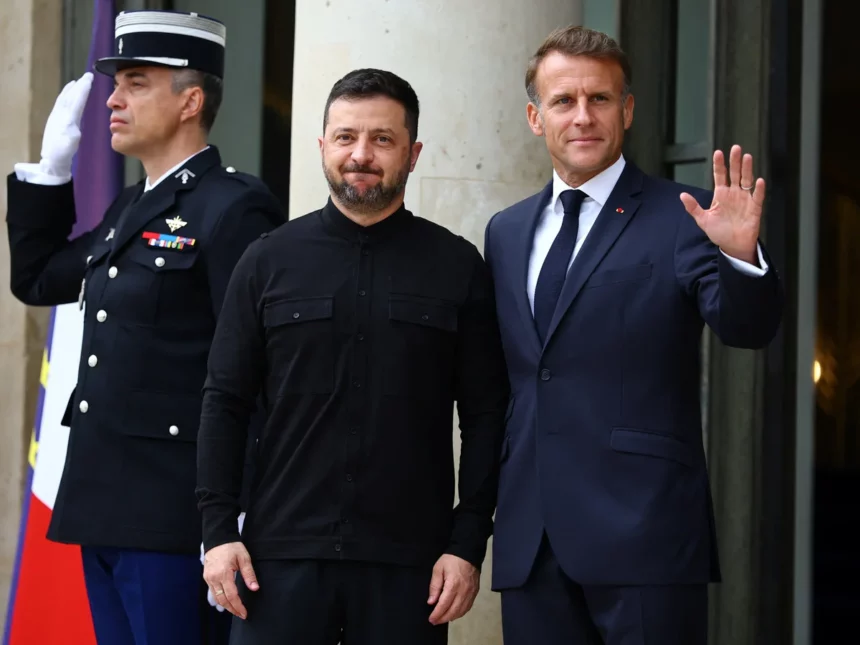
European leaders are gathering in Paris on Tuesday for a high-level summit under the framework of the “Coalition of the Willing”, with the central focus on shaping concrete security guarantees for Ukraine as the war with Russia continues and diplomatic efforts around a potential ceasefire gain renewed momentum. The meeting, hosted by French President Emmanuel Macron, brings together key European partners, Ukrainian leadership, and senior representatives from the United States to assess how a future security architecture for Ukraine could be enforced and sustained.
The summit reflects growing concern among European capitals that any negotiated end to the conflict must be backed by credible military and political commitments to deter renewed aggression. As the war enters another critical phase, discussions in Paris are expected to centre on the creation of a multinational force, supported by the United States, that could help enforce a ceasefire and provide long-term reassurance to Kyiv.
security guarantees and multinational force under discussion
At the heart of the Paris talks is the question of how Europe and its allies can translate political support for Ukraine into enforceable security guarantees. According to officials familiar with the agenda, leaders will explore contributions to a multinational force designed to uphold a ceasefire in the event that negotiations with Russia lead to a pause or end in active hostilities.
President Macron has previously emphasised that security guarantees must go beyond declarations of solidarity. In the lead-up to the summit, he stated that many European states and allied partners were prepared to make “concrete commitments,” signalling a willingness to allocate troops, resources, or logistical support if required. The coalition framework is intended to allow willing nations to move forward collectively, even if consensus across all European Union or NATO members proves difficult.
The presence of Volodymyr Zelenskyy underscores the importance Kyiv places on the outcome of the discussions. For Ukraine, the summit represents an opportunity to secure assurances that any ceasefire will not simply freeze the conflict, leaving the country vulnerable to renewed military pressure. Ukrainian officials have consistently argued that robust international guarantees are essential to prevent a repeat of past arrangements that failed to stop escalation.
The proposed multinational force is expected to be discussed in broad terms rather than finalised at this stage. Leaders are likely to debate its mandate, scale, and rules of engagement, as well as the legal and political frameworks under which it would operate. Questions around deployment, command structure, and coordination with existing NATO forces are also expected to feature prominently in the deliberations.
key european and us figures join strategic talks
The Paris summit has drawn participation from several of Europe’s most influential leaders, reflecting the gravity of the decisions under consideration. Among those expected to attend are British Prime Minister Keir Starmer, German Chancellor Friedrich Merz, and Italian Prime Minister Giorgia Meloni. Their presence highlights a shared recognition among major European powers that the future of Ukraine’s security has direct implications for continental stability.
The United States is also represented at the summit, underlining Washington’s continued involvement in shaping outcomes despite ongoing debates over the scale and nature of its role. US Special Envoy Steve Witkoff is scheduled to attend, alongside Jared Kushner, the son-in-law of US President Donald Trump. Their participation signals American interest in supporting European-led initiatives while maintaining influence over the broader strategic direction of any settlement.
Diplomatic sources suggest that the talks will also touch on the division of responsibilities between Europe and the United States. While European leaders have increasingly spoken about the need for greater strategic autonomy, they continue to view US backing as essential for the credibility of any security guarantees offered to Ukraine. Balancing these considerations will be a key challenge for the coalition.
Beyond military aspects, discussions are expected to include political and economic dimensions of long-term security. These may involve continued sanctions enforcement, reconstruction planning, and institutional support to strengthen Ukraine’s defence and governance capacities. European leaders are aware that security guarantees must be embedded within a broader framework of sustained engagement if they are to be effective.
The summit comes at a moment when diplomatic activity around Ukraine is intensifying, even as fighting persists on the ground. By convening under the “Coalition of the Willing” banner, Macron and his partners aim to demonstrate unity and resolve while retaining flexibility in how commitments are structured. For Ukraine, the meeting represents both reassurance and a test of whether international partners are prepared to move from rhetoric to tangible action.
As leaders gather in Paris, expectations are cautiously high. While no immediate breakthroughs are anticipated, the summit is likely to shape the contours of future security arrangements and influence the direction of negotiations in the months ahead. The decisions and signals emerging from this meeting will be closely watched not only in Kyiv and Moscow, but across Europe and beyond, as the international community continues to grapple with the long-term consequences of the war in Ukraine.