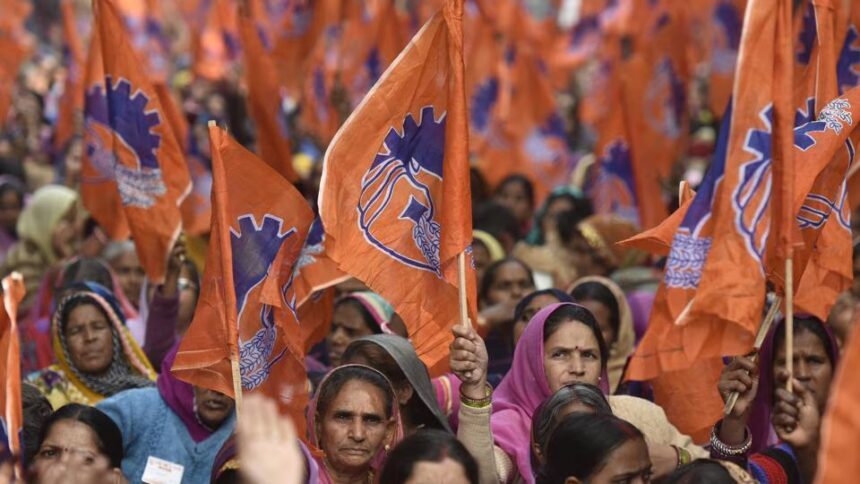
The Bharatiya Mazdoor Sangh, an RSS-affiliated trade union and one of India’s largest labour organisations, will stage a nationwide protest on February 25 to press the Union government on a wide range of workers’ issues, including social security expansion, wage concerns, labour reforms, and the urgent convening of the Indian Labour Conference.
The protest announcement marks a significant development in India’s labour landscape, as the Bharatiya Mazdoor Sangh, widely known as BMS, has traditionally maintained a distinct position among trade unions due to its ideological proximity to the Rashtriya Swayamsevak Sangh. Despite this association, the union has consistently asserted its independence in matters relating to labour rights and worker welfare. The decision to organise demonstrations across the country signals growing unease within sections of the workforce over pending policy decisions and unresolved demands.
The BMS leadership has stated that the protest will take place across multiple States, with rallies, demonstrations, and memoranda submitted to local authorities. The mobilisation is expected to involve workers from diverse sectors, including public services, informal employment, manufacturing, and welfare-linked schemes. According to union representatives, the agitation aims to draw attention to long-standing grievances that, they argue, have not received adequate policy response despite repeated representations.
At the centre of the protest call is the demand for strengthening social security protections for workers, particularly those engaged in unorganised and scheme-based employment. Over the past decade, India’s workforce has seen increasing participation in contractual and gig-based arrangements, raising concerns among labour organisations about job stability, pension coverage, and healthcare safeguards. The BMS has emphasised that social protection measures must keep pace with changing employment patterns to ensure economic security for vulnerable workers.
Another key issue expected to feature prominently in the demonstrations is the condition of scheme workers, including Accredited Social Health Activists and mid-day meal workers. These workers, who form the backbone of several government welfare programmes, have frequently raised concerns over honorariums, delayed payments, and the absence of formal employee status. The union argues that despite their crucial role in public service delivery, many such workers remain outside the ambit of comprehensive labour protections.
growing tensions over labour policies and pending consultations
The protest also reflects broader tensions surrounding labour reforms and policy consultations at the national level. The BMS has reiterated its demand for the early convening of the Indian Labour Conference, a tripartite forum traditionally involving representatives from the government, employers, and trade unions. The conference has historically served as a platform for structured dialogue on labour policy, industrial relations, and employment conditions. According to union leaders, the absence of regular consultations has weakened institutional engagement between policymakers and worker representatives.
Concerns over the implementation of labour codes have also contributed to the current mobilisation. The consolidation of multiple labour laws into four labour codes was presented by the government as a step toward simplification and modernisation. However, several trade unions, including the BMS, have expressed reservations about certain provisions, arguing that aspects related to industrial relations, occupational safety, and social security require further safeguards. While the BMS has not aligned itself with all opposition-led strikes in recent years, it has maintained that labour reforms must not dilute worker protections.
The union has further raised apprehensions about sector-specific legislative proposals that may have implications for employment and public sector enterprises. Among these are concerns linked to amendments affecting utilities and strategic industries, where unions fear job security and working conditions could be impacted. Though the government has maintained that reforms are aimed at improving efficiency and investment climate, labour organisations argue that worker interests must remain central in policy design.
The February 25 protest, therefore, is being positioned not merely as a demonstration of discontent but as an appeal for renewed dialogue. Union leaders have stressed that the objective is to press for constructive engagement rather than confrontation. Nevertheless, the scale of the mobilisation suggests that frustration has been building within segments of the workforce over perceived delays in addressing core demands.
widening labour concerns in a changing economic landscape
India’s labour environment has undergone substantial transformation in recent years, driven by technological change, digitalisation, and evolving patterns of employment. The rise of platform-based work, short-term contracts, and outsourcing has created new opportunities but also introduced uncertainties regarding social protection and collective bargaining. Trade unions argue that regulatory frameworks must adapt to these changes to prevent widening inequality.
The BMS has pointed to the need for clearer mechanisms to extend provident fund coverage, health insurance, and pension benefits to gig workers and those in informal sectors. While certain welfare schemes have been introduced to broaden inclusion, unions contend that implementation gaps persist. They have also called for more transparent and time-bound mechanisms to resolve wage disputes and ensure timely payments.
Another area of concern is inflation and its impact on real wages. Workers’ representatives have argued that rising living costs have eroded purchasing power, particularly for those earning fixed honorariums under government-linked schemes. The union has demanded periodic wage revisions and structured compensation frameworks that reflect economic realities.
Industrial relations in several sectors have also experienced strain due to restructuring, privatisation initiatives, and technological upgrades. Labour organisations insist that any transition process must include safeguards for workers through retraining, redeployment, and adequate compensation. The BMS leadership has maintained that economic growth and labour welfare are not mutually exclusive and that sustainable development requires balanced policy approaches.
The nationwide protest call underscores the continuing relevance of trade unions in articulating workforce concerns. Although union membership patterns have evolved over time, large federations continue to command significant mobilisation capacity. The February 25 demonstrations are expected to serve as a barometer of worker sentiment across industries.
Government officials have previously stated that labour reforms aim to promote formalisation, improve ease of doing business, and generate employment. However, unions argue that reforms must be accompanied by enforceable protections to prevent exploitation and insecurity. The debate reflects the broader challenge of aligning economic competitiveness with social justice.
As preparations for the protest intensify, regional units of the BMS are coordinating outreach campaigns and awareness drives among workers. Memoranda outlining demands are likely to be submitted to district administrations and labour departments. The union leadership has emphasised that the movement seeks policy attention rather than political confrontation, though the mobilisation inevitably carries political implications given the ideological backdrop of the organisation.
The protest also illustrates the diversity within India’s labour movement. While several trade unions have organised nationwide strikes in recent months, the BMS has often charted an independent course, sometimes supporting certain reforms while opposing others. Its decision to mount a nationwide agitation therefore carries particular significance, reflecting a calibrated but firm assertion of labour priorities.
In the broader context, the February 25 protest highlights enduring questions about employment security, social protection, and institutional dialogue in one of the world’s largest workforces. As India continues to pursue economic expansion and industrial transformation, the interplay between policy reform and worker welfare remains central to the national conversation.