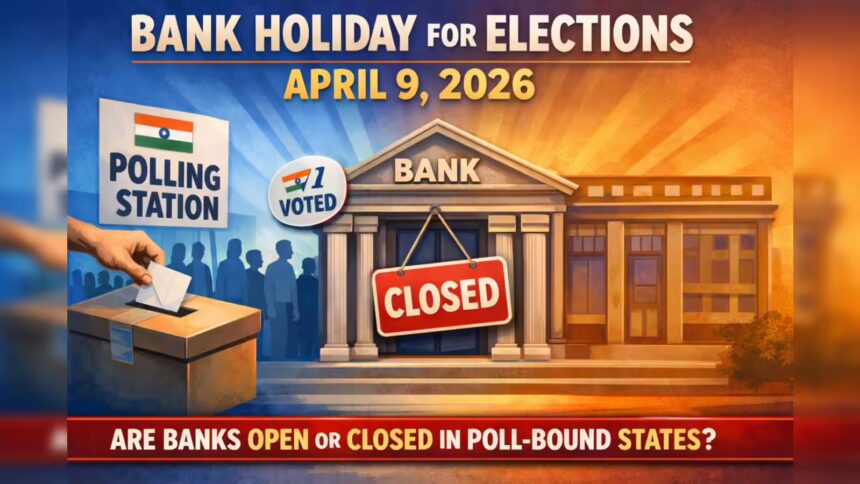
As India witnesses a major electoral exercise on April 9, 2026, confusion has emerged among citizens regarding whether banks will remain open or closed in poll-bound states. With assembly elections taking place in regions like Assam and Kerala, along with voting activity impacting other areas, the question of bank holidays has become particularly relevant for customers planning financial transactions. The clarification lies in understanding how election-related holidays are declared and implemented across different states, often varying based on polling schedules and government notifications.
Bank holiday status varies across poll bound states and depends on local notifications
On April 9, 2026, banks are officially closed in areas where polling is being conducted, primarily to allow employees and citizens to exercise their right to vote. This means that in states like Assam and Kerala, where assembly elections are underway, banks in constituencies going to the polls are likely to remain shut. The holiday is typically declared under the Negotiable Instruments Act, ensuring that voters, including bank staff, can participate in the democratic process without work-related constraints.
However, the closure is not uniform across entire states unless explicitly notified. In many cases, only specific districts or constituencies observing polling will have a bank holiday, while branches in non-polling areas may continue to operate as usual. This localized approach often leads to confusion among customers who may assume a statewide holiday. Therefore, it becomes important for individuals to check with their specific bank branches or local notifications before planning visits.
In contrast, states like Karnataka and Goa, where no elections are being conducted on that particular day, generally do not observe a bank holiday on April 9. Banks in these regions are expected to function normally unless there is any separate state-specific holiday declared for other reasons.
Election driven closures highlight importance of planning financial transactions in advance
The election-related bank holiday underscores the need for careful financial planning, especially for individuals and businesses relying on physical banking services. With banks remaining closed in polling areas, services such as cash deposits, cheque clearances, and in-branch assistance may be temporarily unavailable. However, digital banking services, including online transfers, mobile banking apps, and ATMs, continue to operate without interruption, ensuring that essential financial activities can still be carried out.
The rise of digital banking has significantly reduced the impact of such temporary closures, allowing customers to manage transactions seamlessly even on holidays. Nevertheless, certain services that require physical presence, such as document verification or large cash transactions, may need to be rescheduled.
Election-related holidays also reflect the broader commitment of institutions to support democratic participation. By granting a holiday, authorities ensure that employees are not deprived of their voting rights due to professional obligations. This practice reinforces the importance of inclusive participation in the electoral process and highlights the role of administrative measures in facilitating democracy.
For customers, staying informed through official bank notifications and local announcements remains crucial to avoid inconvenience. As elections continue to shape schedules across different states, understanding the localized nature of such holidays becomes key to managing day-to-day financial activities efficiently.