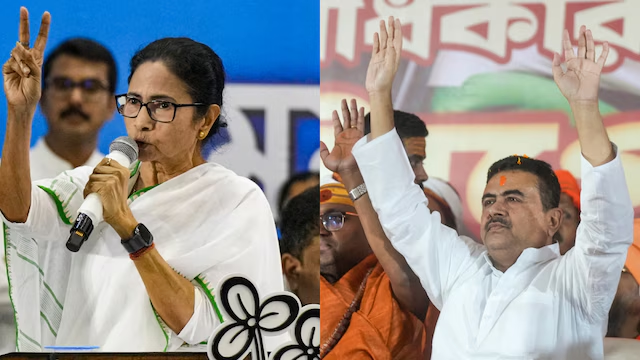
As West Bengal gears up for the 2026 assembly elections, the role of religion in shaping the political discourse is becoming increasingly evident. Recent developments indicate a strategic shift by both the ruling Trinamool Congress (TMC) and the opposition Bharatiya Janata Party (BJP), each positioning itself to leverage religious sentiment for electoral gains.
Chief Minister Mamata Banerjee recently took center stage with the announcement of a grand Jagannath temple in Digha, set to be inaugurated on Akshay Tritiya on April 29. Meanwhile, Leader of the Opposition Suvendu Adhikari unveiled plans for a Ram Mandir in Nandigram, with a large-scale event scheduled for the first week of April. Both projects carry deep political implications, signaling a broader contest over religious identity in Bengal’s political landscape.
The BJP has consistently accused the TMC government of appeasement politics, alleging a bias toward minority communities. However, initiatives such as the Digha temple and the Kalighat temple skywalk provide Mamata Banerjee an opportunity to counter this narrative. By emphasizing her government’s contributions to Hindu religious causes, she aims to reinforce her party’s commitment to inclusive governance. In the recent Assembly budget session, Mamata Banerjee asserted her Brahmin identity and dismissed BJP’s claims that she needs lessons on Hindutva. TMC insiders highlight that their party embodies Bengal’s ethos of religious harmony, celebrating all faiths while implementing welfare schemes benefiting all communities.
On the other hand, the BJP appears determined to intensify its Hindutva campaign. Suvendu Adhikari has underscored the need to address what he calls a Hindu renaissance in Bengal. He has drawn attention to alleged appeasement politics and cited communal tensions in Bangladesh as key campaign issues. Senior BJP leaders suggest that the party will continue to focus on the concept of “Sanatan” identity to mobilize Hindu voters. Adhikari’s approach signals a strong push to consolidate Hindu sentiments ahead of the elections.
Political analysts believe religion will play a significant role in shaping the 2026 electoral landscape. According to analyst Sambit Pal, identity politics has been a driving force in Bengal since the 2019 Lok Sabha elections. He points out that the BJP is actively communalizing the discourse, while Mamata Banerjee is attempting to shed the perception of being pro-minority. Pal predicts that the next assembly elections will see a heightened focus on religious issues, with welfare schemes taking a backseat.
With both parties engaging in religious outreach, it is evident that faith-based politics will be a dominant theme in the upcoming elections. While some view this as a natural extension of electoral strategy, others worry it may overshadow pressing governance and development issues. Regardless, religion is set to be a defining factor in the battle for Bengal in 2026.