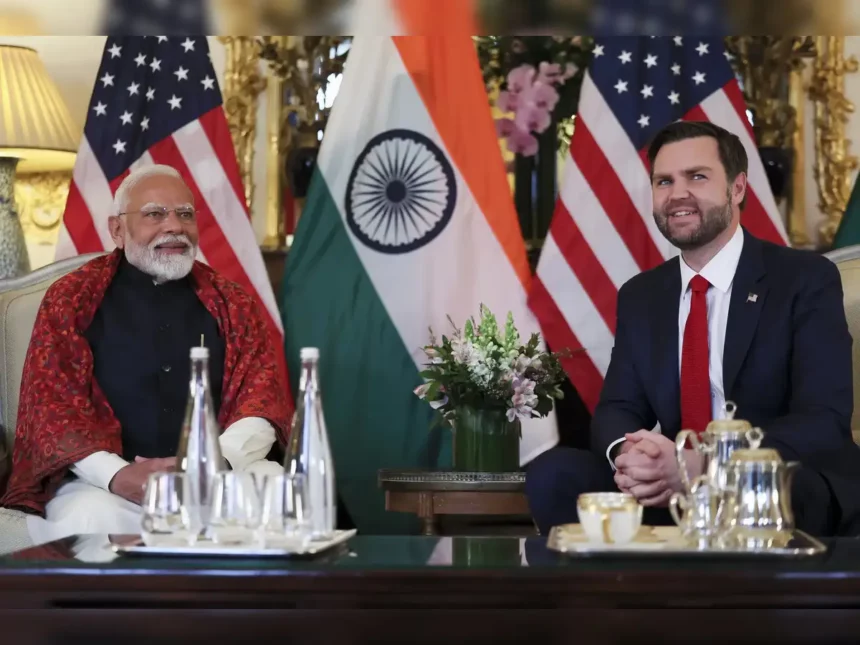
US Vice President JD Vance, along with his wife Usha, arrived in Delhi on April 21, 2025. Their visit is seen as a significant diplomatic gesture, with Vance scheduled to meet key leaders in India, including Prime Minister Narendra Modi. This visit, which will last until April 24, comes at a time when both countries are exploring opportunities to enhance their relationship in light of shifting global dynamics.
Focus of the Visit: Strengthening Key Sectors
During his four-day visit, Vance’s agenda is expected to center around strengthening defence cooperation, bolstering semiconductor and critical technology collaboration, and deepening trade relations between the two countries. With global supply chains undergoing major realignment, the United States views India as a crucial partner in key sectors like electronics manufacturing, clean energy, and artificial intelligence (AI).
The US also sees India as a key player in the context of the growing US-China rivalry. With the ongoing trade conflict between the US and China, India has emerged as a vital ally in the Indo-Pacific region. Vance’s visit underscores the Trump administration’s commitment to expanding both strategic and economic engagement with India. The prospect of a trade agreement between the US and India could prove pivotal in boosting bilateral economic collaboration. As of recent figures, the US remains India’s top trading partner, with bilateral trade reaching approximately $190 billion.
The Ministry of External Affairs of India emphasized that the visit would provide an important opportunity to review the current state of bilateral relations and explore ways to further strengthen them. The talks between Vice President Vance and Prime Minister Modi are expected to also address regional security issues and other global concerns, reinforcing the shared vision of the two democracies in an increasingly complex world order.
Expanding Beyond Diplomacy: Cultural and Economic Engagement
Vance’s visit also extends beyond just formal diplomacy. After his meetings in Delhi, he will travel to Jaipur on April 22 to explore India’s cultural diplomacy and its local innovation ecosystem. His visit to Agra on April 23 will further strengthen people-to-people ties, showcasing India’s rich cultural heritage to the American leadership.
This trip comes after significant geopolitical developments. Just weeks before, Director of National Intelligence Tulsi Gabbard visited India for a geopolitical conference, and two months earlier, Prime Minister Modi met President Trump in Washington. During that meeting, Modi hailed the US-India “mega partnership” and initiated negotiations to address the impact of Trump’s tariffs on Indian goods. These discussions led to temporary relief for Indian exporters after tariffs were imposed on a range of products.
However, despite these positive engagements, the trade war between the US and India has not been entirely smooth. Trump had initially targeted India with a 26% tariff, which was part of a broader tariff programme, though the programme has since been paused. In response, Modi had expressed a willingness to reduce more tariffs on US goods, repatriate undocumented Indian nationals, and purchase military equipment. The two leaders agreed to begin negotiations on a bilateral trade agreement, further solidifying the economic ties between the two nations.
Key Takeaways and Future Prospects
Vance’s visit to India represents a significant effort to deepen US-India ties across multiple domains—economic, defence, and technology. Both countries are looking to capitalize on opportunities in the midst of a rapidly evolving global landscape. Vance’s meetings with Prime Minister Modi will likely focus on finding common ground in areas such as semiconductor production, clean energy, and AI, all of which are critical to the future of both nations’ economies.
India’s strategic role in the region, particularly in the context of the US-China rivalry, cannot be overstated. This visit is not just about strengthening bilateral trade and security relations but also about positioning India as a key player in the global geopolitical landscape. Moving forward, the US and India are expected to continue building on this momentum, addressing challenges in areas such as trade, security, and technology, while navigating the broader geopolitical shifts brought on by the ongoing US-China trade conflict.