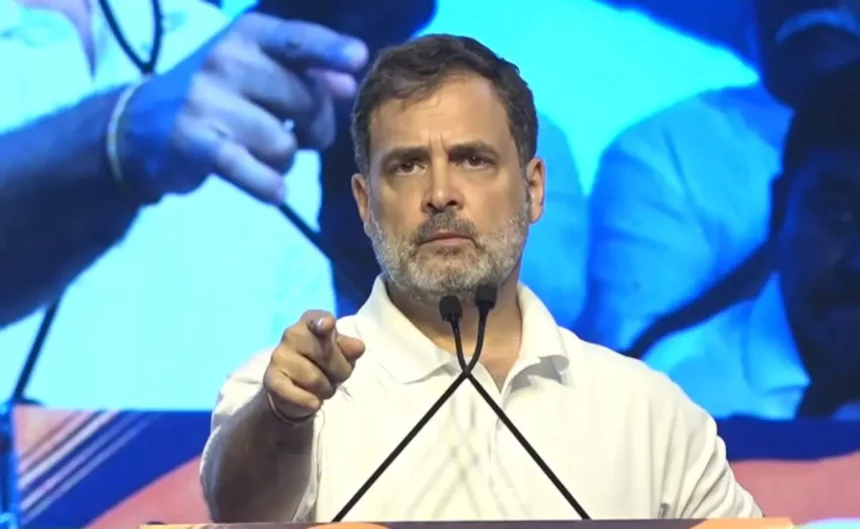
The Congress leader Rahul Gandhi has reignited the debate over India’s electoral integrity by alleging that millions of voters across the country have been deliberately targeted for deletion from electoral rolls. In what he described as the unveiling of a “hydrogen bomb” of evidence, Rahul Gandhi launched a blistering attack during his much-anticipated press conference on Thursday, presenting what he claimed was “100 per cent proof” of systematic attempts to erase voters in constituencies where the Congress party was gaining ground. The allegation is not only aimed at exposing irregularities in the electoral system but also directly questions the role of the Election Commission of India (ECI), which Rahul Gandhi accused of shielding those responsible for orchestrating the operation.
Rahul Gandhi’s Allegations of Voter Deletion Scam
Speaking to the media with a battery of slides and case studies projected on a screen behind him, Rahul Gandhi laid out what he described as irrefutable evidence of a carefully planned voter deletion scam. He began with an example from Karnataka’s Aland constituency, where he claimed that at least 6,018 votes had been targeted for removal. The number, he insisted, was likely much higher, but the attempt had been caught by coincidence. “Like most crimes, it was detected by accident,” Rahul Gandhi said, underscoring that such operations were not isolated errors but deliberate strategies to undermine the electoral process.
The Congress leader then introduced the case of a woman named Godabai, whose name, he claimed, had been misused by creating fake login credentials. Through that fabricated identity, twelve voters were allegedly deleted without her knowledge. Standing before the press, Rahul Gandhi dramatized the point by stating that “Godabai has no idea,” emphasizing how ordinary citizens’ identities were weaponised in the scheme.
Moving to another example, Rahul Gandhi presented the case of a man named Suryakant, who, according to records, managed to delete twelve voters in just fourteen minutes. Among those targeted was Babita Choudhary, whom Rahul Gandhi brought onto the stage alongside Suryakant to demonstrate the tangible human impact of the alleged scam. “How can one person manage to file multiple deletions in such a short time?” he asked rhetorically, arguing that the speed alone indicated the use of automated systems rather than individual human effort.
Further evidence was shared through the case of Nagaraj, who was recorded as submitting two separate voter deletion forms within thirty-eight seconds at around four o’clock in the morning. Calling the feat “humanly impossible,” Rahul Gandhi challenged journalists to attempt filling such forms themselves to appreciate the impossibility. According to him, this showcased the existence of a software-driven, automated program working in the background to eliminate voters at scale.
The broader allegation was that these operations were not random acts by individuals but part of a highly centralised effort conducted at a “call centre level.” Rahul Gandhi suggested that mobile numbers linked to the deletion process did not even originate from Karnataka but were traced to other states, raising questions about the scale and coordination of the network. “The question is, whose numbers are these, how were the OTPs generated, and who operated them?” he asked, insisting that the organised pattern of the deletions pointed to a centralised design rather than localised manipulation.
Accusation Against Election Commission and Escalating Political Tensions
The sharpest edge of Rahul Gandhi’s attack, however, was directed at the Election Commission of India and, in particular, Chief Election Commissioner Gyanesh Kumar. Rahul Gandhi revealed that the Karnataka Criminal Investigation Department (CID), which has been probing the matter, had written no fewer than eighteen letters to the Election Commission over a span of eighteen months. These letters, he said, had sought critical data to further the investigation but received no meaningful response. The last reminder, according to him, was sent in September 2025, yet the Commission had allegedly continued to withhold cooperation.
“The Chief Election Commissioner of India is protecting the people who have destroyed Indian democracy,” Rahul Gandhi declared, intensifying the gravity of his charge. He accused the Commission of not merely negligence but active complicity in protecting those carrying out what he described as the “destruction of democracy.” According to Rahul Gandhi, the correspondence between Karnataka CID and the ECI began as early as February 2023, followed by reminders in March and August of that year, and further appeals in January 2024. Each time, he alleged, the requests were ignored, effectively stalling the investigation.
This was not the first time Rahul Gandhi raised alarms over what he calls “vote chori” or theft of votes. In an earlier press conference held on August 7, he had accused the Election Commission of colluding with the Bharatiya Janata Party (BJP) to manipulate voter rolls. At that time, he had presented findings from a six-month study conducted by a forty-member Congress team that investigated electoral irregularities in the Mahadevapura assembly constituency in Bengaluru. Rahul Gandhi alleged that over 100,000 bogus voter entries had been detected in that constituency alone. The anomalies included fake voter IDs, duplicate entries, inconsistent family names and house numbers, and even destruction of CCTV footage, all of which, he said, pointed to systematic manipulation.
During that earlier presser, Rahul Gandhi had stressed that such irregularities were not confined to Karnataka but had played a role in elections in states such as Maharashtra and Haryana. He argued that these practices were being deployed nationally, constituting a threat not merely to individual constituencies but to the integrity of India’s democracy itself.
Thursday’s press conference therefore appeared to be a continuation of that earlier line of argument, but with a sharper focus on evidence from Karnataka and a direct accusation against the Election Commission for what Rahul Gandhi termed as its “protection of wrongdoers.”
In his latest remarks, Rahul Gandhi also emphasised the use of technology in these deletion attempts. He argued that automated programs ensured the “first voter of every booth was automatically shown as the applicant” for deletion requests. The reliance on mobile numbers from outside Karnataka suggested, in his words, that the operation was conducted in a planned, centralised fashion resembling the coordination of a call centre. The implication was that this was not a case of sporadic fraud but a sophisticated strategy backed by organisational resources.
Rahul Gandhi’s tone was combative yet deliberate. “I am not going to say anything here that is not backed up by 100 per cent proof,” he declared at the outset of the press conference, insisting that his claims were based on verified records and official documentation. His framing was designed to pre-empt accusations that he was exaggerating or politicising routine electoral discrepancies.
The allegations, if proven, would have profound implications for India’s electoral system. By presenting named individuals, mobile numbers, and precise time-stamped records, Rahul Gandhi sought to create a narrative of undeniable wrongdoing, while also portraying himself as the protector of democratic values. At the same time, by accusing the Election Commission of active shielding, he positioned the controversy as not merely about manipulation but about institutional betrayal.
The political fallout of his press conference is likely to be significant. The BJP is expected to reject his allegations outright and accuse him of attempting to undermine faith in India’s democratic processes. Meanwhile, the Election Commission, already under scrutiny for perceived bias in recent years, faces renewed pressure to respond credibly to the specific charges of non-cooperation with the Karnataka CID.
Rahul Gandhi’s latest press conference therefore represents a sharp escalation in the Congress party’s campaign to frame the BJP and its alleged allies within institutions as conspirators in the theft of democracy. By linking voter deletion operations to a wider pattern of electoral manipulation and by accusing the Election Commission of stonewalling investigations, Rahul Gandhi has shifted the conversation from isolated irregularities to a question of whether India’s constitutional democracy itself is under siege.