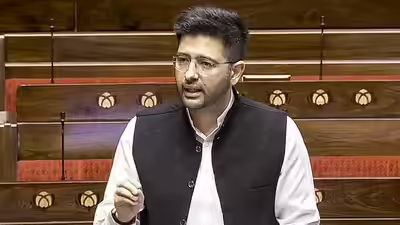
The political temperature within the Aam Aadmi Party has risen sharply following the removal of Raghav Chadha from the post of Deputy Leader in the Rajya Sabha. What began as a quiet internal reshuffle has now escalated into a public confrontation, with Chadha breaking his silence through a strongly worded video message and party leaders responding with equally pointed criticism. The episode has not only exposed internal tensions but also raised broader questions about dissent, discipline, and leadership dynamics within one of India’s most prominent political parties.
In his first reaction after the demotion, Chadha struck a defiant tone, declaring that he may have been “silenced” but not “defeated.” His statement, delivered directly to the public, carried undertones of resistance and hinted at a deeper disagreement with the party’s decision. While he refrained from naming specific leaders, his remarks suggested dissatisfaction with the way his role and voice had been curtailed within the party structure.
Chadha’s Defiance and Questions Over Internal Democracy
Raghav Chadha used his public message to frame the issue as one of principle rather than position. He emphasized that his contributions in Parliament were centered on public welfare, questioning how raising such issues could be seen as detrimental to the party. His rhetorical question—how speaking for citizens could harm the organization—appeared to challenge the rationale behind his removal.
Over the past few parliamentary sessions, Chadha has consistently highlighted issues affecting everyday citizens, ranging from rising food prices at airports to concerns about gig workers’ wages and lack of social security. He has also raised matters such as food adulteration, bank penalties, telecom practices, and healthcare accessibility. By bringing these topics into the spotlight, Chadha positioned himself as a voice for the “aam aadmi,” aligning with the party’s foundational ethos.
His remarks also carried a metaphorical warning, describing himself as a river that could turn into a flood when the time comes. This imagery has been widely interpreted as a संकेत of potential political assertiveness in the future, even as he maintains a formal silence within party forums.
The controversy has been further fueled by reports of Chadha’s growing distance from party activities in recent months. His absence during key moments, including the legal troubles and subsequent acquittal of party chief Arvind Kejriwal, has drawn attention and speculation. Additionally, his stay in the United Kingdom during critical phases of party activity has been cited by observers as a possible factor contributing to the leadership’s decision.
Despite the speculation, Chadha has not clarified his future course, leaving room for multiple interpretations. Whether this episode marks a temporary disagreement or a more significant shift in his political trajectory remains to be seen.
AAP Leadership Responds With Sharp Criticism and Strategic Repositioning
The response from the Aam Aadmi Party leadership has been swift and unambiguous. Senior leaders have dismissed Chadha’s claims and questioned his commitment to the party’s agenda, effectively turning the narrative from one of internal dissent to one of accountability.
Saurabh Bharadwaj, a prominent face of the party, took a subtle dig by stating that AAP does not engage in “soft PR,” implying that Chadha’s public messaging was more about image-building than substantive politics. This remark reflects a broader concern within the party about maintaining a unified and disciplined public stance.
Even more direct was the criticism from Anurag Dhanda, who accused Chadha of failing to effectively represent the party’s position in Parliament. He alleged that Chadha focused on relatively minor issues, such as pricing at airport canteens, instead of championing key party proposals. According to Dhanda, Chadha even declined to sign a proposal brought forward by the party, raising questions about his alignment with its legislative priorities.
The party’s decision to replace Chadha with Ashok Mittal as Deputy Leader in the Rajya Sabha signals a clear shift in strategy. Mittal, who also serves as the Vice-Chancellor of Lovely Professional University, has indicated that his approach will focus on fostering constructive dialogue between the government and the opposition. His emphasis on a different working style suggests a deliberate attempt by the leadership to recalibrate its parliamentary strategy.
Meanwhile, Bhagwant Mann, Chief Minister of Punjab, sought to downplay the controversy by describing the change as a routine organizational decision. By framing it as part of the natural evolution of leadership roles, Mann attempted to contain the political fallout and present a sense of continuity within the party.
Despite these efforts, the public nature of the exchange has made it difficult to dismiss the episode as a routine reshuffle. The sharpness of the remarks from both sides indicates a deeper divide, one that touches on issues of communication, representation, and internal cohesion.
The Raghav Chadha AAP controversy thus stands as a significant moment in the party’s recent history. It reflects the challenges faced by political organizations in balancing individual expression with collective discipline, particularly as they navigate complex electoral and governance landscapes. As the situation continues to unfold, it is likely to have implications not only for Chadha’s political future but also for the internal dynamics of the Aam Aadmi Party.