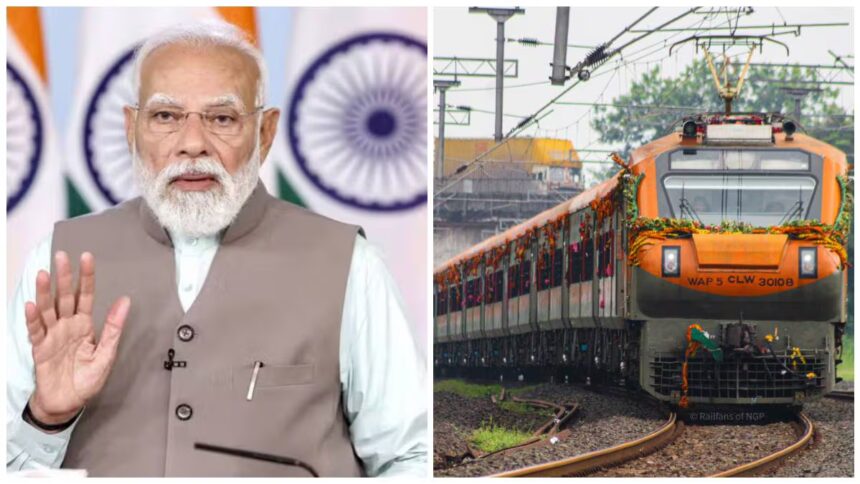
India’s railway network is set to witness a significant expansion in affordable and inclusive connectivity as Narendra Modi prepares to flag off two new Amrit Bharat Express trains on April 28. These trains will connect major regions across Uttar Pradesh, Madhya Pradesh, and Maharashtra, marking a major step toward strengthening inter-state mobility for millions of passengers.
The launch is part of a broader vision by Indian Railways to enhance connectivity while ensuring affordability, particularly for low and middle-income travellers. With rising demand for efficient and cost-effective transportation, the introduction of these trains reflects a shift toward inclusive infrastructure development.
The two new services include a daily train between Varanasi (Banaras) and Hadapsar in Pune, and a weekly service connecting Ayodhya with Mumbai’s Lokmanya Tilak Terminus. These routes have been strategically designed to link religious centres, industrial hubs, and migration corridors, ensuring both economic and social benefits.
Strengthening Affordable Rail Connectivity Across Regions
The introduction of Amrit Bharat Express trains represents a new chapter in India’s railway modernization efforts. Unlike premium trains such as the Vande Bharat Express, these services are designed specifically for affordability while still incorporating modern features.
Fully non-AC in configuration, the trains include General and Sleeper class coaches, making them accessible to a wide segment of the population. However, affordability does not come at the cost of comfort or safety. The trains are equipped with upgraded seating, improved lighting, mobile charging ports, modern toilets, and Divyangjan-friendly facilities.
Safety has also been prioritized through features such as CCTV surveillance, fire suppression systems, and emergency communication mechanisms. The integration of semi-automatic couplers ensures smoother rides, reducing jerks and enhancing passenger experience.
This balance between cost-effectiveness and modernization highlights a key policy focus: delivering dignity in travel without increasing financial burden on passengers.
Banaras to Pune Route: Bridging Culture and Industry
The daily Amrit Bharat Express connecting Varanasi to Pune is expected to become a vital corridor linking cultural heritage with industrial growth.
Varanasi, one of the oldest continuously inhabited cities in the world, is a major spiritual hub. It is home to the iconic Kashi Vishwanath Temple, attracting millions of pilgrims annually. The city is also known for its traditional industries, including Banarasi silk weaving, which contributes significantly to local livelihoods.
On the other hand, Pune has emerged as a major IT, education, and industrial centre. Areas like Hadapsar host numerous multinational companies and industrial units, drawing a large workforce from northern India.
The direct rail connection between these two cities is expected to facilitate easier movement of workers, students, and tourists. It will also open up new market opportunities for small-scale industries in Varanasi by providing better access to western India.
The route will pass through key cities such as Prayagraj, Jhansi, Bhopal, Itarsi, Jalgaon, and Manmad, effectively connecting multiple economic and agricultural zones. This integrated connectivity is likely to boost regional development and trade.
Ayodhya to Mumbai Route: Enhancing Pilgrimage and Migration Links
The second train service, connecting Ayodhya with Mumbai, is equally significant from both religious and economic perspectives.
Ayodhya has witnessed a surge in tourism following developments around the Ram Mandir, making it one of the fastest-growing pilgrimage destinations in India. The new train provides a direct and economical link to Mumbai, enabling easier access for devotees from western India.
Mumbai, being the financial capital, attracts a large migrant workforce from Uttar Pradesh and surrounding regions. The new service is expected to ease travel for these workers, particularly during festivals and family visits.
The route includes important stops such as Sultanpur, Pratapgarh, Jabalpur, Bhusaval, and Nashik. These regions have strong migration links to Mumbai, and improved connectivity is likely to enhance economic integration.
The train will also benefit pilgrims traveling to Shirdi, another major religious destination in Maharashtra, further strengthening tourism circuits.
Technological Advancements and Operational Efficiency
Both trains will operate using push-pull technology, a modern system where locomotives are placed at both ends of the train. This configuration improves acceleration, reduces turnaround time, and enhances overall efficiency.
The Banaras–Pune service is expected to complete its journey in approximately 30 hours with 18 stops, while the Ayodhya–Mumbai train will take around 28 hours with 12 stops. These travel times are competitive considering the extensive coverage and affordability of the services.
The adoption of such technologies reflects Indian Railways commitment to modernization without compromising accessibility.
Economic and Social Impact
The launch of these trains is expected to have a significant economic impact. By improving connectivity between rural, semi-urban, and urban regions, the services will facilitate trade, tourism, and employment opportunities.
For migrant workers, the trains offer a reliable and affordable mode of transport, reducing travel costs and improving accessibility. For businesses, especially small and medium enterprises, better connectivity can lead to expanded markets and increased revenue.
Tourism is another sector likely to benefit. Religious destinations such as Varanasi and Ayodhya, along with cities like Shirdi and Nashik, will see increased footfall, contributing to local economies.
The initiative also aligns with broader goals of inclusive growth, ensuring that infrastructure development benefits all sections of society.
Expansion of Amrit Bharat Express Network
With the addition of these two services, the total number of Amrit Bharat Express trains in India will rise to 66. This expansion reflects a strategic effort to create a nationwide network of affordable and modern trains.
The focus is not just on connecting major cities but also on linking smaller towns and rural areas to larger economic centres. This approach ensures balanced regional development and reduces disparities in access to transportation.
The success of these trains could pave the way for further expansion, with more routes being introduced in the future.
Government’s Vision for Inclusive Mobility
The launch of Amrit Bharat Express trains is part of a larger vision to transform India’s transportation landscape. By prioritizing affordability, safety, and accessibility, the government aims to make travel more inclusive.
This initiative complements other infrastructure projects, including highways, airports, and urban transit systems, creating an integrated transportation network.
The emphasis on connecting spiritual centres, economic hubs, and migration corridors highlights a holistic approach to development, where mobility plays a key role in economic growth and social integration.
Challenges and Future Outlook
While the introduction of these trains is a positive step, challenges remain. Ensuring consistent service quality, managing high passenger demand, and maintaining infrastructure will be critical for long-term success.
However, with continued investment and technological advancements, the future of India’s railway network looks promising. The focus on innovation and inclusivity is likely to drive further improvements in the sector.
Conclusion
The launch of two new Amrit Bharat Express trains by Narendra Modi marks a significant milestone in India’s journey toward inclusive and modern transportation. By connecting key regions across Uttar Pradesh, Madhya Pradesh, and Maharashtra, these services promise to enhance mobility, support economic growth, and improve the quality of life for millions of passengers.
As Indian Railways continues to expand its network, initiatives like these highlight the importance of balancing affordability with innovation. The Amrit Bharat Express trains stand as a symbol of progress, bridging distances and bringing opportunities closer to people across the country.