Russia Victory Day Parade 2026 Reduced As Kremlin Faces Drone Threats And War Pressure
Russia’s iconic Victory Day parade, long considered one of the strongest symbols of the country’s military power and geopolitical influence, is witnessing one of its most subdued editions in recent years as the ongoing Ukraine war, growing security concerns and economic pressure force the Kremlin to significantly reduce the scale of the annual celebrations in Moscow.
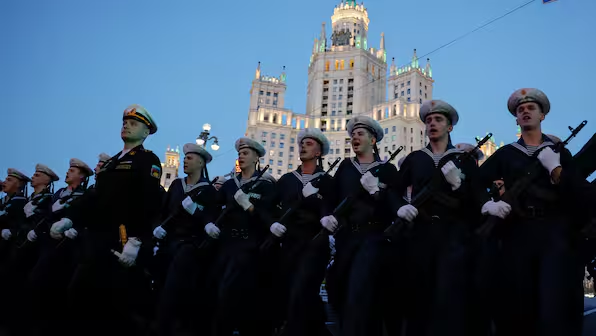
President Vladimir Putin will preside over a much smaller military parade at Red Square on May 9, marking the 81st anniversary of the Soviet Union’s victory over Nazi Germany during the Second World War. However, unlike previous years that featured massive displays of tanks, missile systems, military vehicles and international dignitaries, this year’s event reflects a visibly restrained and defensive Russia shaped by the realities of the continuing conflict in Ukraine.
Russia’s Defence Ministry has confirmed that heavy military hardware will not be displayed during the celebrations because of what officials described as the “current operational situation.” The absence of tanks and advanced military equipment from the parade has become one of the most discussed aspects of this year’s Victory Day event, especially because the ceremony traditionally serves as a powerful demonstration of Russian military strength before domestic and global audiences.
The scaled down format highlights how deeply the Ukraine conflict has altered Russia’s internal security calculations. Since the beginning of the war, Moscow has increasingly faced drone attacks, sabotage fears and growing pressure on strategic infrastructure. Ukrainian strikes targeting oil refineries and military-linked facilities inside Russian territory have intensified concerns regarding the safety of high-profile public events.
The atmosphere surrounding this year’s celebrations therefore appears far more cautious than triumphant. Anti-aircraft systems have reportedly been deployed around Moscow, while additional security restrictions have been introduced across the capital. Authorities have also warned residents about possible disruptions to mobile internet and messaging services during the celebrations as part of heightened security measures.
The Kremlin has simultaneously tightened media access to the event. Several international journalists who had earlier received accreditation for the parade were later informed that they would no longer be permitted to attend in person. Russian officials stated that the number of journalists allowed at the event had been restricted because of the scaled-back format, although the decision triggered criticism and raised concerns regarding media transparency.
International coverage of the parade will now depend heavily on footage distributed through Russian state broadcasters. The reduced media presence further reflects the Kremlin’s increasing sensitivity regarding security and public messaging during wartime conditions.
Political analysts believe the smaller parade represents a rare symbolic compromise for the Russian leadership. For decades, Victory Day celebrations have been central to Russia’s national identity and political messaging. The event traditionally projects themes of military pride, sacrifice, patriotism and strategic strength.
Experts argue that reducing the scale of the parade creates an unusual contrast with the image of confidence and control that President Putin typically seeks to project domestically and internationally. Analysts noted that the Kremlin’s decision to prioritise security over military spectacle demonstrates the extent to which the war has reshaped Russia’s political environment.
The event also comes amid broader economic and social strain inside Russia. While the government continues to maintain public support for the war effort, ordinary citizens are increasingly feeling the effects of economic slowdown, military mobilisation and restrictions linked to national security concerns.
Residents in Moscow interviewed during the lead-up to the parade expressed mixed emotions regarding the prolonged conflict. Some openly stated that the war had already lasted too long and was creating unnecessary hardship for ordinary people. Concerns regarding financial pressure, restrictions on daily life and growing uncertainty have become increasingly visible in public conversations.
At the same time, patriotic symbolism remains highly visible throughout the Russian capital. Streets have been decorated with the colours of the Russian flag alongside the black and orange St George Ribbon, a military symbol closely associated with Russian nationalism and wartime remembrance.
Unlike the large-scale commemorations held in previous years, the list of foreign dignitaries attending this year’s parade is also significantly smaller. Earlier celebrations had attracted major international figures including Xi Jinping and leaders from several allied nations. This year, attendance appears limited primarily to Russia’s closest political partners.
Among the expected guests are Alexander Lukashenko, Malaysia’s King Sultan Ibrahim Iskandar and Lao President Thongloun Sisoulith. Slovak Prime Minister Robert Fico is also expected to visit Moscow for bilateral discussions with Putin but has reportedly decided not to attend the parade itself.
The reduced diplomatic presence reflects Russia’s increasingly complicated international position since the escalation of the Ukraine war. Western nations continue to maintain sanctions and political isolation measures against Moscow, while Russia deepens ties with selected allies and non-Western partners.
The military situation surrounding the celebrations has also evolved rapidly over the past week. On the eve of Victory Day, former United States President Donald Trump announced that Russia and Ukraine had agreed to a temporary three-day ceasefire from May 9 to May 11. The announcement was later acknowledged by both Moscow and Kyiv.
The ceasefire reportedly includes a halt to fighting and a large-scale prisoner exchange involving approximately one thousand prisoners from each side. Ukrainian President Volodymyr Zelenskyy confirmed the arrangement and stated that securing the return of Ukrainian prisoners remained more important than symbolic political disputes surrounding the Moscow parade.
Despite the ceasefire announcement, distrust between both sides remains extremely high. In the days leading up to the truce, Russia and Ukraine repeatedly accused each other of violating earlier ceasefire understandings and escalating attacks near sensitive regions.
Russia’s Foreign Ministry had earlier issued strong warnings suggesting possible retaliatory action if Ukrainian forces attempted to disrupt Victory Day celebrations. Ukrainian authorities, meanwhile, appeared to mock the Kremlin’s concerns by issuing statements “allowing” the Moscow parade to proceed.
The symbolic battle surrounding Victory Day has therefore become closely tied to the broader information and psychological dimensions of the war. Both Russia and Ukraine continue to use public messaging, symbolism and diplomatic signalling to influence domestic morale and international perception.
Security experts believe the Kremlin’s anxiety has been heightened not only by Ukrainian drone attacks but also by global political instability and recent assassination attempts or security threats involving international leaders elsewhere in the world. Russian analysts suggest the leadership is increasingly wary of unexpected security incidents during highly visible state events.
The absence of military hardware at the parade may also reflect practical wartime considerations. Much of Russia’s modern equipment remains deployed in active operational zones connected to the Ukraine conflict. Displaying reduced equipment inventories publicly could create uncomfortable political optics at a time when Moscow seeks to project resilience and military readiness.
Meanwhile, ordinary citizens continue to experience the human consequences of the prolonged war. Residents from Russian occupied regions of eastern Ukraine visiting Moscow during the celebrations spoke openly about fatigue, suffering and hopes for peace after years of conflict.
The ongoing war has dramatically reshaped Russian society, state priorities and international relations since the large-scale invasion of Ukraine began in 2022. Victory Day celebrations that once focused primarily on historical remembrance have now become deeply intertwined with contemporary geopolitical confrontation and wartime nationalism.
This year’s smaller parade therefore carries symbolism beyond the event itself. It reflects a Russia under pressure, balancing wartime security concerns with the desire to preserve national pride and political control. The reduced spectacle also demonstrates how the realities of modern conflict can alter even the most deeply entrenched state traditions.
As global attention remains fixed on Moscow during the Victory Day commemorations, the world will closely observe not only the parade itself but also the broader signals emerging from the Kremlin regarding security, diplomacy and the future direction of the Ukraine conflict.